Get all your news in one place.
100's of premium titles.
One app.
Start reading
Bangkok Post
Bangkok Post
Comment

Thaksin no longer a political talisman?

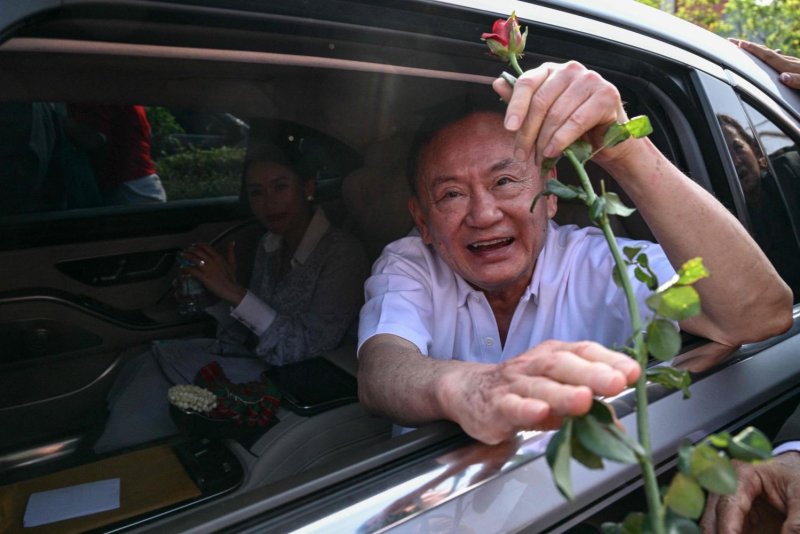
File photo dated May 11 shows former prime minister Thaksin Shinawatra after his release from Klong Prem Central Prison. (Photo: AFP)

Thaksin Shinawatra will complete his parole period in September, finally removing the last visible reminder of his legal troubles: the electronic monitoring bracelet fastened to his ankle. Yet for political observers, the greater question is not his freedom, but what role he might still play in a political order that no longer revolves around him.

For more than two decades, Thaksin has been a force of nature in Thai politics. Even during 17 years in self-imposed exile, the political movement he founded repeatedly returned to power, often winning elections decisively. But the political landscape he returned to in 2023 is markedly different from the one he left behind.

Today, the influence of the ruling Pheu Thai Party has waned, challenged by the rise of the People's Party and the growing clout of the Bhumjaithai Party. The Shinawatra brand no longer sits unchallenged at the apex of Thai politics.

That shifting reality gives fresh meaning to the image of Thaksin wearing an electronic monitoring bracelet after being granted parole on May 11. The device is more than a legal formality. In Thai politics, symbolism matters, and the bracelet serves as a reminder that even Thaksin must now operate within constraints.

Under Department of Probation rules, elderly parolees -- particularly those over 70 and considered low-risk -- are often exempted from wearing electronic monitoring devices. At 77, Thaksin could plausibly have qualified. Instead, the bracelet projects a strikingly different image from the commanding alpha figure Thai politics has long associated with him: restrained, subdued and no longer untouchable.

In that sense, the bracelet has taken on a symbolism beyond its practical purpose. It signals not only legal supervision, but also the narrower political room for manoeuvre now available to a man once accustomed to setting the national agenda almost at will. The unmistakable message is that Thaksin, too, must move more carefully.

Yet it would be premature to mistake reduced visibility for political irrelevance.

Even after returning to Thailand following nearly two decades abroad, Thaksin quickly demonstrated that retirement from politics remained more fiction than fact. During the formation of the government under his daughter, Prime Minister Paetongtarn Shinawatra, his influence over cabinet appointments appeared unmistakable. To many observers, he remained the ultimate power broker within Pheu Thai.

Still, influence is not the same as dominance. Thailand's political centre of gravity has shifted during Thaksin's long absence. The electoral machine he once built no longer commands automatic loyalty, while coalition politics has become more fragmented and transactional. Pheu Thai, once the unquestioned standard-bearer of the Shinawatra political movement, now governs in a political environment where compromise often matters more than charisma.

That changing environment presents an unfamiliar challenge for Thaksin. Much of his political career was defined by decisiveness and control -- allies deferred, rivals reacted and political momentum often moved in his direction. The Thailand he returned to, however, is one in which influence increasingly must be negotiated rather than assumed.

The rise of Bhumjaithai as a coalition heavyweight, coupled with the electoral disruption caused by the People's Party, has diluted the dominance Pheu Thai once enjoyed. Even business elites and political networks that once gravitated instinctively towards Thaksin now appear more willing to hedge their bets. That reality may explain his studied caution since returning home.

Aware of criticism surrounding political interference, Thaksin has recently kept a more careful distance from day-to-day party affairs, allowing senior party figures and ministers greater room to operate. Publicly at least, he appears content to watch and wait.

Thaksin himself has described his time in detention, with characteristic theatrical flair, as a period of "hibernation", joking that it had left him unable to remember much. Beneath the humour, however, may lie a more serious political calculation: that survival now depends less on commanding the stage than choosing carefully when to step onto it.

Political scientist Stithorn Thananithichot argues Thaksin is unlikely to remain on the sidelines indefinitely. While his direct influence over ministerial appointments may have diminished, personal trust and loyalty still appear to shape decision-making within Pheu Thai more than institutional seniority or factional bargaining.

But the political conditions that once allowed Thaksin to dominate have changed. Business elites and political power centres are no longer drawn automatically into his orbit. Attention has shifted elsewhere, particularly towards Prime Minister Anutin Charnvirakul and Bhumjaithai's growing leverage within government. The political spotlight that once followed Thaksin almost exclusively is now more fragmented.

If Thaksin intervenes too visibly, he risks reinforcing criticism that Pheu Thai remains under the shadow of one man. More importantly, he risks exposing the limits of his influence in a political environment that no longer bends so readily to his will.

Once the bracelet comes off, expectations surrounding Thaksin's next move will intensify. Allies will look for signals. Rivals will watch for missteps. The question is no longer whether he still matters -- he plainly does -- but whether he can adapt to a political order in which power is more dispersed and patience matters more than command. For the first time in more than two decades, Thaksin remains influential without being indispensable -- a powerful figure, certainly, but no longer the political talisman he once was.

Sign up to read this article
Read news from 100's of titles, curated specifically for you.
Already a member? Sign in here
Related Stories
Top stories on inkl right now
One subscription that gives you access to news from hundreds of sites
Already a member? Sign in here
Our Picks
Fourteen days free
Download the app
One app. One membership.
100+ trusted global sources.