Thailand’s rubber industry has relied on the same land for generations, but scientists have found that repeated planting may come at the expense of the surface. Rubber plantations in southern Thailand found that soil biodiversity declined as rubber was replanted through successive rotations, with the sharpest deterioration appearing in the third rotation. Because a typical rubber plantation lasts about 25 years, three rotations can represent roughly 75 years of continuous rubber production. The researchers found that the soil biodiversity quality index deteriorated after about 50 years, suggesting that prolonged monocropping can gradually weaken the biological health of the soil. The findings highlight the importance of monitoring plantation soils over long periods, particularly where rubber cultivation continues on the same land. Maintaining soil organisms and biological functions could become an important consideration for sustaining productivity and ecosystem health across future plantation rotations.
Get breaking news anytime, anywhere. Download the TOI app now!

Repeated rubber planting damaged soil biodiversity
According to the study published in the Journal of Taylor and Francis, titled ‘ How 75 years of rubber monocropping affects soil fauna and nematodes as the bioindicators for soil biodiversity quality index ’, the rubber trees studied were Hevea brasiliensis, the main commercial source of natural rubber. In the area, the original rubber plantations were established after forests were cleared. The researchers noted that Thailand's rubber-growing areas have commonly gone through two or three replanting cycles, while the typical economic lifespan of a rubber plantation is around 25 years. This means the same piece of land can remain under rubber production for decades, with new trees planted after earlier plantations reach the end of their productive lives.
To examine what happened over those repeated cycles, the scientists compared an adjacent natural forest with rubber plantations representing three rotations. Each rotation was assessed at both an early stage, between three and six years old, and an old stage, between 18 and 22 years old. The study therefore compared forest with first-, second- and third-rotation rubber plantations rather than simply looking at one plantation over 75 years. Soil samples were taken from the top 10 centimetres, where much of the soil biota responsible for soil processes is found.
Soil animals revealed biodiversity loss
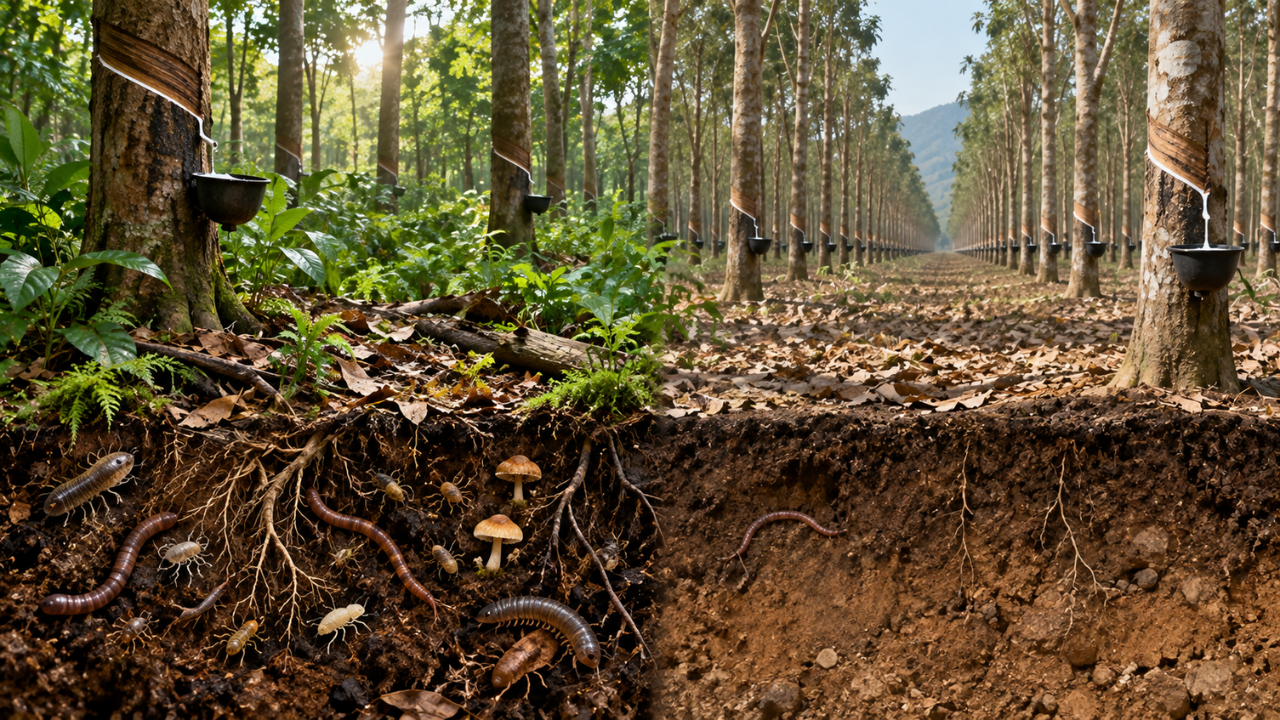
They examined soil macrofauna and nematodes as indicators of soil biodiversity. 30 macrofaunal taxonomic groups were identified and placed into feeding categories, including predators, detritivores, phytophagous organisms, omnivores and geophagous organisms. Earthworms were particularly relevant because they belong to the geophagous group and can influence soil structure and the movement of water and gases through the soil.
Nematodes provided another window into the soil food web. Bacterivorous nematodes were the most abundant feeding group in the study, but their numbers were highest in the forest and declined in old rubber plantations. The same downward pattern was found for omnivorous and plant-parasitic nematodes, as well as total nematode abundance and richness. Nematode richness continued to fall along the rubber chronosequence, reaching its lowest level in the old stage of the third rotation.
The third rubber rotation showed the greatest soil decline
The researchers combined seven measurements of soil macrofauna and nematodes into a biodiversity quality index. This included measures such as predator and earthworm-group abundance, macrofaunal richness, and several nematode measures. The resulting index decreased significantly along the succession of rubber plantations and reached its lowest value in the third rotation. Nematode richness was identified as the main driver of the biodiversity index in this study, followed by earthworm abundance.
The researchers also found that soil chemical properties followed a broadly similar pattern. Soil fertility decreased immediately after deforestation and land-use change, while potassium, magnesium and calcium decreased after deforestation and successive rotations. The study reported that soil degradation was evident in the third rotation. Importantly, the biodiversity quality index did not show a difference between the first and second rotations, but it was considerably reduced in the third.
Soil damage built up after decades of rubber
The findings suggest that the damage associated with continuous rubber monocropping builds over time rather than appearing only when a plantation is first established. The researchers observed a rapid decline in soil properties and biodiversity immediately after forest clearance, followed by continued deterioration along the rubber chronosequence. They linked this pattern to changes in habitat, soil organic carbon and nutrient availability following land-use conversion and repeated plantation disturbance.
Although three 25-year plantation cycles amount to roughly 75 years of potential rubber production, the researchers concluded that soil biodiversity quality had deteriorated after the second rotation, at about 50 years of continuous rubber monocropping. They suggested that two rotations appeared to be the maximum period for rubber monocropping in terms of soil biodiversity recovery, and pointed to agroforestry or intercropping as alternative approaches that could help maintain environmental benefits.