Get all your news in one place.
100's of premium titles.
One app.
Start reading
Bangkok Post
Bangkok Post
Business

Thai exports on course for double-digit growth

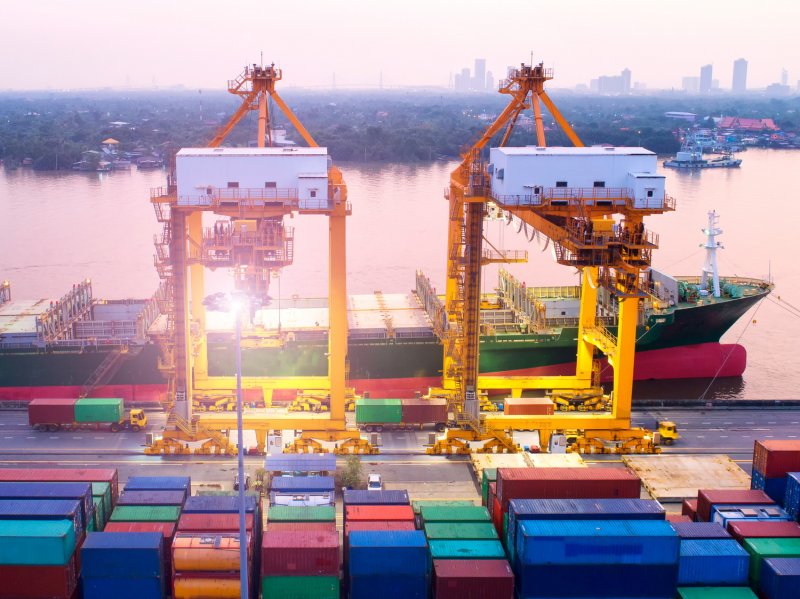
Photo: 123RF

Exports are projected to ‌rise by 8-10% this year, says the Thai National Shippers' Council (TNSC), adding that a favourable exchange rate of 34 baht per US dollar could help drive export growth firmly into double digits.

The projection was upgraded from a January forecast of 2-4% growth.

In the first five months of 2026, exports totalled US$162 billion, rising 17% year-on-year. Imports increased 35.6% to $187 billion, resulting in a trade deficit of $25.2 billion, according to the TNSC.

Dhanakorn Kasetrsuwan, chairman of the TNSC, said an improved outlook for the Middle East war and sustained demand from major trading partners could bolster exports in the second half of this year.

The council expects exports of electronics goods and electrical appliances to continue to post robust growth, with air conditioners and refrigerators projected to expand driven by demand from Europe and the US.

Rice shipments will be helped by free trade agreements and government-to-government deals, with total rice exports projected to reach 7 million tonnes this year, noted the TNSC.

Automotive exports are forecast to remain steady at last year's level of 950,000 units. The TNSC anticipates improvement in the final quarter, following weaker demand in Australia, a key export market, due to competition from Chinese electric vehicles.

Suparp Suwanpimolkul, vice-chairman of the TNSC, said improved shipping conditions through the Strait of Hormuz could support automotive exports to the Middle East in the final quarter.

Sompol Tanadumrongsak, vice- president of the TNSC, said exports could achieve double-digit growth this year if the exchange rate holds at around 34 baht per dollar.

Despite the improved outlook, Mr Dhanakorn cautioned that exports still face several domestic and external headwinds.

Domestically, manufacturers are grappling with persistently high production costs, including raw materials, labour, transport and energy expenses. Electricity prices remain elevated compared with those of regional competitors.

Businesses also face difficulties in accessing financing, while the effects of the Super El Niño have affected both the quantity and quality of agricultural output, raising concerns over raw material supplies and rising production costs in the agriculture and food sectors, he noted.

Global economic uncertainty, geopolitical tensions, volatile energy prices and US monetary policy continue to threaten trade and supply chains, Mr Dhanakorn said.

"Businesses hope Thailand's policy rate will be maintained at 1% for the remainder of the year to help contain costs," Mr Suparp said.

To aid the export sector, the council proposed measures such as streamlining licensing procedures and eliminating overlapping regulations, maintaining exchange rate stability, promoting the use of local content in supply chains to increase domestic value addition, strengthening oversight of imported goods through both conventional and online trade channels, and easing logistics and energy costs.

"Implementing an excise tax on imported products is another option to encourage the use of local content in the supply chain," said Mr Dhanakorn.

Sign up to read this article
Read news from 100's of titles, curated specifically for you.
Already a member? Sign in here
Related Stories
Top stories on inkl right now
One subscription that gives you access to news from hundreds of sites
Already a member? Sign in here
Our Picks
Fourteen days free
Download the app
One app. One membership.
100+ trusted global sources.