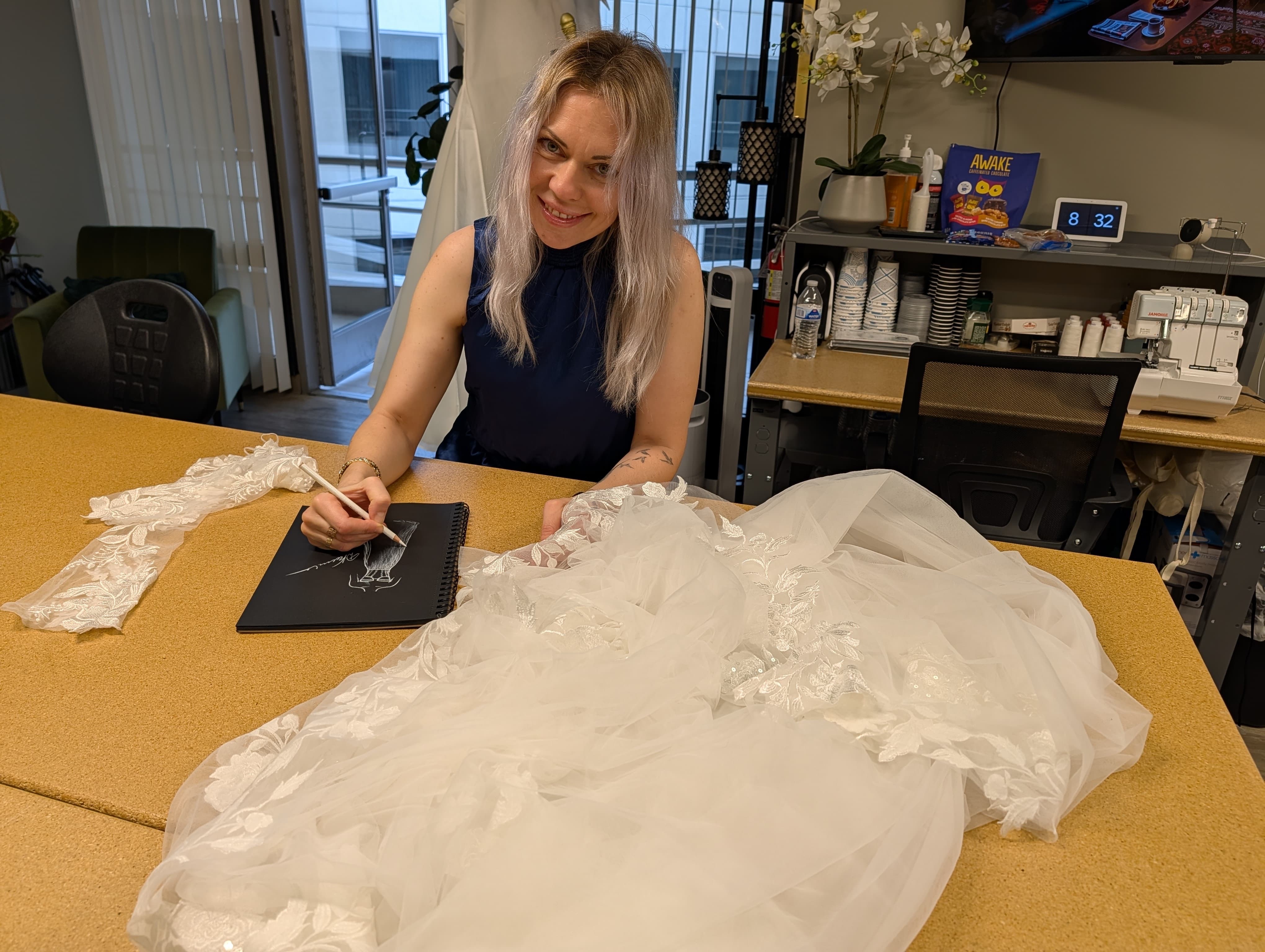
A master tailor and designer of wedding clothing with more than twenty years of experience, Tetiana Kibkalo has gone from Ukrainian ateliers to international boutiques in Egypt and the USA. Behind her are her own salons, unique collections, and collaborations with artists of world level. Today she continues to develop her craft, combining couture traditions with modern technologies.
Tetiana, how did your path in the world of fashion begin?
— It all began in 1998, when I finished a vocational-technical college in Dnipro and received the qualification of a seamstress-tailor of the highest grade. Already a year later, I defended a diploma as a universal pattern maker and, on the recommendation of masters, was accepted into the prestigious salon “Hymenaios.” It was a true center of wedding fashion in Ukraine — collections for salons all over the country were created there. There was a competition of five people for one position, but I passed the probation period and stayed. This experience gave me an understanding of how a real wedding dress is born — with love, attention to every stitch and detail.
At what moment did you feel that you were ready for your own brand?
— The experience received in the “Hymenaios” salon and “Olesya Wedding Fashion” became the foundation of my development. At some point, I realized that I was ready for my own path — for creating author’s dresses. In 2007, I opened my own boutique “Tetiana Kibkalo-Couture.” This became a symbol of professional maturity. I built a full work cycle — from an individual meeting with the bride to the final fitting. Each dress was created like a story: we selected fabrics, developed patterns by hand, perfected the fit, thought through embroidery and décor. I never trusted the fitting to others — only this way can one achieve perfection.
Which project became special for you?
— Probably the case when a bride with a strong spinal curvature came to me. All salons refused her because it was impossible to fit a corset. I developed a unique cut with internal pads and reglin that visually evened out the figure. When she came for the dress with her mother and, hugging me, cried from happiness — that was a real reward. Such stories remind you why we create.
At what moment did you go beyond the borders of Ukraine?
— In 2022, the war began. We lost everything, and for the sake of my child I left for Egypt. For a month and a half, I couldn’t take fabric in my hands — I was empty. But one day I simply bought a sewing machine and began to sew. First — silk robes and suits, then orders appeared. Soon the owner of the Sufel boutique called me and offered to meet. That’s how a new stage in my life began: I created stage costumes for well-known belly dance artists. This is a completely different level — working with felts, crystals, constructions that must be safe and resistant to stage dynamics. I was responsible for the whole cycle — from design to incrustation. This experience taught me to work with an international clientele and to maintain the quality of luxury couture level at high speed.
Today you live and work in the USA. How did professional adaptation go?
— This was perhaps the most difficult period. First, I went around all the ateliers and realized that everything is arranged differently here: most work inside shopping centers and specialize in small repairs. Custom tailoring is almost undeveloped — it is easier for people to buy a ready-made dress. There was a moment of despair. But I pulled myself together, printed my résumé, and went to wedding salons.
The first to accept me was a woman named Nazi, who cooperates with large salons and completely handles wedding dress alterations. She said, “I don’t care about your English, what matters are your hands.” A week later, she raised my salary to the level of workers who had already worked for six months. Later, I was invited by Daria and Lance Fomina, the founders of a large boutique where I now work. They entrusted me with developing an entire line of wedding robes, Morning Bride. The project is now completed: the photoshoot has been carried out, and the launch is being prepared. I also helped build production processes and a quality control system. We increased the client base because I can take on the most complex wedding dresses. This is enormous professional growth.
You mentioned digitalization. How do you assess its influence on the profession of tailor and designer?
— Digitalization has changed the approach to fashion, allowing craft and innovation to be combined. 3D-design programs save time and reduce the number of errors. But for me, they remain only a tool. A real dress is born from feelings, from the ability to “read” the figure, to sense the fabric. A program cannot replace the master’s hand. Handcrafted skill today is valued even more than before because it becomes the soul of the item.
Digital technologies are convenient for visualization: you can experiment with draping, shades, and shape. But ideal fit, balance, every fold — all of this is created only by a person who understands anatomy and aesthetics.
You have worked in Ukraine, Egypt, and the USA. How does the approach to clothing and clients differ in these countries?
— Ukraine gave me a school of quality, precision, individual tailoring, and attention to detail. Egypt opened emotionality and freedom of form — there fashion is closely connected with art and the stage. The USA — this is system, business approach, speed. Here, efficiency and functionality are valued, but handwork is perceived as the highest class.
Each country taught me something important. Ukraine — craftsmanship, Egypt — boldness, America — strategy. All of this came together in me, and now I can create items in which soul and professionalism are felt, regardless of borders.