Shares of Tesla Inc (NASDAQ: TSLA) were trading down more than 2% in Thursday’s premarket session following the company’s latest earnings report, released on Wednesday night. Though not the immediate market reaction investors hoped for, it neatly captures the company’s current dilemma.
On the one hand, Tesla has laid out an ambitious and transformative vision that doubles down on its artificial intelligence (AI) and autonomy plans. On the other hand, the cost of that vision is becoming increasingly difficult to ignore.

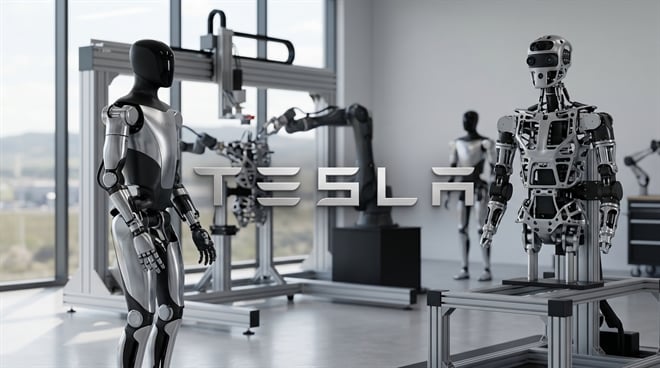
While the company beat expectations on headline numbers, this was a much smaller focus than usual. Instead of focusing on how it’s stabilizing the core business, Tesla used the moment to reinforce its long-term strategy and reposition itself even more clearly as an AI and robotics company. The question for investors now is whether that shift brings clarity or raises the stakes. Let’s take a closer look.
Tesla Is Going All-In on AI
If there was one clear takeaway from the report, it’s that Tesla is doubling down on its long-term ambitions. The company highlighted its expectations for future AI-driven profits while confirming that production of its long-awaited Cybercab will begin later this year. At the same time, it is taking concrete steps to strengthen its position in the AI ecosystem, such as acquiring an as-yet-unnamed AI hardware company for $2 billion and leveraging advanced semiconductor technology through partnerships tied to next-generation manufacturing processes.
Taken together, these moves point to a company that is effectively going all-in on building a fully integrated AI stack, from hardware to software to deployment. That’s the story Tesla wants investors to focus on, and it’s easy to see why. If it works, the upside is enormous.
The Cost of That Vision Is Rising Fast
However, that vision will not be cheap. Tesla made it clear that capital expenditure is set to increase significantly as it invests in AI infrastructure, manufacturing capabilities, and new product development. This is where the tone of the earnings report began to shift. Investors considering leaning into the long-term opportunity will need to carefully consider what it will take to get there.
Higher spending means greater pressure on margins in the near term, which will be painful given that the company already has tight margins in its core automotive business. In other words, investors are being asked to accept a period of elevated costs in exchange for future returns that remain uncertain.
This is a story playing out across many tech companies right now, creating a difficult balancing act. The more aggressively Tesla invests, the stronger its long-term positioning could become. But the more it spends, the harder it becomes to justify the current valuation based on near-term fundamentals.
The Core Business Is No Longer Carrying the Story
Tesla’s core business further exacerbates that tension. While not the primary focus of the earnings narrative, it remains clear that the automotive segment is no longer the driver of investor excitement it once was. Demand is showing signs of slowing, pricing remains competitive, and those all-important margins are under pressure. These are not catastrophic issues, not yet anyway, but they do limit the extent to which the core business can support the longer-term growth potential.
In that context, it’s perhaps not that hard to see why the stock was selling off in the aftermath of the report. In previous years, Tesla relied on strong car-delivery growth and expanding EV margins to underpin its valuation while pursuing its longer-term ambitions. The fact that that’s no longer the case is a near-term risk to the share price.
What It Means for the Stock in the Coming Weeks
The immediate reaction to the earnings report suggests that investors are still trying to process this shift. The stock’s move lower in premarket trading reflected a degree of caution, even if the long-term narrative remains intact.
In the near term, it’s fair to say that means a more volatile environment. Yes, there’s a compelling growth story centered on AI, autonomy, and vertical integration. But there are still legitimate concerns around execution, expanding expenditure, and the lack of near-term support from the core business.
Those selling here are likely the investors who don’t have the stomach to ride out the long-term vision, and that’s where the opportunity starts to open up. If weakness continues into next week, watch for a move back toward $350, which could serve as strong support. It may take time and volatility, but Tesla knows exactly where it’s heading.
Where Should You Invest $1,000 Right Now?
Before you make your next trade, you'll want to hear this.
MarketBeat keeps track of Wall Street's top-rated and best performing research analysts and the stocks they recommend to their clients on a daily basis.
Our team has identified the five stocks that top analysts are quietly whispering to their clients to buy now before the broader market catches on... and none of the big name stocks were on the list.
They believe these five stocks are the five best companies for investors to buy now...
The article "Tesla’s Earnings Confirm the Shift to AI—But at What Cost?" first appeared on MarketBeat.