Submissions have been lightly edited for brevity and clarity.
As it is written, Wednesday is mailbag day.
• Here’s the latest Served podcast. Chris Eubanks geeks out on Mac Forehand as it were:
• Counterprogramming to the Super Bowl, perhaps you missed the 60 Minutes book hour last week?
• Rest in peace Mark Hodgkinson, who died at 46. This is a terrible loss for the tennis community. Here’s his latest.
Onward …
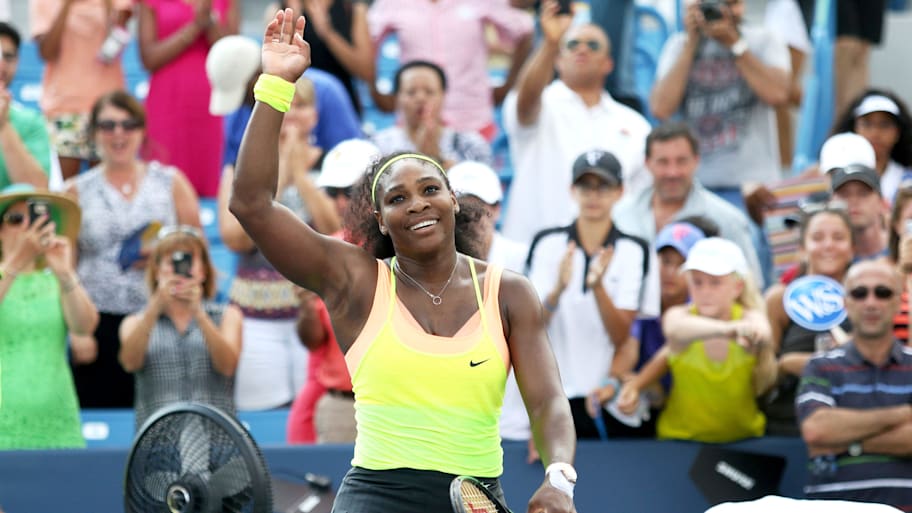
Most of the chatter this week focused on Serena Williams and the next step in what clearly seems to be a studied comeback. On Monday, Williams’s name appeared on the International Tennis Integrity Agency’s reinstatements list, with the star eligible to return to competition on Feb. 22.
• Days before an unspeakable tragedy hit her family, Savannah Guthrie did a surprisingly pointed interview on Today, and Williams’s nonresponse spoke—nay, screamed—volumes. Four points to make:
1) Should we really be so surprised? Yes, Williams is 44, a mother of two, and hasn’t played a sanctioned match since the 2022 US Open. She’s also ferociously competitive, the younger sister of an active player, and not insignificantly, said she’s lost over 30 pounds in recent months. You knew this if you were watching the Super Bowl, which featured an ad for the telehealth company Ro starring Williams. (If you were watching last year’s Super Bowl, you would know that she can command a stage.)
2) No one enters doping protocols without designs of coming back. I’ve yet to find anyone who voluntarily likes to submit their whereabouts to strangers and avail themselves of getting blood drawn indiscriminately. We know she’s been practicing with an assortment of sparring partners. (Yes, Alycia Parks, but also Jesse Levine, a leftie who was often summoned by Roger Federer.) We also understand, via hearsay, that Serena was motivated by watching the U.S. Open—both mixed events and patchy singles events —that did not exactly douse her fire to return.
3) Comeback is a sexy word. But it takes many forms. Does comeback mean Williams plays doubles, perhaps with her sister, with eyes on Wimbledon and/or the 2028 Los Angeles Olympics? Does comeback mean she puts herself back on the whereabouts list so she can play the mixed event at the U.S. Open? Does comeback mean she pulls a Lindsey Vonn—in the best sense of the word, hopefully without any adverse consequences—and gears up for one last hoorah (i.e. Wimbledon 2026)? Williams whisperers are quick to note that her last match—a defeat to Harmony Tan, unworthy of a seven-time champion—still sticks in her craw. Or does she go full-bore and try to resume a legitimate singles career? My guess is some version of the first three.
4) Let’s be clear, this is an unqualified positive. Tune out the haters and the ragebaiters who question the wisdom or attempt to tell Williams she’s too old. This is an instant news story in tennis. This is an unqualified good. This is a ratings-and-interest bonanza. Either she storms back and adds yet another data point to her superior reputation. Or it doesn’t go as planned, and she gets credit for trying (no shame losing to time and biology) and, in turn, validates the current crop of players. Good for her. Good for tennis.
5) A quick word about Ro, the telehealth company, and GLP-1 she endorses. (And it ought to be disclosed on which her husband, Alexis Ohanian, serves on the board.) You could argue that a drug that enables you to lose a substantial percentage of your body weight is a clear performance enhancer. I discussed this with the ITIA in Australia, and per WADA, weight loss drugs are currently on the monitor list. Which is to say, anti-doping authorities are studying them, but as of today, they are not on the banned list. So, for all the potential complications and potholes, it’s important to know that Williams’s comeback will not be impeded by her GLP-1 usage.
Hi Jon—A question for the mailbag. Now that the U.S. Open has become too crowded and pricey (at least for me), and Montreal can expect more no-shows due to its expansion right after Wimbledon, I’m shopping for a new tournament to attend.
What’s the best value tournament in North America, considering price, experience, and quality of play. Charleston’s been suggested. Cincinnati seems great, but hot, hot, hot.
Bill, Belmont, MA
• It all depends on what you’re going for. These events all have their pros and cons. First, I think you can hack the tournaments you mentioned. Get shaded seats in Cincinnati. Go early to Montreal/Canada, so you’re there for the event and the high volume of matches, not for Carlos Alcaraz, Jannik Sinner and Novak Djokovic sightings. The U.S. Open is basically a three-week event, so go Week 1, watch the mixed doubles and don’t dip into your 401(k) in doing so?
But if you’re intent on moving to a different part of the year, Indian Wells is an obvious choice. The setting is exquisite, and the event is well-run. I’m a fan of Charleston as well. Obviously, it’s a WTA event only, and set in a lovely, quaint region of the country. Combine it with a beach vacation? And, in my experience, it has relatively affordable tickets. (Flights to Columbia, S.C., can be much cheaper than Charleston. Rent a car, and it’s a 90-minute straight shot.)
You highlight a real issue, though. Yes, tennis is global and travels well. But this has been detrimental to pro events in North America. You used to have dozens of choices here. Amelia Island, Hilton Head, Philadelphia, San Diego, Manhattan Beach, Stanford, New Haven, Indianapolis, Quebec City, etc. The U.S. Open can spit off hundreds of millions in profit. But the presence of professional tennis in the U.S. is a fraction of what it once was. Globalization comes for us all …
Hello Jon,
I hope you are well. Alcaraz has made it clear that he wants to be the GOAT, or at least sit at the table with the rest of the big three. Obviously he is off to a tremendous start. But I was/am curious how he progresses in the next few years mentally. The big three always had relatively feasible records always in their sights. Alcaraz has monumental numbers in front of him. Twenty four majors? Fourteen Roland Garros titles. Other big three records that take decades to accumulate. Imagine if he wins his third Wimbledon this year … he’s thinking “Jeeze, I have to win five more just to tie [Roger] Federer?” Does this impact him at the singular match level, possibly making him not as hungry? The want to win this first Australian is because it was the first, and it completed the career grand slam. But imagine next year, is the motivation as strong to win “just” his second Australian when the record of Australian titles is 10?
Respectfully,
Anthony, Melrose MA
Anthony, Melrose MA
• Great question. We work on the assumption that it’s a great benefit to future generations of athletes that they know exactly where the bar is set. It’s like batting second in extra innings. The visiting team just compiles as many runs as possible. The home team knows precisely how many runs are required to win.
Yet, I love your point. Is it not demoralizing, just how high the bar is currently perched? Great job, Carlos, only 13 (!) more until you tie Federer. Only 17 until you’re in Novak-land. That career major is awesome. Let’s see if you can do it three times like Djokovic. Or, wait, four times, like Steffi Graf.
Only Alcaraz knows for sure. But you wonder if this awesome history sharpens motivation? Or dulls it, even subconsciously?
Hi Jon,
As always, thanks for the great insight and especially the 50 thoughts.
Definitely not a page 1 development, but I appreciated the lights on the net post & umpire’s chair to indicate an out ball. That was a first at a tourney, right? Among other benefits, it made it easier to follow what was happening when watching on mute (which is a requirement for marital peace while the tourney during U.S. viewing times!).
I’ll plug again for the idea of tracking points won when players are on the same vs. opposite sides of their team. (Along those lines, are the players’ teams on opposite sides of the net at every tourney? Would be another angle to slice the data for when they are and aren’t.) Lastly, as an econ podcaster I follow asks his guests, what is the Jon Wertheim production function? From this vantage point you seemingly have two full-time-plus gigs.
Safe travels, Troy
• Hah! A) I keep the production function close to the vest (an argyle vest, if you will) for fear that one employer will feel slighted.
B) Love the idea of showing points won—as a percent, not a raw number—one end versus the other. Your implication is interesting. Does proximity to coaching help or hurt players? But even without the coaching component, it’s interesting. Players—for some reason, I remember Lleyton Hewitt in particular—have long claimed that one end of Arthur Ashe Stadium court is higher than the other. Does the percentage of points won bear that out?
C) Totally with you on the net post light. I had not seen it before, but it was a simple element that added value.
D) Say it again, since both are contained in your question: After all the commotion in the run-up, it’s amazing (or perhaps not) how quickly we adjusted to on-court coaching and robots replacing line judges.
Dear Jon,
Your “sparse crowds” comment seemed to have included an apology for the honesty … but find it refreshingly accurate just like your call for better marketing doubles matches. Let’s take your frequently used “market argument”: You have the doubles finals with enough empty seats to reduce the beyond overcrowded grounds. However, you do not adjust ticket prices to help promote the players, the matches while also maybe/perhaps/possibly making some money. It “looks” like bad optics and bad business. Unless, of course, Tennis Australia can demonstrate the futility of the proposal by showing that the almost empty court was more profitable than giving away expensive seats at a 90% markdown. In other words, bad optics is acceptable as long as the AO coffers overflow … which I doubt it happened. Now the post-tournament biggest question: What will [Craig] Tiley decide?
Regards,
L. Pereira (BC, Canada)
• Tiley reserves the right to change his mind. But let’s put it this way: There will be a lot of shocked—and disappointed—USTA employees if he does not come on as CEO. (I understand the urge to wait until after the Australian Open to make an announcement, not wanting to overshadow the players of the tournament itself. But candidly, I’m surprised there has been no official word by now.)
As for your other question, it goes to a larger point we made last week. There are all sorts of cutting-edge dynamic ticketing models. Creativity is made even easier in the age of AI. (Aside: I heard a proposal for a streaming model that basically ups the price point depending on the drama of the match. So if the match goes to a deciding set, the price goes up. If the match is a stinker, the price stays low.) There must be a way to make sure the fat cat seats don’t go unfilled. There must be a way to price doubles tickets accordingly, so there are no empty stands.
Shots
• Keep Scott Davis in your thoughts:
Hello Jon,
Scott Davis, a retired and decorated tennis pro, is receiving support after suffering serious injuries in a mountain bike accident.
“Recently, our good friend, Scott Davis, suffered a mountain bike accident that has temporarily disabled him. For those that know him, know of him, or don’t know him, he is USA tennis royalty in that he held the title of the most Junior National titles in US history until recently. As a college player, he won the NCAA title at Stanford as a team and then turned pro. As a professional, he reached a top ranking of #11 in singles and #1 in team doubles, having won the Australian Open Men's Doubles Grand Slam with long-time partner David Pate. In retirement, Scott has been coaching in Newport Beach. For those that know the life of a teaching pro and coach, if he's not working, he’s not earning, and he will be out for a while!"
You can learn more here: Rally for Scott Davis: Tennis Legend Needs Us.
Kindly,
Jeff
More Tennis on Sports Illustrated
- Ilia Malinin Couldn’t Believe Novak Djokovic Watched Him Skate at the Olympics
- Rafael Nadal Believes That Carlos Alcaraz Is Already a Tennis ‘Legend’
- Serena Williams to Make Major Step Ahead of Potential Tennis Return
- Tennis Mailbag: How Elena Rybakina’s Coach Created a Conundrum for WTA
This article was originally published on www.si.com as Tennis Mailbag: What a Potential Serena Williams Comeback Could Look Like .