
Get all your news in one place.
100’s of premium titles.
One app.
Start reading
Euronews
Euronews
Pascale Davies

Tamagotchi-like robots, Rubik's Cube, and LEGO all get digital upgrades at CES 2026

From adorable Tamagotchi-like robots, to LEGO’s new Smart Brick, to tech-infused Rubik’s Cubes, toys are in abundance at the CES 2026 tech conference in Las Vegas.

These types of innovations could shape the future of children’s play as the debate intensifies over screen time and the impact of social media on the next generation.

Here are some of the boundary-pushing tech toys that caught our attention this year.

1. Rubik’s WOWCube

One of the most iconic toys of the last 50 years has gotten a really smart upgrade. Featuring 24 screens, the Rubik’s WOWCube allows you to twist and shake the cube to play different games.

The Rubik’s WOWCube allows you to twist and shake the cube to play different games. (The Rubik’s WOWCube allows you to twist and shake the cube to play different games.)

Some of the games include lining up former presidents’ faces, which, when completed, unlock history lessons. Users can also design and programme their own games into the 2x2 cube.

The device costs $299 (€257).

2. LEGO Smart Brick

Then there is, of course, the LEGO Smart Brick – one of the buzziest innovations at this year’s CES. It can light up, make sounds, and react to other Smart Bricks to create a more interactive way of playing. Euronews Next had a play with it, which you can read more about here.

As part of its partnership with Star Wars, LEGO has created deeply interactive scenarios you can play with the smart brick technology. (As part of its partnership with Star Wars, LEGO has created deeply interactive scenarios you can play with the smart brick technology.)

“I think physical play has a tremendous number of benefits, and even if it's not benefits, it's fun in different ways. It’s building, hiding behind sofas, even if it's getting hit by a dart, and it's slightly hurting. These are all things that are additional aspects to play, and they've sometimes been a little hard to access in a more advanced way,” Tom Donaldson, senior vice president at the LEGO Group, told Euronews Next.

“I do hope that more broadly imaginative play gets ever and ever stronger in all the different forms, whether it's digital or here, in the more physical side,” he added.

3. Tamagotchi gets an AI makeover

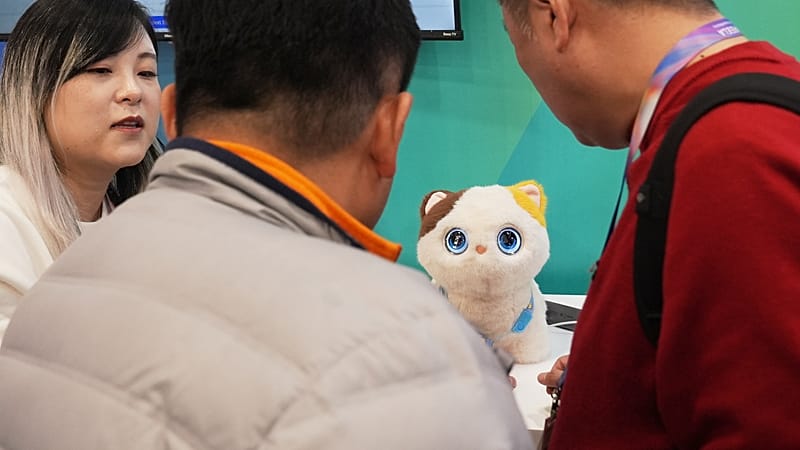
The Chinese company Takway AI unveiled Sweekar, which it says is the world’s first emotionally-intelligent, physically growing artificial intelligence (AI) pet.

The Chinese company Takway AI unveiled Sweekar, calling it the world’s first emotionally-intelligent, physically growing AI pet. (The Chinese company Takway AI unveiled Sweekar, calling it the world’s first emotionally-intelligent, physically growing AI pet.)

Just like the Tamagotchi, the handheld Japanese digital pet of the 1990s, it hatches and goes through different life stages. In this case, they’re defined as eggy, baby, teen, and adult. The company says it is a touchable and evolving AI lifeform that can simulate body warmth and gentle breathing.

Sweekar learns from its surroundings and can even repeat back to you its day when you may leave it at home.

"Inspired by classic nurturing games and reimagined through modern AI and robotics, Sweekar transforms pet-raising into a physical and emotional experience,” said Irving Gao, founder and CEO of Takway AI.

“Through growth, care, and interaction, it is designed to foster a long-term, meaningful bond between humans and AI," he added.

It is not on the market yet and will launch soon on a crowdfunding website.

4. The pocket-sized AI companion

The Japanese company Sharp showed off Poketomo, a cute, pocket-sized AI companion that resembles a meerkat.

The robot was not designed for children, but rather to help combat loneliness in young adults.

Poketomo is a cute, pocket-sized AI companion that resembles a meerkat, designed help combat loneliness in young adults.. (Poketomo is a cute, pocket-sized AI companion that resembles a meerkat, designed help combat loneliness in young adults..)

Poketomo will always be by your side to talk with you during life's everyday moments, the company says.

It is already available in Japan and costs around €300, but is so far not available for purchase in Europe and North America.

Sharp said that though the product was targeted for young women, older adults have also been interested in the device.

Physical play versus AI-enhanced toys

While toys are generally the realm of children, many of the cute AI-infused robots on display at CES 2026 are actually targeted at adults. Exhibitors say this is often deliberate, as there is more scrutiny and criticism when it comes to children.

Despite this, we’re still seeing AI-enabled products targeting younger and younger children, said Daniela Braga, founder and CEO of Defined.ai, a US company that’s building a global marketplace of ethically-sourced training data.

“I believe exposure to AI should be delayed for children as much as possible, with the clear exception of accessibility and assistive technologies,” Braga told Euronews Next.

“Introducing AI too early in a child’s development risks changing how we, as humans, learn, interact, and build foundational skills,” she added.

Sign up to read this article
Read news from 100’s of titles, curated specifically for you.
Already a member? Sign in here
Related Stories
Top stories on inkl right now
Our Picks
Fourteen days free
Download the app
One app. One membership.
100+ trusted global sources.