
Get all your news in one place.
100's of premium titles.
One app.
Start reading
Euronews
Euronews
Aleksandar Brezar

'Take me to America': Bosnia unites behind viral anthem in its World Cup return

After stand-in forward Jovo Lukić headed in a corner kick in the 21st minute for Bosnia and Herzegovina in its World Cup opener against one of the host nations Canada on Friday, a small yet vibrant group of Bosnian fans erupted in celebration at the Toronto Stadium.

The Western Balkan nation of some 3 million has been anxiously awaiting its appearance — only its second since declaring independence from the former Yugoslavia in 1992, which triggered a bloody four-year war within weeks.

Bosnia was the last country to qualify after coming up big, eliminating four-time champion Italy in the European playoffs with a feverish penalty shootout at home.

Two months later and thousands of kilometres away, outnumbered by a sea of Canadian fans wearing red at the stadium along the shores of Lake Ontario — including the likes of Ryan Reynolds and Mike Myers — Lukić's goal sparked tears of joy from the Bosnian fans in blue in the upper deck of the stands.

Starting in place of the team's mainstay star striker Edin Džeko, Lukić, who plies his trade at Romania's Universitatea Cluj, flicked in a team effort after a lively opening to the match in which Bosnia was expected to play the role of the underdog the Canucks would easily run aground.

Bosnia's Jovo Lukić (25) celebrates scoring the opening goal during the first half of the World Cup Group B match between Canada and Bosnia, 12 June 2026 (Bosnia's Jovo Lukić (25) celebrates scoring the opening goal during the first half of the World Cup Group B match between Canada and Bosnia, 12 June 2026)

Bosnia went on to play a record-setting game, becoming only the fourth team in World Cup history to make more than 70 defensive clearances in a single match, but Canada rallied to claw one back in the 78th minute, with the match ending in a draw.

The Dragons — the Bosnian football team's long-standing moniker — still drew applause for their efforts at the final whistle from the ever-friendly Canadians.

Bosnia is 64th in the current FIFA rankings, the lowest-ranked team in Group B behind Switzerland (19), Canada (30) and Qatar (56).

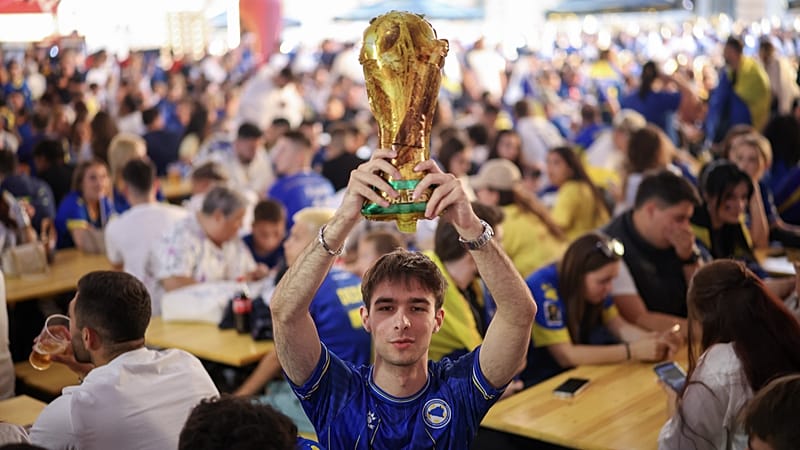
Yet for Bosnia, rolling over was never on the cards, much to the rapture of its fans, many of whom are part of the country's large diaspora displaced across western Europe and North America by the war more than three decades ago.

Bosnian fans celebrate at a fan festival in Sarajevo, 12 June 2026 (Bosnian fans celebrate at a fan festival in Sarajevo, 12 June 2026)

Others left Bosnia in the postwar period, as the country became increasingly marred by stalled progress and persistent political bickering between the representatives of the country's three main ethnic groups — Bosnian Serbs, Bosnian Croats and Bosniaks.

At the World Cup, Bosnians brought with them an anthem that turned out to be one of this year's bangers: a 15-year-old song by much-beloved Bosnian band Dubioza Kolektiv that opens with the lyrics: "I am from Bosnia, take me to America".

'American football dream for the entire nation'

The song, which went viral on social media after it was embraced by fans as Bosnia neared qualification and whose lyrics have since been emblazoned on banners and t-shirts, is not just a Balkan earworm.

The number, titled "USA" when it first came out, was meant to be a tongue-in-cheek take on the tendency of post-war Bosnians to believe that the grass is always greener in countries abroad.

Originally, the lyrics went, "I want to start all over, return to no man's land, send greetings to your leader, don't want your green card, I want to fly back like a rocket to the Balkans."

"It's an interesting story how this song got its second and third and fourth incarnation in these 15 years," Dubioza Kolektiv's bass player Vedran Mujagić said.

Now it has been reimagined as the soundtrack to possible World Cup success.

"It evolved from this satirical take on immigration and the American Dream and it was translated into an American football dream for the entire nation."

Brano Jakubović and Vedran Mujagić, members of Bosnian band Dubioza kolektiv, pose for a photo in Sarajevo, 11 June 2026 (Brano Jakubović and Vedran Mujagić, members of Bosnian band Dubioza kolektiv, pose for a photo in Sarajevo, 11 June 2026)

Dubioza's viral anthem continued to catch on: after the game with Canada, superstar commentator duo Thierry Henry and Zlatan Ibrahimović repeated the catchy "I am from Bosnia, take me to America" line live on TV.

Once the world's top strikers, both are intrinsically linked to Bosnia and the song's message: Henry's children are half-Bosnian, while Ibrahimović's father hails from there, too.

"This is the best thing for the band or for the song: when people take over and load new meaning and then it becomes theirs," Dubioza Kolektiv's keyboardist Brano Jakubović said. "It's not ours anymore."

How bad can it get?

News out of Bosnia over the past years has been nothing short of depressing. The country has largely stalled on its path to EU membership, as ethnonationalist leaders continue to sacrifice progress for personal, political and financial gain.

An estimated quarter of the population lives in relative poverty amid record-high unemployment rates. The country's healthcare system is in shambles, plagued by widespread corruption.

To make matters worse, Bosnia's dizzyingly complicated government structure made it easy for those in power to emphasise division through separate educational systems and a lack of desire to reckon with the past, made apparent in their open denial of war crimes and genocide.

This despite a long list of international court sentences for the culprits and repeated pushes by the international community toward reconciliation.

A woman walks past a billboard displaying lyrics from the Dubioza kolektiv song "I Am From Bosnia, Take Me to America" in Sarajevo, 11 June 2026 (A woman walks past a billboard displaying lyrics from the Dubioza kolektiv song "I Am From Bosnia, Take Me to America" in Sarajevo, 11 June 2026)

In 2024, the state-level ministry of security estimated that some 1.8 million Bosnians born in the country left to live elsewhere — in 54 countries worldwide. Another half a million were born abroad.

The last state-run census in 2013 showed that 3.7 million Bosnians lived in their home country. This number has since been estimated to have plummeted to below 2.8 million, one of the worst rates of depopulation in Europe.

While Dubioza Kolektiv's "USA" resonates differently with those on the outside, Bosnian emigrees are cognisant of the song's deeper meaning: that emigration comes with its own set of problems.

Once they leave, Mujagić said, "they encounter this hostility of the locals, right-wingers, and they just don't want them there."

"It's this schizophrenic situation in which you want to go there, but you somehow know that you won't have it good on the other side as well," Mujagić said. "So in that sense, this song still works perfectly well as it worked before."

Still dreaming dreams

In all of this, football has been the one great unifier, a spark of hope in the face of a politics of fear and division.

Following years of disappointment at the hands of Europe's footballing superpowers in qualifying rounds — Bosnia infamously lost out to Portugal in World Cup and Euro playoffs twice in a row — the country finally made it to the World Cup in Brazil in 2014, and a similar football frenzy enveloped the country at the time.

Under the watchful eye of coach Safet Sušić, himself a legendary striker still popular with PSG fans who he enthralled with his skills in the 1980s and early 1990s, the team lost its opener against Argentina 1-2. Leo Messi scored the decider.

It was the match against Nigeria, however, that to this day irks all Bosnian fans: Džeko, who was Manchester City's star striker at the time, broke away from Nigerian defenders after a pass from playmaker Zvjezdan Misimović and scored, only to have the goal ruled offside.

FILE: Bosnia's Edin Džeko reacts as his team was defeated after the Group F World Cup match against Nigeria at the Arena Pantanal in Cuiaba, Brazil, 21 June 2014 (FILE: Bosnia's Edin Džeko reacts as his team was defeated after the Group F World Cup match against Nigeria at the Arena Pantanal in Cuiaba, Brazil, 21 June 2014)

These were pre-VAR times and the decision stood, even though TV replays which can still be found online showed Džeko was clearly onside. Bosnia lost the game 0-1 and despite winning their final group match against Iran, the Brazilian dream was over.

Another 12-year wait ensued until current coach Sergej Barbarez, himself a former national team captain with a stellar career in Germany as a potent attacking midfielder for the likes of Borussia Dortmund and Hamburger SV, produced nothing short of magic during the two-game playoffs against Wales and Italy.

Only two players from the group that went to Brazil in 2014 remain on the pitch for Bosnia today: Džeko, one of a handful of 40-plus players at the tournament still at the top of their game, and Atalanta left-back Sead Kolašinac, who captained the team on Friday.

'You are Bosnian, the world is at your feet'

In a letter addressed to the children of Bosnia published by The Players' Tribune right before the game against Canada, Džeko reminisced about his own path to glory.

He wrote about playing football as a child in besieged Sarajevo during breaks between the shelling and while hiding from snipers, his humble beginnings at Željezničar, one of the Bosnian capital's two major teams, and his doubts after transferring to the Czech Republic at the age of 17 for just €25,000.

"To be honest, I didn’t even know what my dream was. I just wanted to get better. I had this belief in myself," Džeko said.

"The strongest part of my body was my mind. When I arrived at Teplice, I told myself, Edin, you have to outwork these guys, or else they will send you away."

When City came to get him from Wolfsburg, he said his value had risen to nearly €40 million.

"I grew up with war. Suddenly, I was living a fairy tale. Nothing is ever impossible. Not even taking Bosnia to the World Cup," Džeko said.

Children in Bosnian national team jerseys feed pigeons in the old part of Sarajevo ahead of the FIFA World Cup 2026 match between Canada and Bosnia, 12 June 2026 (Children in Bosnian national team jerseys feed pigeons in the old part of Sarajevo ahead of the FIFA World Cup 2026 match between Canada and Bosnia, 12 June 2026)

The team he captains this time is replete with youngsters, most of whom are second-generation immigrants, and Džeko's message reads as both a nod to his fresh-faced peers and a rallying cry for a nation long divided.

"I’m playing for my people. I’m playing for the boys and girls in the streets of Sarajevo. I’m playing for all the different cultures and religions that make our country so beautiful, even if some people are still trying to break us apart," Džeko said. "They will never succeed."

"Not because of me. Not because of the adults. We never learn. It’s because of you kids... You never change."

"So do me one final favour, OK," Džeko asked.

"Whether you live in Sarajevo, or Rome, or St Louis... Whether you are Muslim or Jewish or Catholic or Orthodox... Never forget where you came from. You are Bosnian. The world is at your feet."

Sign up to read this article
Read news from 100's of titles, curated specifically for you.
Already a member? Sign in here
Related Stories
Top stories on inkl right now
One subscription that gives you access to news from hundreds of sites
Already a member? Sign in here
Our Picks
Fourteen days free
Download the app
One app. One membership.
100+ trusted global sources.







