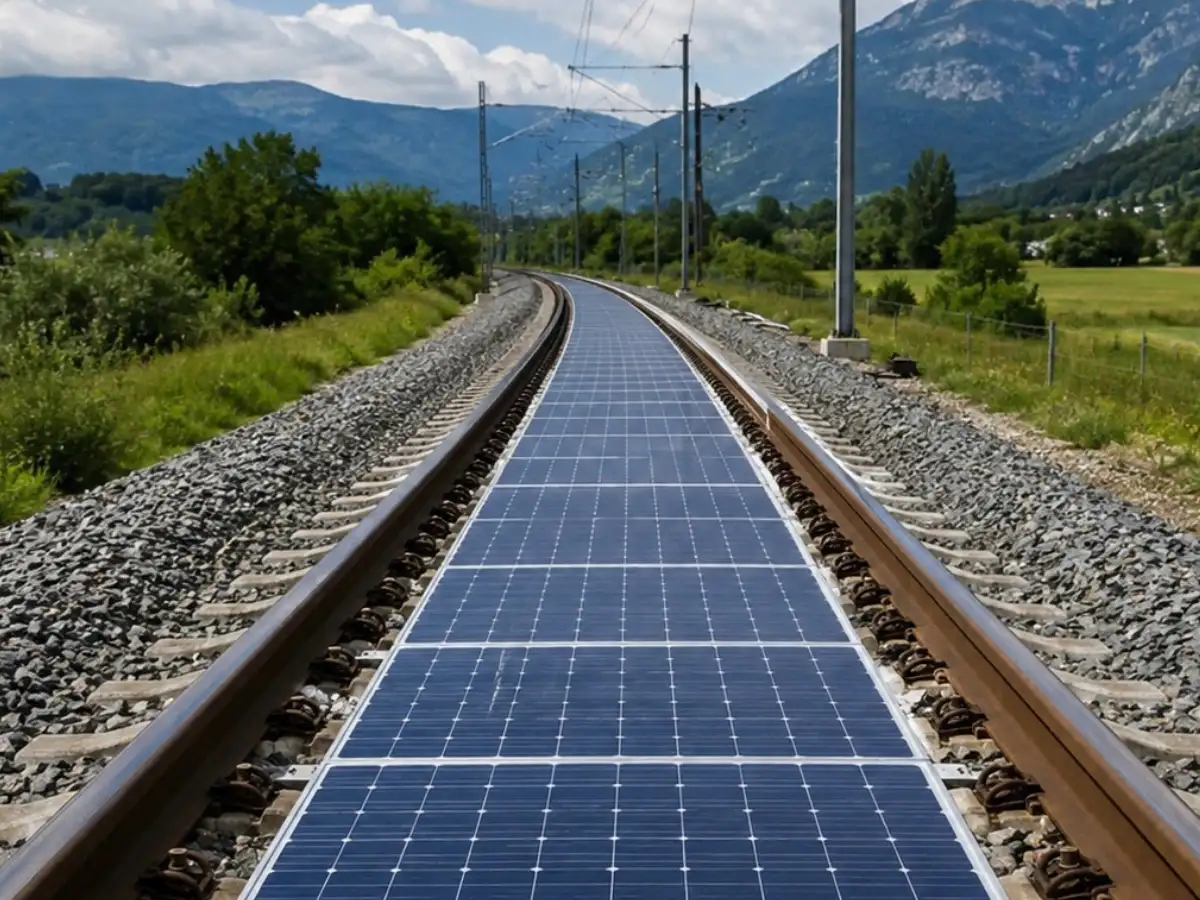
Right now, trains are rolling over solar panels somewhere in western Switzerland, and nobody had to chop down a forest or pave over a farm to make it happen.
A Swiss startup called Sun-Ways commissioned what might be the most unusual solar installation in the world on April 24, 2025. Today, 48 photovoltaic panels sit flush between the rails on a 100-meter stretch of active railway near the village of Buttes, low enough that trains pass directly overhead without slowing down. The panels are also completely removable. Maintenance crews can pull them out, do their work and put them back without shutting down the line.

The installation mechanism, developed with Swiss track maintenance company Scheuchzer, lays pre-assembled one-meter-wide panels between the rails like a carpet unrolling from a moving train and can cover up to 1,000 square meters a day.
The figures are deliberately low. The 18-kilowatt installation is expected to produce about 16,000 kilowatt-hours of electricity per year, enough to power a handful of homes. That's not the point. The question is whether solar panels can handle the weight, vibration, metal dust from braking and repeated pressure waves of live train traffic in a three-year test running through April 2028.
Why nobody wants another solar farm in their backyard
The thing about solar is people like it, until it’s in their backyard. Big ground-mounted farms compete with communities for the same farmland, open spaces and scenic views they want to preserve. That tension has been painfully apparent in Switzerland, where voters turned down a 2023 proposal to put solar panels on Alpine mountainsides, underscoring that support for clean energy doesn’t necessarily include every site.
As the demand for solar grows, scientists and engineers have been working to figure out how to mitigate conflicts over the conversion of agricultural land a challenge that has spawned entire research fields around how to co-locate energy production with existing land uses without cannibalizing one another.