
The Environmental Protection Ministry categorized suspected oil patches that were spotted about 20 kilometers off the coast of Israel on Tuesday night as being Tier 3-level concern, meaning that it has the potential to be a major marine pollution event on a regional or national scale.
According to the International Petroleum Industry Environmental Conservation Association (IPIECA), a Tier 3 oil spill event is one in which all available local and additional Tier 2 resources are not enough to effectively respond. The Environmental Protection Ministry stated that the oil spill has a wide geographical distribution and is rapidly moving.
On Tuesday, the European Maritime Safety Agency (EMSA) notified the Environmental Protection Ministry about a suspected oil patch. The Environmental Protection Ministry failed at first to find any signs of an oil patch, but aircraft from the defense establishment were later able to find signs of oil patches about 20 to 40 kilometers west of the coast ranging between Rishon Lezion and Netanya. The patches will be checked again on Wednesday.
A number of private vessels owned by the Environmental Protection Minister are preparing to begin blocking and pumping as much oil as they can. "If it is found to be a patch that extends over many miles, the ability to treat it at sea will be quite limited," said the ministry.
During a situation evaluation on Wednesday, the Environmental Protection Ministry decided to increase preparedness for the arrival of the suspected oil patches on the shores of Israel. The coastal authorities, the Nature and Parks Authority, the Electric Company, desalination facilities and companies and factories along the coast have been instructed to activate the local emergency plan for oil pollution events and prepare accordingly.
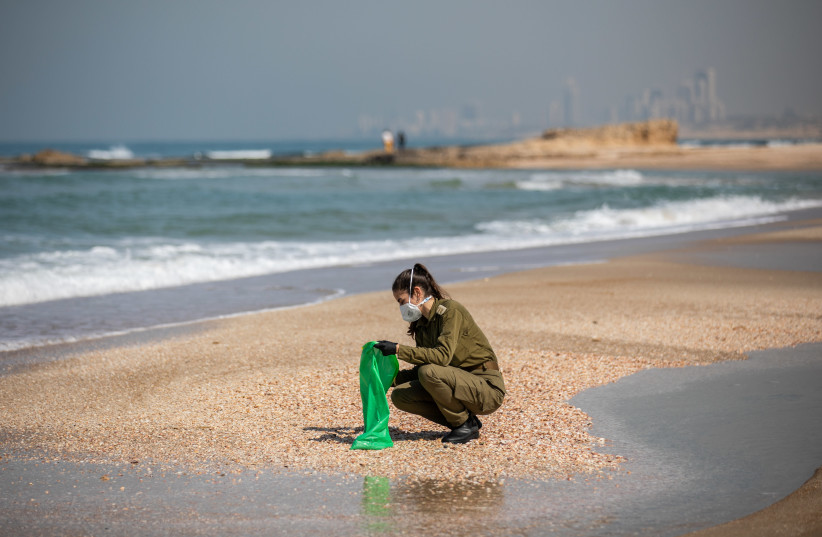
Environmental Protection Minister Tamar Zandberg stressed that all parties are working in the field and the situation room to monitor and manage the incident, adding that the suspicion of an oil patch has not yet been confirmed or refuted and that searches are continuing. "We're hoping for the best case scenario, but are prepared for any situation."
The suspected oil spill comes about a year after an oil spill in the Mediterranean caused an unprecedented ecological disaster along Israel's coast. That spill was designated as a Tier 2 incident.
"A year since the oil disaster at sea and Israel has not learned its lesson," said Mor Gilboa, director-general of the Israeli NGO Zalul, on Wednesday. "The huge oil slick that is making its way to the shores of Netanya at the moment and threatens to strike the marine environment again is far beyond another warning sign."
Gilboa stressed that the situation is an ongoing failure by the Environmental Protection Ministry and the Finance Ministry who have not implemented the conclusions reached by a committee which convened after the oil spill last year and have not promoted the National Contingency Plan for Preparedness and Response to Combating Marine Oil Pollution.
"The great absurdity is that in parallel with the unwillingness to deal with such disasters, Israel continues to promote dozens of offshore oil and gas exploration wells that further increase the likelihood of offshore oil disasters, damaging ecosystems and seawater that Israel is so dependent on to desalinate its drinking water," added Gilboa.
Arik Rosenblum, director-general of EcoOcean, also expressed dissatisfaction with the country's lack of preparedness for oil pollution incidents, saying that despite the "clear and unequivocal decisions" reached by the director-general's forum, "no one is acting on the matter and we have been caught yet again when we were not prepared for the next disaster."
"The dangers are clear and existent, ignoring them would be an irresponsible step," added Rosenblum. "We appreciate the intention of the Environmental Protection Ministry headed by Minister [Tamar] Zandberg and understand her limitations, but without the transfer of budgets, we will not be able to continue to maintain the volunteer array, and also, in the absence of emergency tools and equipment, we can not provide an effective response."
EcoOcean is working to identify whether there is an oil patch, and if so, where it is located. The association is also already recruiting volunteers who are ready to come and clean beaches if needed. The volunteers will provide direct reports on oil clumps if they are found on beaches.
The association sent out a first response ship called The Mediterranean Explorer in coordination and under the direction of the Environmental Protection Ministry on Wednesday morning in order to help identify the suspected oil patch.
Then-environmental protection minister Gila Gamliel claimed that the spill was caused by an Iranian oil tanker and Lloyd's List, a leading international shipping journal, later reported that a tanker called Emerald which was carrying Iranian oil had been confirmed to be responsible for the spill.
Some reports at the time claimed that the Emerald had been damaged by an Israeli attack although Defense Minister Benny Gantz denied the allegations.
The latest possible oil spill comes shortly after the Iranian ship Parnia traveled through the Mediterranean from the Suez Canal to the port of Latakia in Syria, according to open source intelligence account Intellitimes.