Get all your news in one place.
100's of premium titles.
One app.
Start reading
The Conversation
The Conversation
Politics
Riley T. Keenan, Assistant Professor of Law, University of Richmond

Supreme Court makes prosecution of Trump on obstruction charge more difficult, with ruling to narrowly define law used against him and Jan. 6 rioters

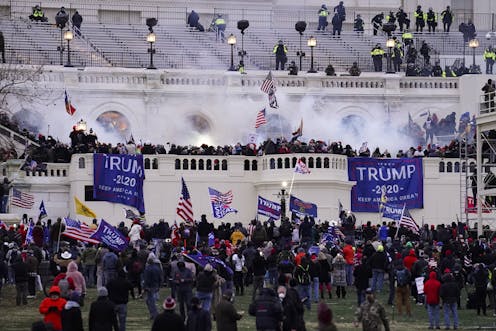
The Supreme Court faced a decision in a case involving participants in the Jan. 6, 2021, U.S. Capitol riot. AP Photo/John Minchillo, File

The indictments – and in some cases, the convictions – of hundreds of people charged with participating in the riot at the U.S. Capitol on Jan. 6, 2021, will have to be reconsidered, and possibly dropped, because of a ruling by the U.S. Supreme Court on June 28, 2024. Among those charged using a broad interpretation of the obstruction law now narrowed by the high court: former President Donald Trump.

In its decision in Fischer v. United States, the Supreme Court held that a federal statute that prohibits obstructing an official proceeding may not apply to three defendants who were charged with participating in the U.S. Capitol riot. Although former President Donald Trump is not a defendant in the case, special counsel Jack Smith has charged him separately with violating the same statute.
Sign up to read this article
Read news from 100's of titles, curated specifically for you.
Already a member? Sign in here
Related Stories
Top stories on inkl right now
One subscription that gives you access to news from hundreds of sites
Already a member? Sign in here
Our Picks
Fourteen days free
Download the app
One app. One membership.
100+ trusted global sources.