Topline
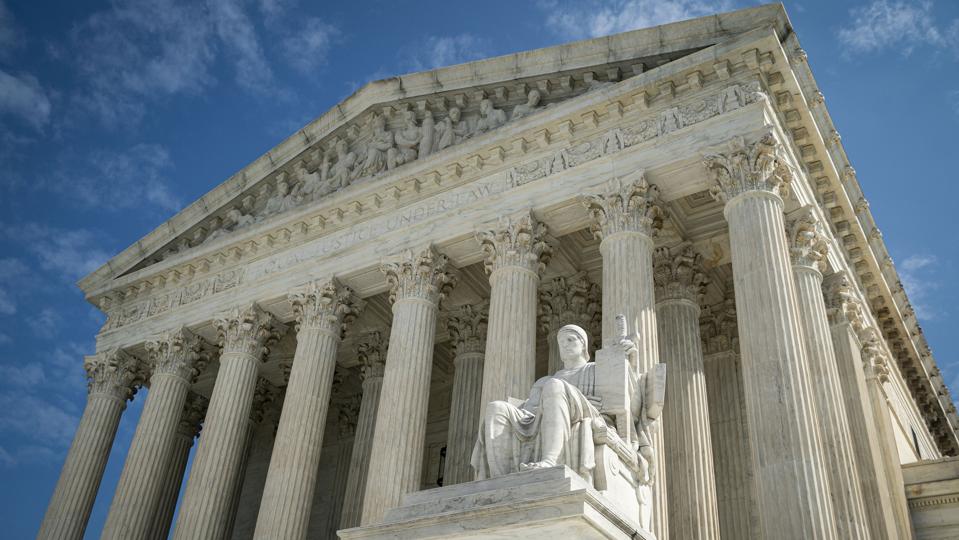
The Supreme Court voted 5-4 on Monday to halt a lower court order requiring Alabama to create a new congressional district map that better represents Black voters, after the lower court argued the state’s current map suppresses the growing Black population’s vote and violates the federal Voting Rights Act.
Key Facts
The decision means Alabama will not be forced to draw a second congressional map, leaving in place a map drawn by Republican lawmakers last year that Democrats argued was unfair.
Five of the court’s six conservatives chose to put the lower court’s ruling on hold, with Chief Justice John Roberts (R) joining the court’s three liberal justices as the only conservative objecting to the decision.
The lower court ruling from January 24 noted just one of Alabama’s seven congressional districts is majority-Black, despite Black voters making up 27% of the state’s population—a figure that has grown while the white population has declined.
Conservative Supreme Court Justice Brett Kavanaugh argued in a concurring opinion Monday that federal courts should not halt state election laws prior to an upcoming election, and clarified the order is not a decision on the merits of the lower court’s ruling, but a way to give the Supreme Court time to decide the case’s merits “in an orderly fashion.”
Roberts argued for the dissenting judges that Alabama’s current map violates Section 2 of the 1965 Voting Rights Act, which “prohibits voting practices or procedures that discriminate on the basis of race [or]
color.”Democrats currently hold one out of seven congressional districts in Alabama under the current map.
Chief Critic
Rick Hasan, an election lawyer and University of California, Irvine professor, believes this ruling to be a bad sign for future voting rights cases and could lead to a narrowing of the Voting Rights Act. "As I’ve said many times, these days, the last place you want to be with a voting rights case is before the U.S. Supreme Court," he wrote for Election Law Blog.
Crucial Quote
“Today’s decision is one more in a disconcertingly long line of cases in which this Court uses its shadow docket to signal or make changes in the law, without anything approaching full briefing and argument,” liberal Justice Elena Kagan wrote in her dissent. “It does a disservice to Black Alabamians who…have had their electoral power diminished.”
Key Background
This year, states are reapportioning their congressional districts based on data from the 2020 U.S. census. Redistricting only happens once every 10 years, and several states are embroiled in high-stakes battles as they draw maps that could influence Congress’ composition for the next decade. In Ohio, the state Supreme Court rejected Republicans’ first attempt at a new congressional map, and lawmakers now have until Sunday to present a new one or the bipartisan Ohio Redistricting Commission will be forced to take over the task. On Friday, North Carolina’s Supreme Court also rejected new maps submitted by Republican lawmakers, finding gerrymandering—the political strategy of deliberately manipulating congressional district lines to favor one party—in the redistricting. Democratic lawmakers in New York approved new maps last Wednesday, potentially shifting as many as three House seats from Republicans to Democrats, leading a Republican-led group of voters to file a lawsuit the next day claiming the Democrats gerrymandered.
Tangent
The Freedom to Vote Act, proposed by President Joe Biden and congressional Democrats, sought to ban partisan gerrymandering on a national level. The bill was blocked in the Senate by Republicans in January, as Democrats did not have the 60-vote supermajority necessary to end debate on the legislation. Democrats attempted to change the filibuster rules in the Senate so the the bill could pass with a simple majority, but moderate Sens. Joe Manchin (D-W.Va.) and Kyrsten Sinema (D-Ariz.) joined Republican senators to reject the rules change.