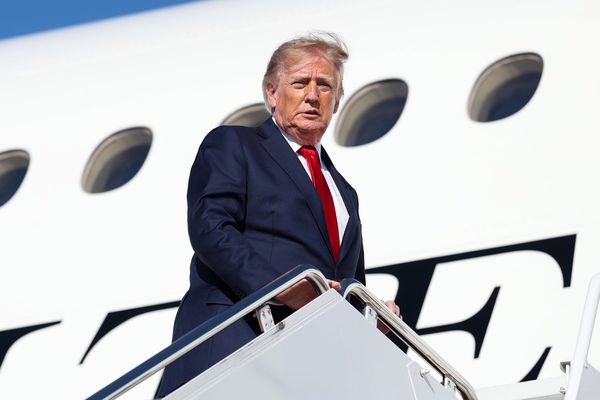
The Supreme Court's decision striking down many of President Trump's tariffs curbs his power to use energy to pressure trading partners.
Why it matters: Trump has aggressively used tariffs — real and threatened — to gain economic and geopolitical leverage.
- Multiple trade deals have included pledges from partners to buy U.S. oil and liquefied natural gas. Trump has also threatened tariffs to pressure other countries not to buy Russian or Iranian oil.
Catch up quick: The high court on Friday ruled that the president lacks legal authority to impose tariffs under the International Emergency Economic Powers Act (IEEPA).
What they're saying: "This absolutely will limit Trump's ability to wield tariffs for geopolitical pressure," said Trevor Sutton, a trade researcher with Columbia University's Center on Global Energy Policy.
- "One of the oddest and most innovative aspects of Trump's use of IEEPA was the way he used them as quasi-sanctions to punish countries for trade that did not involve the United States," he said.
- He cited Indian purchases of Russian oil as an example.
- Trump can still use tariffs coercively, but the "scope and timeline of that coercion" is now more bounded, he said in an email.
State of play: The ruling will "have a major impact on batteries for uses other than electric vehicles, with South Korean and Japanese firms particularly likely to benefit," the research firm BloombergNEF said in a note Friday.
- "Solar will be less affected, as major solar producers in Southeast Asia continue to face high tariffs in place under authorities not impacted by today's ruling," it states.
Yes, but: Fallout will vary by sector, depending largely on which authorities and statutes tariffs have been imposed under.
- For instance, oil and gas companies have chafed at steel tariffs that remain under Section 232 the Trade Expansion Act, noting they raise domestic drilling costs.
- Duties on solar equipment from several Asian nations remain under Section 301 of the Trade Act of 1974.
Trump, in remarks Friday, vowed expanded use of multiple tariff powers outside of IEEPA. He said he would sign an executive order to impose 10% tariffs on all nations.
- But some goods won't be subject to the duty, including certain critical minerals, metals used in currency and bullion, energy, and energy products. the White House said.
Zoom out: The decision is a win for business overall.
- "The Supreme Court's decision highlights the interconnected nature of global markets and the role predictable trade plays in reliability for American consumers," Aaron Padilla, vice president of corporate policy for the American Petroleum Institute.
Our thought bubble: Trade policy whiplash under Trump has for years slowed private equity firms and investment banks from underwriting certain low-carbon projects reliant on imports, such as solar and energy storage projects, Pro Deals' Alan Neuhauser notes.
- The question now is whether the Supreme Court's ruling is seen as relief by such financiers, or simply the latest round of uncertainty in U.S. trade.
What we're watching: Capitol Hill. The ruling "could increase momentum for Republicans to pursue legislative tariff-setting measures," ClearView Energy Partners said in a note.
- One bill to watch: bipartisan legislation sponsored by Sens. Lindsey Graham (R-S.C.) and Richard Blumenthal (D-Conn.) that would impose sweeping U.S. trade penalties on countries that buy Russian oil and gas.
Editor's note: This story was updated to add that certain minerals and energy-related goods won't be subject to Trump's 10% tariff.