Get all your news in one place.
100's of premium titles.
One app.
Start reading
The Times of India
The Times of India
World
TOI World Desk

Study suggests the woman named on a 2,000-year-old Roman well belonged to one of Rome's most influential families

For almost a century, visitors to the ancient city of Butrint in modern-day Albania have passed an inscription bearing a simple name: Junia Rufina. It appears on the stone parapet of a Roman well, accompanied by just a few Greek words describing her as a "friend of the Nymphs". There was no family history, no official title and no explanation of why her name had been carved into such a prominent public monument. That absence turned the inscription into one of the site's enduring puzzles. Now, a fresh examination of the monument, its architecture and the political landscape of the Roman Empire suggests that the woman behind the inscription may not have been an obscure local benefactor after all. Instead, she may have belonged to an influential Roman family whose connections stretched from Egypt to Greece and perhaps even imperial circles. Researchers argue that combining archaeological evidence, inscriptions from across the Mediterranean and Roman naming traditions has revealed a far richer picture of her identity, offering new insights into elite women, civic patronage and the far-reaching networks that linked prominent families throughout the empire nearly 2,000 years ago.

Get breaking news anytime, anywhere. Download the TOI app now!

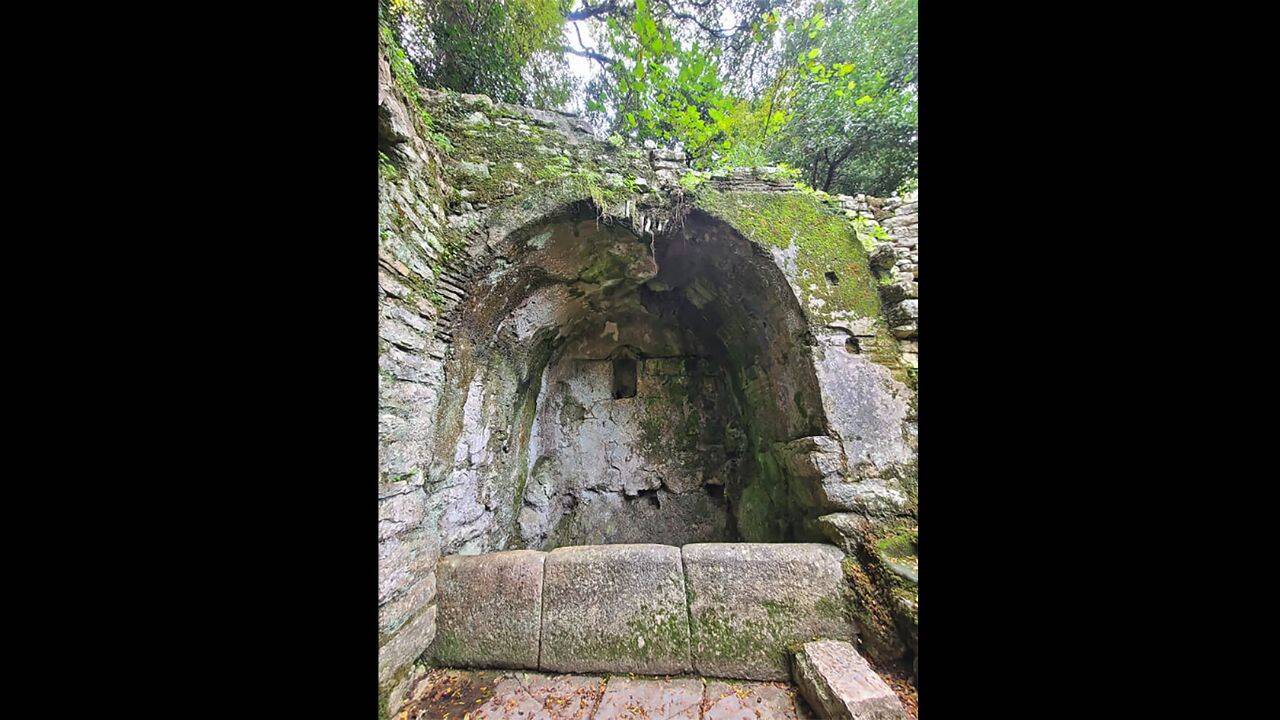
Why the well of Junia Rufina was more than just a place to collect water

The monument itself sits beside the Lion Gate, one of the main entrances into ancient Butrint. Although known simply as the "well of Junia Rufina", it was much more than a place to collect water. According to the study published in Cambridge University Press, titled “Patronage and public amenities in Roman Epirus: the well of Junia Rufina at Butrint”, archaeological evidence indicates that the natural spring had been reshaped into an impressive Roman structure resembling a small nymphaeum, or sacred water shrine, where fresh water and religious symbolism came together. The stone slabs forming the parapet still preserve marks left by ropes repeatedly lowered into the well over many centuries.

The inscription itself is striking because of what it does not say. It identifies Junia Rufina only by name and describes her as a "friend of the Nymphs". There is no mention of her family, office or achievements. According to the study, that simplicity may not have reflected a lack of importance. Instead, it could suggest that those who encountered the monument already knew exactly who she was.

The researcher also argues that the inscription may have worked alongside a portrait displayed nearby. A niche built into the original Roman structure could have held a bust or statue of Rufina, allowing visitors approaching the well to recognise the benefactor whose name appeared across the stone frontage.

How the well's age helped researchers learn more about Junia Rufina

Dating the monument has always been important because it helps narrow the search for Junia Rufina's identity. Rather than relying only on the inscription itself, the study compares the well with a much broader pattern of rebuilding that transformed Butrint during the reign of Emperor Hadrian in the second century CE.

As per the study, during this period, the city saw extensive redevelopment. Baths were renovated, monumental fountains appeared, theatres were expanded, and public spaces acquired more elaborate architecture. The well shares building techniques and decorative features with several of these projects, placing it within the same wave of urban investment focused on water infrastructure.

Language offers another clue. Earlier monumental inscriptions at Butrint were overwhelmingly written in Latin. Junia Rufina's dedication, however, appears in Greek despite her thoroughly Roman name. The study links this choice to Hadrian's promotion of Greek culture across the eastern provinces of the empire. If the inscription belongs to this period, it reflects a cultural environment in which elite Romans increasingly embraced Greek language and traditions for public display.

Study suggests Junia Rufina may have been part of an influential Roman family

The most intriguing part of the research concerns Rufina herself. By comparing names preserved in historical records, the author suggests that the woman at Butrint may have belonged to the powerful Junii Rufini family, whose members occupied senior positions across the Roman Empire.

According to the study, one possibility is that she was the daughter of Marcus Junius Rufus, a former prefect of Egypt. Such a background would place her within an exceptionally well-connected network that included literary figures, provincial governors and people associated with Emperor Hadrian's travelling court. If correct, it would also explain why she appears comfortable commissioning a Greek inscription while operating within the eastern provinces.

The study cannot prove this family connection beyond doubt. Much of the argument depends on assembling separate pieces of historical evidence rather than discovering a single document naming Rufina directly. Even so, the proposed identification fits several otherwise puzzling details, including the rarity of her name combination, her apparent wealth and the confidence with which the inscription assumes her identity required no explanation.

How Junia Rufina's monument shows the growing role of women in Roman public life

The research reaches beyond solving a historical mystery. It also sheds light on the role wealthy women could play in shaping Roman cities during the second century CE. Across the eastern empire, elite women financed fountains, public buildings and civic improvements, particularly during Hadrian's reign, when urban renewal accelerated in many provinces. Junia Rufina's well appears to fit comfortably within that wider tradition of female patronage.

The paper also points to another discovery that keeps the discussion open. Archaeologists working at Baelo Claudia in southern Spain uncovered a grand mausoleum honouring another woman named Junia Rufina, dated to roughly the same period. Although there is no firm evidence that both inscriptions refer to the same individual, the unusual name and the elite character of both monuments leave open the possibility that they belonged to one woman whose life crossed several regions of the Roman Empire.

Whether that final connection can ever be confirmed remains uncertain. Yet the inscription at Butrint no longer appears to commemorate an anonymous donor.

Sign up to read this article
Read news from 100's of titles, curated specifically for you.
Already a member? Sign in here
Related Stories
Top stories on inkl right now
One subscription that gives you access to news from hundreds of sites
Already a member? Sign in here
Our Picks
Fourteen days free
Download the app
One app. One membership.
100+ trusted global sources.