
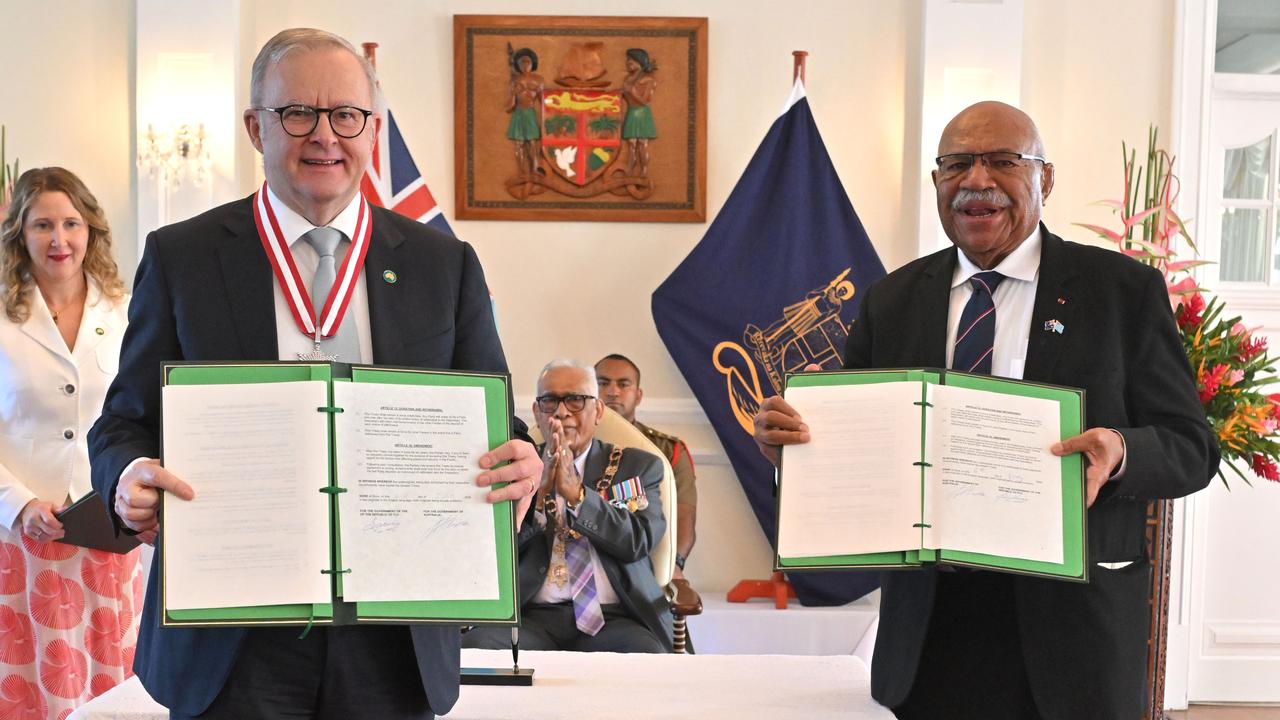
Australia has moved to ratify a landmark defence alliance with Fiji, which will aim to curb growing Chinese influence in the Pacific.
Prime Minister Anthony Albanese signed the Ocean of Peace alliance with Fiji in July, which would mean an attack on one country would be considered an attack on the other.

It is just Australia's fourth formal treaty, after the US, New Zealand and Papua New Guinea, and the first for Fiji.
In introducing the treaty with Fiji, and a separate agreement known as the Vuvale Union, to be formally ratified by parliament, Foreign Minister Penny Wong said it would strengthen ties with the Pacific ally.
"These treaties reaffirm Fiji and Australia as trusted partners working together not only to benefit each other, but as contributors to a more stable, peaceful and resilient Blue Pacific continent," Senator Wong said on Tuesday.
"We know that in these unprecedented, dangerous times, we are stronger together. Everything we do will also be aimed at supporting our Pacific region."
Both countries would need to formally ratify the alliance in their respective parliaments for it to come into effect.
The alliance was agreed to try and curb Chinese influence in the region, with the Asian power seeking its own agreements with Pacific countries.
The signing of the alliance coincided with the testing of a Chinese ballistic missile, which landed in the Pacific.
Pacific countries have been negotiating for a potential region-wide agreement at summits ahead of the Pacific Islands Forum in September.
Senator Wong said Australia could not be passive at a time of growing change.
"We are using all tools of statecraft to invest in Pacific relationships, trust and regionalism. Embracing Pacific leadership and backing initiatives that make our region safer, more prosperous and more resilient," she said.
"And we could not have a better partner in this than Fiji.
"(The alliance) will build ever deeper levels of interoperability. We will, plan, train, exercise and deploy together, strengthening our combined capability, to enhance our respective sovereignty and ensure our nations' and our region's security at a time of fracture and disruption."







