
Get all your news in one place.
100’s of premium titles.
One app.
Start reading
Fit & Well
Fit & Well
Health
Lou Mudge

Stretching can be a powerful tool to help the over-60s feel their best—combat aches and pains with these five assisted stretches

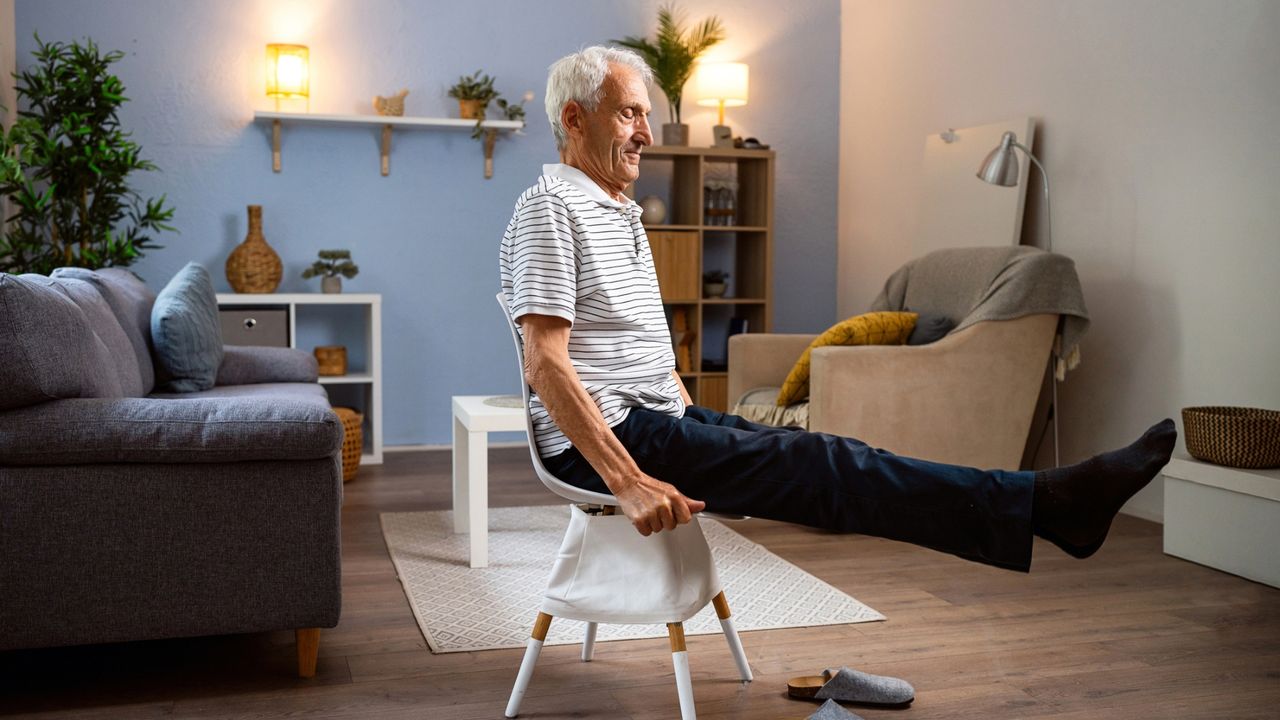
Man in a striped tshirt sitting on a chair with legs outstretched with a living room setting behind him .

Most of us experience more aches and less mobility as we age. You might wake up with tension in your back or shoulders or feel that the range of motion in your joints isn’t as free as it used to be.

These changes might leave you feeling uncomfortable, less steady on your feet and less confident in everyday movement.

“Stability is a key component to help our body maintain balance and control as we move,” says Kelsey Kerr, a NSCA-certified trainer and director of training at StretchLab.

With age, physical stability often declines due to a natural loss of muscle mass and mobility, particularly common in people approaching or beyond retirement age.

Gentle exercise is one of the most effective ways to counteract this. But where should you start?

Kerr advises three simple steps: identify your goals, acknowledge your limitations and determine whether or not you can do the moves safely.

“Someone in their 60s might be looking to reduce tightness or aches, move around safely, feel younger and improve their overall wellbeing,” says Kerr.

“When setting out to achieve these goals, you must consider whether you have past or recent surgeries or injuries, any health conditions, a repetitive lifestyle that causes imbalances, or a lack of stability or strength that will impact your progress or ability to perform movements. If you’ve not stretched before, do you know where to start?”

If you are comfortable and have been cleared by a healthcare professional to move, try the five stretches below, which use a chair for assistance. Alternatively, you can explore assisted stretches with a professional.

1. Assisted hamstring stretch

(Image credit: StretchLab)

Time: 20-30sec each side

“Low-back tension is a common pain point for many people and the hamstrings can be the culprit,” says Kerr.

  • Stand with your hands on the back of a chair for support.
  • Bend your left knee and move your right foot forward, placing your right heel on the floor with your toes pointing up.
  • Hinge forward from your hips, pushing your hips back—you should feel a stretch in your right hamstring.
  • Hold for time, then repeat on the other side.

2. Standing quad stretch

(Image credit: StretchLab)

Time: 20-30sec each side

“This is a great stretch to work on your balance while also opening up through the quads and hips,” says Kerr.

  • Stand with your hands on the back of a chair for support.
  • Bend your right knee, lifting your right heel to your buttocks.
  • Hold your right ankle or pant leg to maintain the stretch.
  • Keep your knees close and avoid arching your back.
  • Hold for time, then repeat on the other side.

3. Torso twist

(Image credit: StretchLab)

Time: 20-30sec each side

“Mobility in the spine is very important, and rotational movements can help with keeping the spine healthy with movement in multiple planes of direction,” says Kerr.

  • Sit upright in a chair with your feet flat on the floor.
  • Carefully rotate your torso to the right, taking hold of the back of the chair with your right hand and placing your left hand on the outside of your right knee to assist you in a hold.
  • Hold for time, then return to the center and repeat on the other side.

4. Chest opener

(Image credit: StretchLab)

Sets: 2 Time: 15-20sec

“This is a great movement to help improve posture and work on proper breath intake, which in turn helps to reduce stress,” says Kerr.

  • Sit upright in a chair with your feet flat on the floor.
  • Interlock your hands behind your back or, if your range of motion is limited, hold the ends of a towel instead.
  • Straighten your arms if comfortable and carefully lift them behind you to stretch your chest.
  • Hold for time, breathing slowly and deeply.
  • Release the position, then repeat.

5. Lateral neck stretch

(Image credit: StretchLab)

Time: 20-30sec

“We hold more tension in our upper traps than we think,” says Kerr. “This stretch will help bring extra blood flow to those muscles, lowering tension and stress.”

  • Sit upright in a chair with your feet flat on the floor.
  • Drop your right ear toward your right shoulder, stretching the opposite side of your neck.
  • Hold for time, then repeat on the other side.
Sign up to read this article
Read news from 100’s of titles, curated specifically for you.
Already a member? Sign in here
Related Stories
Top stories on inkl right now
One subscription that gives you access to news from hundreds of sites
Already a member? Sign in here
Our Picks
Fourteen days free
Download the app
One app. One membership.
100+ trusted global sources.