Get all your news in one place.
100's of premium titles.
One app.
Start reading
Evening Standard
Evening Standard
Politics
Nicholas Cecil and Tom Place

Stop attacks on Lebanon, Britain tells Israel amid fragile ceasefire as it warns Tehran not to 'hijack' Strait of Hormuz

Israel must end attacks on Lebanon as part of a ceasefire in the Iran war, says Britain.

Prime Minister Keir Starmer said that Israeli strikes on Lebanon following the ceasefire deal are “wrong” and “should stop.”


Starmer also said the UK is monitoring the use of UK bases by Washington, to ensure they are being used for collective self-defence rather than for offensive operations against Iran.

The Prime Minister arrived in Bahrain on Thursday as part of a trip to the region, and said it was “hard to say” whether the strikes were a breach of the ceasefire between the US and Iran.

He told ITV’s Talking Politics podcast: “We haven’t all got access to all the details of the ceasefire. But look, let me be really clear about it – they’re wrong.”

Asked whether Israel was “wrong to be attacking in Lebanon now”, Starmer replied: “Yes, that shouldn’t be happening. That should stop – that’s my strong view – and therefore, the question isn’t a technical one of whether it’s a breach of the agreement or not.

“The (question) is actually a matter of principles as far as I am concerned and, in a sense, my argument would be it should be included in a ceasefire and that’s the important part of the overall approach.”

Foreign Secretary Yvette Cooper also told Tehran to stop “hijacking” the Strait of Hormuz and allow freedom of navigation through the key waterway for tankers.

She made the demands as the two-week truce between the US and Iran was hanging by a thread.

Israel pounded Lebanon with its heaviest strikes yet on Wednesday, killing hundreds of people and drawing a threat of retaliation from Iran, which suggested it would be “unreasonable” to proceed with talks to forge a permanent peace deal with the US.

The warning ⁠from Iran’s lead negotiator, parliament speaker Mohammed Bager Qalibaf, laid bare the continued volatility in the region following Tuesday’s ceasefire announcement by Trump.

The two sides have laid out sharply contrasting agendas for peace talks set to start on Saturday, but it was unclear whether the two-week ceasefire would hold until then.

Qalibaf said Israel had already broken several conditions of that ceasefire by ramping up its parallel war against the Iran-aligned militia Hezbollah, while the US had violated the agreement by insisting that Iran abandon its nuclear ambitions.

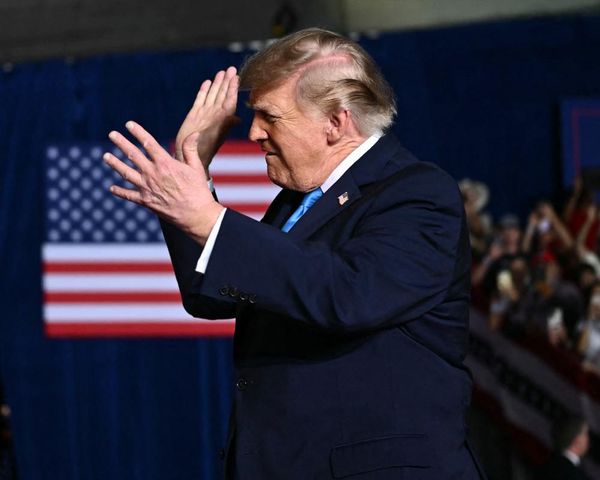
Donald Trump has announced a two-week ceasefire in the Iran war (PA Wire)

“In such a situation, a bilateral ceasefire or negotiations were unreasonable,” he said.

Israel and the United States both said the two-week ceasefire did ⁠not cover Lebanon, and Israeli Prime Minister Benjamin Netanyahu said the strikes would continue.

“I think the Iranians ​thought that ⁠the ceasefire included Lebanon, and it just didn’t,” US Vice President JD Vance, who will lead the US delegation, told reporters in Budapest.

Foreign Secretary Yvette Cooper in the air traffic control centre at Riyadh airport during a visit to Saudi Arabia (PA Wire)

But Ms Cooper told Times Radio: “One of the things I do feel very strongly about is we want to see Lebanon included in the ceasefire.

“Otherwise that will destabilize the whole region still, and also it’s just the right thing to do is Lebanon.

“That escalation that we saw from Israel yesterday, I think was simply damaging.”

She urged Israel and the Lebanese authorities to work together to tackle the threat posed by terror group Hezbollah.

She also stressed the need to get the Strait of Hormuz, through which a fifth of the world’s oil and liquefied natural gas is transported, reopened.

“It’s an international shipping route, and we cannot have any one country hijacking international shipping routes like that in order to hold the global economy hostage,” she said.

The Strait of Hormuz (AFP/Getty Images)

The strait had been effectively closed by Tehran by targeting ships with drone attacks, and allowing tankers to pass through it again is a key element of the ceasefire deal.

The US and Tehran also appeared to be far apart on Iran’s nuclear programme as well, one of the factors that Trump cited as the basis for war.

The US president said Iran had agreed to stop enriching uranium, which can be ⁠turned into nuclear weapons, and the White House said Iran has indicated it would turn over its existing stocks.

“The United States will, working with Iran, dig up and remove ​all of the deeply ⁠buried ... Nuclear ‘Dust,” Trump, who has clashed with Nato allies over the war, said on social media.

Qalibaf, however, said it was allowed ‌to continue enriching uranium under the terms of the ceasefire.

Though both the United States and Iran declared victory in a five-week-old war that has killed thousands, their core disputes remained unresolved.

Each side is sticking to competing demands for a deal that could shape the Middle East for generations.

Despite the uncertainty, world stock market surged while oil prices plunged 14% to settle near $95 (£71) per barrel, after ‌falling as low as $90.40 (£67.50).

Benchmark Brent crude remains roughly $25 (£19) higher than before the joint US-Israel attacks began, which has fuelled a rise in petrol and diesel prices.

The UK has been facing rising fuel prices due to the US-Israeli conflict with Iran (Nick Ansell/PA) (PA Archive)

Tehran’s newly ‌demonstrated ability to cut off Gulf energy supplies through its grip on the strait, despite decades of massive US military investment in the region, shows how the conflict has already altered power dynamics in the Gulf.

Netanyahu said Israel had its “finger on the trigger” and was prepared to return to fighting at “any moment.”

Lebanon’s civil defense service said 254 people had been killed in Israel’s strikes across Lebanon on Wednesday.

The highest toll was in the capital Beirut, where Israeli strikes killed 91 people, it said. ⁠Residents said some of the Israeli strikes had come without the usual warnings for civilians to evacuate.

Hezbollah, the Iran-backed militant group in Lebanon, said early Thursday that it fired rockets at northern Israel in response to “ceasefire violations.”

French president Emmanuel Macron (POOL/AFP via Getty Images)

French President Emmanuel Macron condemned “in the strongest possible terms” what he called indiscriminate Israeli attacks on Lebanon, saying in a statement on X that Lebanon “must be fully covered” by the ceasefire.

Leaders of 13 European countries, Japan and Canada also issued a joint statement welcoming the ceasefire and calling for a swift end to hostilities in order to “avert a severe global energy crisis.”

Iran also struck oil facilities in nearby Gulf countries, including a pipeline in Saudi Arabia that has been used to bypass the blockaded Strait of Hormuz, according to an oil industry source.

Kuwait, Bahrain and the UAE also reported missile and drone strikes. The Strait of Hormuz remained shut to vessels sailing without a permit and shippers said they needed more clarity before resuming transit.

Iran’s Revolutionary Guards navy posted a map showing alternative shipping ‌routes in the Strait of Hormuz to help ships avoid naval mines, the semi-official Iranian news agency ISNA said.

Sign up to read this article
Read news from 100's of titles, curated specifically for you.
Already a member? Sign in here
Related Stories
Top stories on inkl right now
One subscription that gives you access to news from hundreds of sites
Already a member? Sign in here
Our Picks
Fourteen days free
Download the app
One app. One membership.
100+ trusted global sources.