
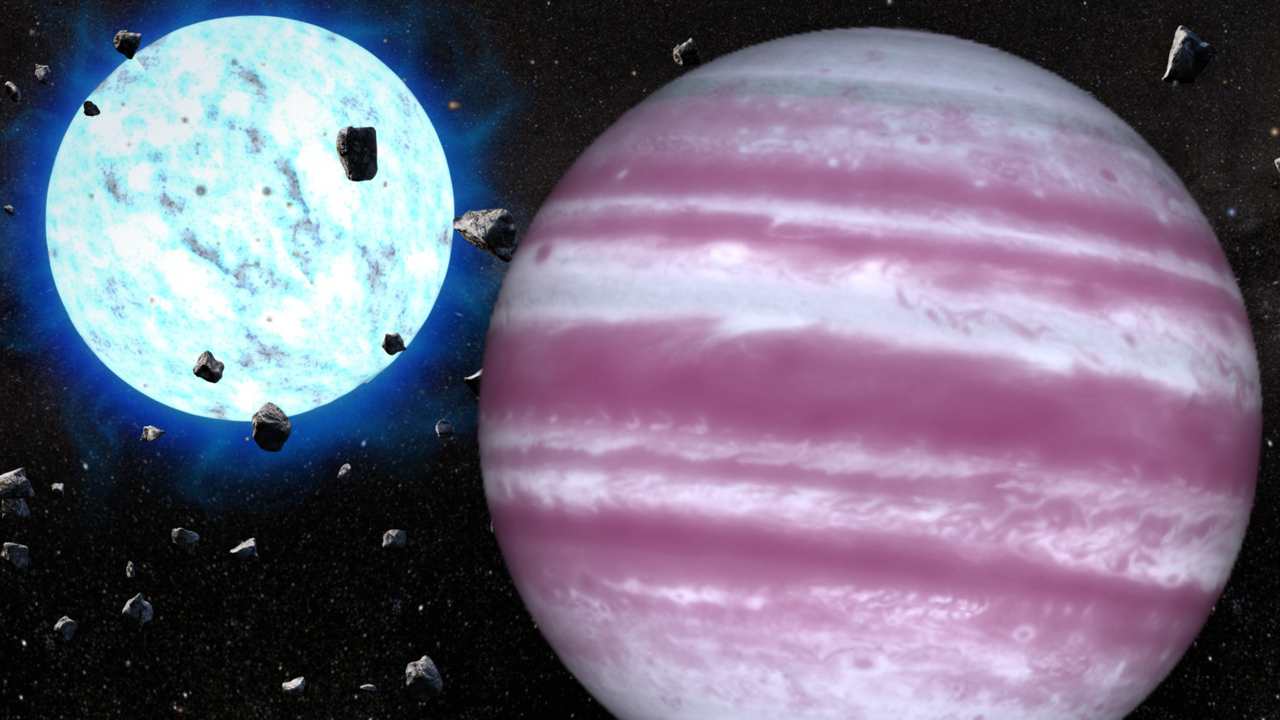
Astronomers have used the James Webb Space Telescope (JWST) to observe an oddball gas giant exoplanet orbiting a dead star, a white dwarf, located some 80 light-years away. This "life after death" system gives scientists a portentous vision of what the solar system may look like in around 6 billion years after the sun has exhausted the hydrogen in its core, shed its outer layers, and left behind a smoldering white dwarf stellar remnant.
Prior to the final stages of that transformation, our star will have become a red giant, swelling out to many times its original radius, swallowing the inner rocky planets including Earth but leaving the outer planets — although changing them irrevocably. Reflecting this, the white dwarf at the heart of this research is orbited by a Jupiter-sized exoplanet, designated WD 1856 b.
As WD 1856 b orbits its dead parent star, it crosses or "transits" the face of this white dwarf, known as WD 1856+534. By observing these transits with the JWST, the team was able to measure the mass and temperature of this Jupiter-like planet while also observing the composition of its atmosphere. To their surprise, they found WD 1856 b is hotter than expected. They also discovered how this planet came to have such an unusually tight orbit around its host white dwarf star.