Get all your news in one place.
100’s of premium titles.
One app.
Start reading
Inverse
Inverse
Entertainment
Ryan Britt

'Starfleet Academy' Review: Star Trek Takes Its Biggest Swing In Years

Who is Star Trek for? When Gene Roddenberry created the series back in 1964 — which later debuted in 1966, six decades ago this year — the answer to that question was easy: everyone. Because of Star Trek’s impact on entertainment and culture, well-meaning fans tend to want to believe that Roddenberry set out to make a show about an idealistic future, full of stories that tackled hard-hitting social issues in sci-fi guises. The truth is, the actual pitch for Star Trek wasn’t really that at all; instead, the goal of the series was actually much simpler and harder: to make a good science fiction series, populated with legit science fiction ideas, but one that appealed to the actual mainstream population, specifically, adults. The visions of a better tomorrow? That was a bonus.

But interestingly, in the 21st century, whenever a new Star Trek thing comes along, there’s always a tension between both goals: Is this a crowd-pleasing action Star Trek designed to bring in everyone, or is this a contemplative social issues show? With the new series, Star Trek: Starfleet Academy (launching on Paramount+ with two episodes on January 15), the answer is both, and also, a strange third thing: a hopeful show about, and possibly specifically for, young adults. Starfleet Academy’s stated goal is very much not to be your parents' Star Trek. This is interesting, because older fans will likely be, at times, delighted by all the Easter eggs, and at other times, bewildered by what these kids are all about.
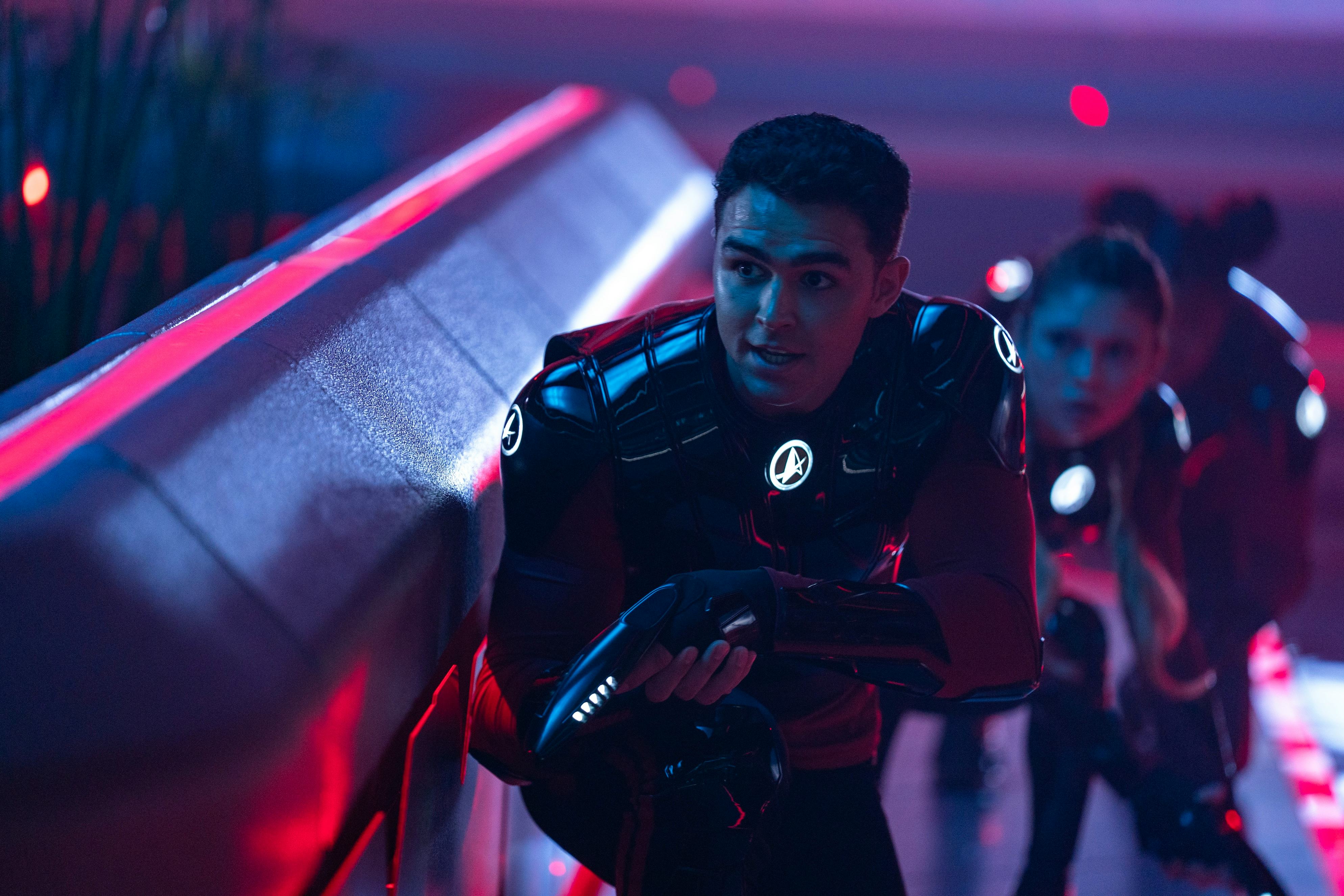
Starfleet Academy is at its best when its focus is on its young cast. | John Medland/Paramount+

The first episode of Starfleet Academy is called “Kids These Days,” which establishes the tone and mission of the show. We’re in the 3190s, in the time established by Discovery’s latter seasons, which includes the backstory of the galaxy-wide catastrophe known as “the Burn.” This was the moment in 3069 when a bunch of warp drives randomly detonated, and the Federation was thrown into chaos. Captain Nahla Ake (Holly Hunter) was around not just for the tail-end of the Burn, but for all those bad years, owing to the fact that she’s a long-lived Lanthanite, a species of human-passing aliens first introduced in Strange New Worlds Season 2 in the form of Carol Kane’s sassy engineer Pelia. Apparently, the new Star Trek rule is that if you’re going to get someone to play a near-immortal, wise alien, you have to cast Hollywood royalty.

In fact, although Starfleet Academy eventually gives the young adults the spotlight, the pilot episode is about the space boomers Captain Ake and her longtime nemesis Nus Braka, played by Paul Giamatti. Seeing as SFA is a show about a school, and about teaching young people to find themselves, one could imagine a mirror universe in which these roles were reversed — Giamatti in his Holdovers role, but in space, and maybe Hunter being super evil. But, as it stands, Giamatti seems like he’s always been in the Star Trek franchise, while Hunter seems, if not out of place, certainly something new. If you don’t like the idea of Starfleet captains who walk around barefoot and behave like a cross between a quirky Hogwarts professor and, well, Holly Hunter, aspects of Captain Ake will feel jarring, to say the least.

Paul Giamatti as Nus Braka and Holly Hunter as Captain Nahla Ake, the Boomers of a very Zoomer-coded Star Trek show. | Brooke Palmer/Paramount+

Somewhat ironically, for an elder millennial fan like myself who was raised on the paternal, adult figures of The Next Generation, I expected myself to love the older characters, including Tig Notaro’s as Jett Reno (imported from Discovery and technically a time traveller from the TOS era) as well as Robert Picardo’s triumphant return as the cankerous AI holographic Doctor from Star Trek: Voyager. And yet, throughout the pilot episode (which is over an hour and plays like a mini-movie), I found myself wanting to stay with the kids, not the adults. In one action scene in the pilot, a character on the bridge of the USS Athena (which is also, technically, the school) says “another teachable moment.” If there’s any weakness SFA has, it's this. The teachers can seem a little on-the-nose and one-dimensional, while the cadets feel more multifaceted.

Leading the crew is rebel-without-a-cause Caleb Mir (Sandro Rosta), who has a rocky past with Captain Ake. Caleb is like if Han Solo and Kirk’s son, David Marcus, were the same person, with a good dose of Dal from Star Trek: Prodigy. For anyone who has read a book where somebody gets dumped in a boarding school and hates everyone, but eventually comes to love everyone, Caleb’s journey will be a familiar one. This isn’t to say it doesn’t work, but simply to say it won’t work for everyone. He’s joined by Genesis Lythe (Bella Shepard), a nepo baby with something to prove; Kragg (Karim Diane), a peace-loving Klingon who steals every single scene he’s in; Kerrice Brooks as Sam, a sentient hologram; Darem Reym (George Hawkins), an arrogant hothead with a secret; and, by the second episode, Tarima Sadal (Zoë Steiner), a Betazoid with powers that make her kind like Star Trek’s Jean Grey.

Zoë Steiner as Tarima Sadal and Sandro Rosta as Caleb Mir bring the heat in Starfleet Academy. | Paramount+

For those who want to know what Starfleet Academy is really like, the pilot episode oddly doesn’t really set you up for the actual show. In fact, the second episode, in which Tamira is introduced, and her possible romance with Caleb starts to happen, is really closer to the format and tone of the rest of the show. While the pilot might suggest to you that there’s going to be a big Discovery-style season-long arc, the next batch of episodes (the press has received six total) end up being more self-contained, and more in the spirit of classic Star Trek: Here’s a strange, new dilemma, can these wacky kids come up with a solution?

If you don’t know anything about Star Trek, Starfleet Academy is fairly accessible, though it’s also stuffed with Easter eggs, and some very unexpected cameos as the show goes on. It’s too early to tell if this fan service will help or hinder the overall appeal of the show, but suffice to say, the series has a strong desire to make sense of the Star Trek puzzle during this historic 60th anniversary year. And one way SFA tackles the “Who is Star Trek for?” question is to zoom in on a different question: “Is Starfleet good?”

Throughout Star Trek’s now 60-year history, the franchise has had an almost built-in self-critical narrative plot device because everything about Starfleet is paradoxical. In the 2009 reboot film, co-written by current Trek boss Alex Kurtzman, Captain Pike (Bruce Greenwood) called Starfleet “a peacekeeping armada,” which accidentally describes everything weird about Starfleet. They’re supposed to boldly go where no one has gone before, but don’t forget to be really careful and not interfere with planets that don’t have warp drive. Starfleet’s mission has always been one of peace, but every single starship is armed to the teeth, and one hand phaser would make someone a warlord overnight on a planet with 21st-century technology. The Federation, the governing body that Starfleet serves, wants to be inclusive, but only to planets that play by its cultural rules.

All of this has been unpacked before, notably in Star Trek VI: The Undiscovered Country and nearly all of Star Trek: Deep Space Nine. And yet, Starfleet Academy is zooming in ever closer. When TNG or Strange New Worlds asked these hard questions, providing a clear answer to the paradox of Starfleet wasn’t necessary, because there were more important outer-space things to do. Because Starfleet Academy largely takes place on Earth and deals with a version of Starfleet that has been struggling for a century, there’s less room for the show to hide from these tricky topics.

The old generation meets the next generation: Robert Picardo as The Doctor, Kerrice Brooks as Sam, and Bella Shepard as Genesis in Starfleet Academy. | Paramount+

For decades, we’ve wondered if actually going to Starfleet Academy was more like a military school or a liberal arts college. SFA leans much closer to the latter, but creates an interesting schism to explain the former. Some of these ideological minefields are tap-danced around, others are confronted outright. But the show is generally better when you question whether you’d actually want to go to Starfleet Academy, rather than the love-fests that suggest Starfleet is the greatest thing ever.

Intentional dichotomy is Starfleet Academy’s blessing and curse. Along with Kurtzman, showrunner Noga Landau and creator Gaia Violo have delivered a fun-focused YA space adventure, full of likable cadets, who are putting up with their stuffy Starfleet adults. But that Starfleet stuff is right in the title, and if SFA will indeed live long and prosper, it may end up scrutinizing the boldly going space adventurers more than any other series in the franchise. This fact means that although SFA may not be the show hardcore Trekkies were expecting, it is certainly and undeniably new.

Star Trek: Starfleet Academy debuts with two episodes on Thursday, January 15.

Sign up to read this article
Read news from 100’s of titles, curated specifically for you.
Already a member? Sign in here
Related Stories
Top stories on inkl right now
One subscription that gives you access to news from hundreds of sites
Already a member? Sign in here
Our Picks
Fourteen days free
Download the app
One app. One membership.
100+ trusted global sources.