
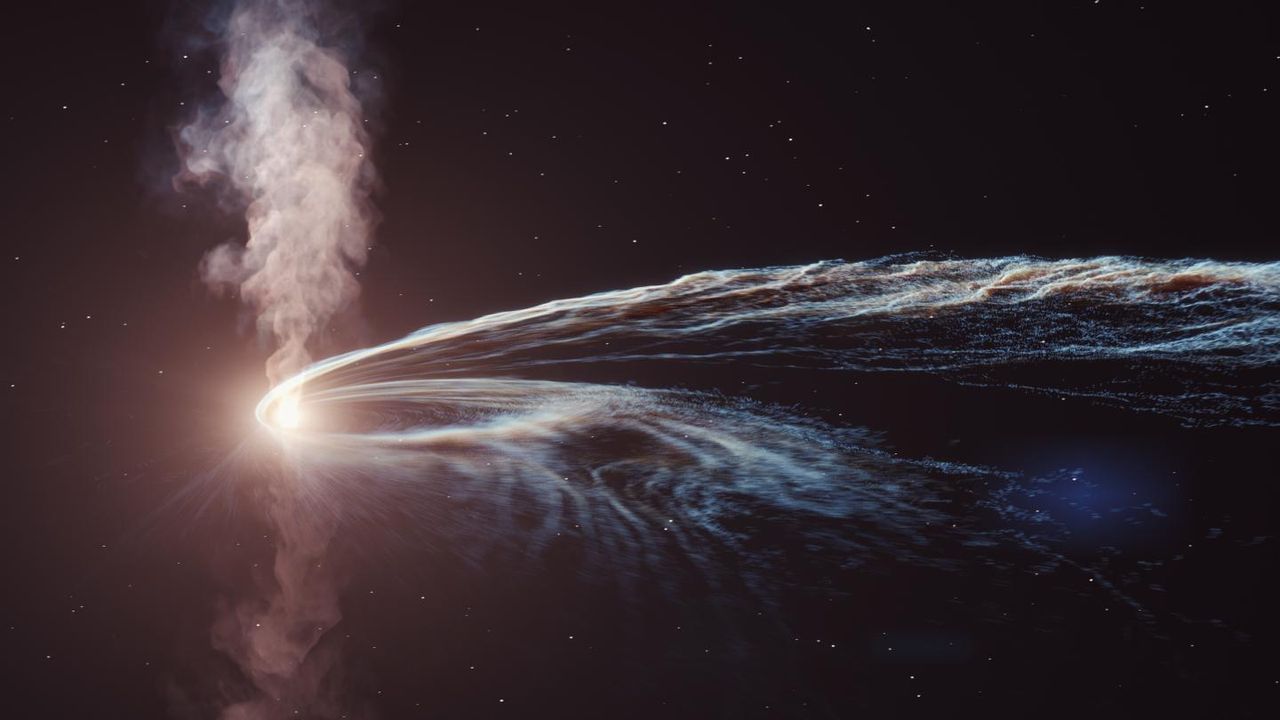
A jet from a supermassive black hole is getting more energetic with time, and is now believed to be one of the most energetic objects in the universe.
The jet — nicknamed "Jetty McJetface" — is emanating from a black hole that was previously studied in 2022, after it picked up a star and began shredding it to pieces, releasing the jet in the process. Now, some four years later, that bout of "cosmic indigestion" is still going strong, researchers said.

"This is really unusual," Yvette Cendes, an astrophysicist at the University of Oregon who led the study published Feb. 5 in the Astrophysical Journal, said in a statement. "I'd be hard-pressed to think of anything rising like this over such a long period of time."
Many such star-shredding events have been spotted before, when a star gets too close to the gravitational field to a black hole and is violently torn apart in a process called "spaghettification." But such energy from spaghettification has never been seen before, Cendes said.
Cendes has a long affiliation with the black hole, formally known as AT2018hyz. (Her nickname for it, Jetty McJetface, is a pun on the British research vessel Boaty McBoatface, whose name was chosen by a viral Internet poll about 10 years ago.)
Cendes and her colleagues discovered the black hole in 2018, before publishing a paper in 2022 on the black hole's star-shredding behavior. Analysis of the radio waves blasting out of Jetty reveal that he black hole is roughly 50 times brighter than it was in 2019, emitting at least a trillion times the equivalent energy of the fictional Death Star of the "Star Wars" universe, according to the researchers.
New predictions suggest that the radio waves coming from the black hole will keep rising exponentially before peaking sometime in 2027.
Also, the team suggests the spaghettified star's radiation is blasting away from the black hole in a single direction, and likely not aimed at Earth. That may explain why the star wasn't seen near the black hole at first glance. But the team says more data will be required to verify that theory.