
All this week (19 – 28 June) the St Magnus Festival, held in Kirkwall and Stromness in Orkney, has been celebrating its 50th anniversary. It was founded as a result of the composer Peter Maxwell Davies, later the Master of the Queen's Music, moving to the islands and forming a creative partnership with the Orcadian poet George Mackay Brown. The result was a series of works examining Orkney's narrative and musical heritage in very 20th century language.
In the half century since, the festival has had several artistic directors but it has stayed true to its roots, covering music vaguely within the 'classical' genre with an emphasis on Scotland and the Nordic countries, as well as contemporary composers and a good dose of the repertoire that audiences in Orkney would not hear during the rest of the year.

I attended three early days of this year's festival, arriving on the ferry from the Scottish mainland on Saturday (20 June), disembarking in Stromness in time for the early afternoon concert in the Town Hall. It was the sort of event that characterises the festival's spirit of innovation by offering music few in its audience will find familiar. In this case Lucine Musaelian sang traditional Armenian and early 17th century Italian music, accompanying herself on the viola da gamba. She has a natural and gorgeously accurate soprano voice, untainted by operatic convention, with a improvisatory sense in everything she sings, as if she is the singer-songwriter from the earlier age. The result is breathtakingly beautiful.
The festival, guided these days by another composer, Alistair Nicholson, is refreshingly unconventional – so the weekend's evening concerts turned expectations on their heads. Mozart's Requiem was performed in the breeze block auction hall of Kirkwall's livestock market, next to where the vast cruise ships dock, while St Magnus Cathedral was filled for a programme of American and New Zealand percussion works. It is a tribute to the open-mindedness of the festival audiences that both were sell-outs.
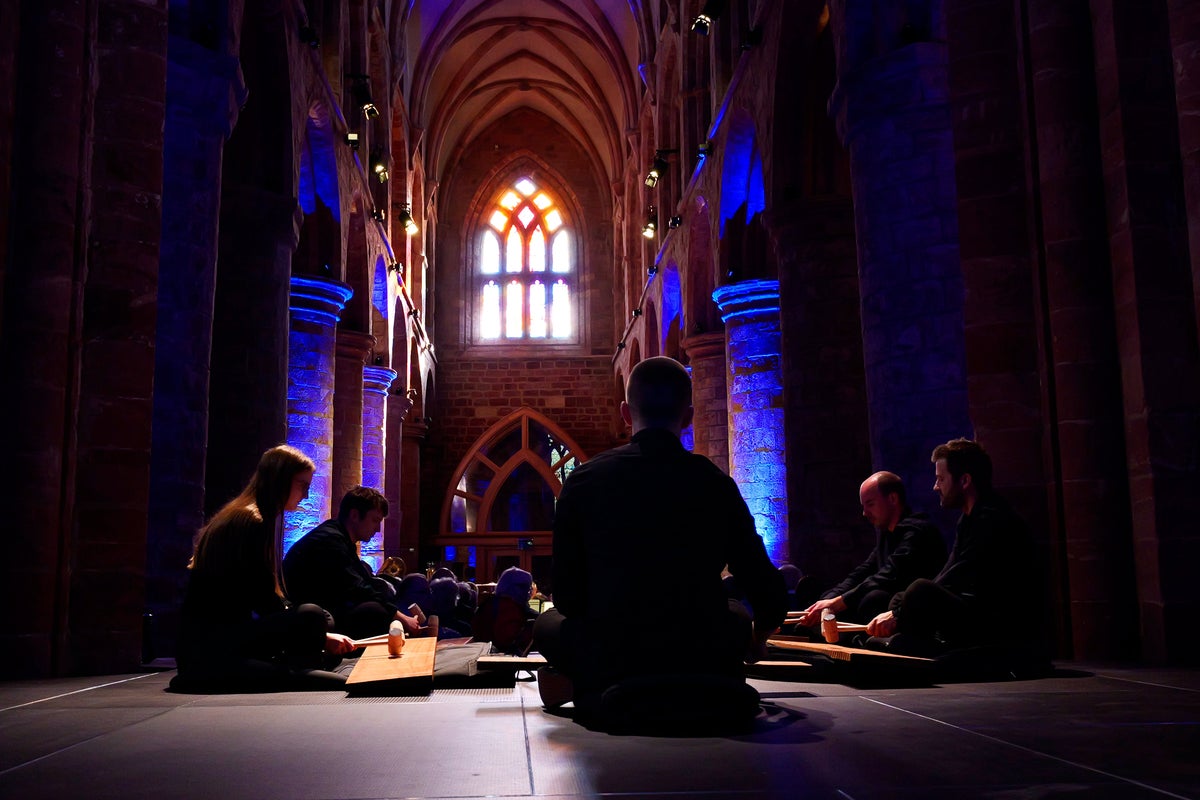
In the Romanesque nave of Kirkwall's red sandstone cathedral, percussionists from the Royal Birmingham Conservatoire, led by O Duo (Owen Gunnell and Toby Kearney) gave us pieces that utilised just about every object that can be hit. The surprise though, was that this was a remarkably quiet and lyrical concert, not the cathedral-jarring occasion one might have feared, except in George Crumb's setting of spirituals when the walls of Jericho came tumbling down. Instead contemplative works by the New Zealand composers Gemma Peacocke and John Psathas were either side of Steve Reich's Music for Pieces of Wood, struck in minimalist progression up where the choir would normally sit. Crumb's A Journey Beyond Time, exploring nine spirituals starting with Swing Low, Sweet Chariot and ending with Sometimes I Feel Like A Motherless Child, sensitively phrased by soprano Susanna Fairbairn, felt symphonic in comparison.
Fairbairn changed styles radically for the Mozart Requiem the following night. The venue for this was a challenge for everyone but a generally successful one. Kirkwall's livestock auction hall (though not the auction ring where the cattle are sold) just about had enough room for several hundred listeners, a large chamber orchestra and a hundred plus strong choir, but it was a squeeze and oxygen was sparse by the end. Charles Peebles conducted his forces elegantly and with no hint that this was not Edinburgh's Usher Hall and the choir, drawn from all over the islands, took Mozart's far from easy parts in their stride.
One of the great strengths of the festival is its imaginative programming. The first half of Samson Tsoy's Sunday afternoon recital in Stromness framed Busoni's arrangements of Brahms and Bach between short expressive pieces by Gyorgi Kurtag in one seamless flow. Though there were moments when Tsoy muddied the textures by being too fond of the sustaining pedal, it was mesmerising. The following morning in the same Town Hall, so was the cellist Geirthrudhur Gudhmundsdottir in Bach's Second Suite and her father, Gudhmund Hafsteinsson's immense solo work, Spuni (Spinning) 1.
Gudhmundsdottir was playing on her uncle's cello, for whom it was written 10 years before she was born. It was one of several works in the festival dealing with mental turmoil, resolved or not. These included the session with the popular woman versifier in Scots, Len Perrie, and Gemma Peacocke's percussion work Death Wish. There was balm of sorts back in the cathedral on Monday afternoon, with 15 of Chopin's Nocturnes played by Pavel Kolesnikov. He has an iridescent touch on the piano, made all the more effective by the extraordinary clarity of the cathedral acoustics, unlike so many big churches resonant without an echo.
The festival continues just as imaginatively until Sunday night. It is midsummer and in Orkney that means night barely arrives before it is banished. With the weather warm but not boiling (like in the south) having a few drinks and ice creams out by the water between passages of great music from all ages is as good a way to celebrate a solstice as any. If readers will forgive the awful pun, a Midsummer Night's Dram.







