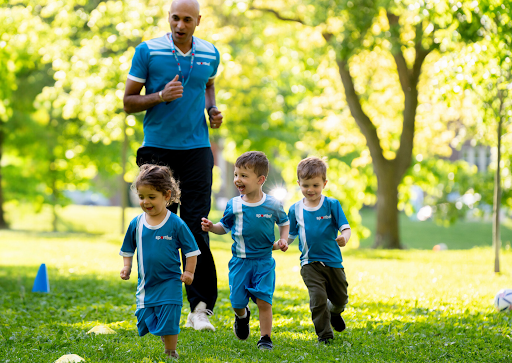
Playing sports can often be the first transformative moment a child experiences, and Sportball is one player elevating that stepping stone for children globally. By treating early physical literacy as the foundation for strengthening sports acumen and lifelong health, the company redefines how children experience movement. Emboldened by its multi-sport model, Sportball gives young kids the space to explore various sports without lingering pressure or comparison, allowing confidence, coordination, and creativity to grow alongside their athletic capabilities.
The program is centered around an integral objective: introducing sports in a way that strengthens both physical development and emotional resilience. "We're often the first touchpoint outside of a child's home and school where they engage with sports," says Jason D'Rocha, Vice President of Sportball. "This is where we create their foundational building blocks with intentionally designed programs that never lose the fun."
The idea took shape when a couple brought a multi-sport concept from South Africa to Canada and reshaped it for a North American audience. "It all started in a small room in a church basement," D'Rocha recalls. "They wanted to approach daycare centers and summer camps with the idea of introducing sports in a developmentally appropriate way that's fun and creative, and give kids a new sport every week so they could learn the basics without feeling intimidated."
That idea became the backbone of Sportball's methodology. Each session breaks down skills into simple, functional movements, driven by engaging storylines and visual demonstration. "We are taking sports skills and turning them into basic building blocks a child can immediately recognize," D'Rocha notes. "'Look at the ball,' 'run and kick,' 'stop and turn,' those keywords help them believe they can do it, even before they've learned how to speak." This early success, he believes, can translate into early confidence, which becomes the entry point to independence.
Sportball's multi-sport integration remains the key that informs its goal of promoting diverse athleticism. "Each sport has its own movement patterns, and we integrate all of them," says Laura Peever, Head of Marketing at Sportball. "When kids learn multiple sports, their brains and bodies can build far more neural and muscular connections." Peever highlights that these varied movements can improve balance, agility, and reaction skills while reducing the strain that often comes with single-sport specialization. Its changing weekly format is further aimed at fueling engagement and excitement. As D'Rocha puts it, "Contrast creates attention. When the sport changes, imagination, creativity, and passion will follow."
As children experience a variety of new sports in a single season, Sportball offers them the autonomy to explore their passion for the sport of their liking. "We don't believe in sports specialization before the age of 12, and the data support this," Peever shares. "When they learn a new sport every week, they can have experiences that speak to their heart, which can encourage them to follow that path and eventually reap the personal and social benefits that a sport brings."

Coaching sits at the center of how Sportball maintains its standards across locations. The company invests in a full certification pathway that moves coaches from entry-level to expert instructors capable of leading new markets. D'Rocha emphasizes the impact of this system. He says, "A lot of our coaches start part-time, continue full-time, and some end up owning a franchise. We're teaching them how to be effective leaders and role models and mentor others as a master-level coach."
Every session at Sportball begins with a defined learning outcome, a practice D'Rocha describes as coaching with purpose. Every activity holds a deeper meaning, from greeting parents at the door to telling children to place colorful balls in a basket. "Our job is twofold," D'Rocha notes. "One is to coach with purpose in a way that delivers a skill with a specific learning outcome, and the other is to articulate what that learning outcome is to caregivers." Parents are encouraged to understand these outcomes, creating a trusted partnership between coaches and families.
The programs themselves move in an intentional developmental sequence. Sixteen-month-olds join the junior program, where puppets, songs, and simple demonstrations help them interpret actions they cannot yet articulate. Parent and child classes build familiarity and independence. Between the ages of three to 12, children participate in drop-off programs, learning social development, fundamentals of sports, emotional regulation, teamwork, and leadership through carefully structured activities. "We start with the ABCs of sports, then FUNdamentals, then team play, and culminate in giving kids the skills they need to become a leader on and off the field. By the time they are older, many can assist coaches and guide younger kids," D'Rocha says.
While multi-sport is the core offering, Sportball locations also run seasonal single-sport programs including soccer, basketball, and T-ball. Markets with unique sports cultures integrate additions like cricket or lacrosse. This adaptability allows the program to feel local, relevant, and community-rooted.
Franchising has allowed the organization to expand while preserving quality. Sportball awards franchises based on mission alignment, not simple availability. "We're not selling a product. We're choosing people who believe in active living and community impact," D'Rocha says. Peever highlights that the company looks for owners who see Sportball as long-term work rather than a short-term venture. A high-trust culture supports this philosophy, strengthened by centralized tools such as Sportball Central, its online registration portal, and a unified global training platform that standardizes coaching across continents.
Sportball's multi-sport model shows that youth sports can be inclusive, imaginative, and developmentally rich without losing structure. In a world where many children face digital overload and declining physical activity, Sportball offers a solution rooted in joy, consistency, and purposeful play.