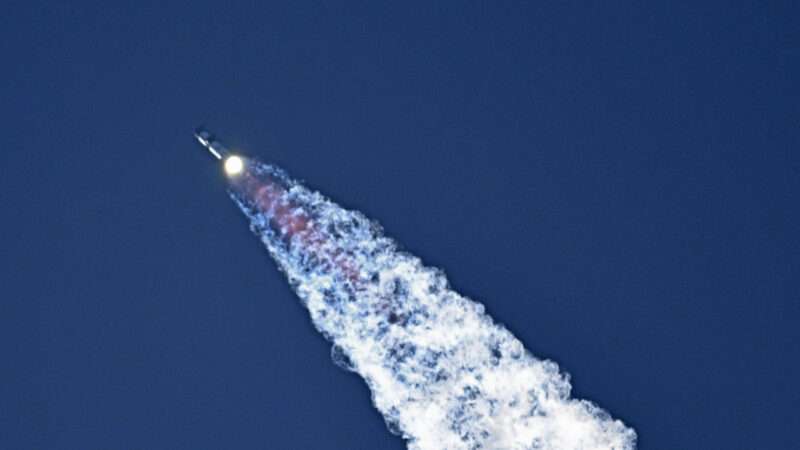
On Saturday morning, SpaceX conducted its second test launch of Starship, the super heavy–lift rocket that could one day carry astronauts to the moon and Mars. The vehicle lifted off without incident from SpaceX's Starbase, on the southern tip of Texas, just after 7 a.m. local time. A new water-deluge system deflected the heat of the booster's 33 Raptor engines, preventing the kind of launchpad damage that occurred during the first launch last April—that test ended in self-detonation four minutes into flight, when the ship and the booster failed to separate. For the second run, SpaceX converted the rocket to a "hot staging" system, with the ship's six Raptor engines starting to fire, blasting the top of the booster, as the separation process began. This time, the uncoupling was successful. The booster broke apart shortly thereafter. The second stage carried on another five minutes, rising 90 miles skyward before exploding.
More than twice as powerful as the Apollo program's Saturn V—and designed to be reusable to boot—Starship is already a marvel of human planning and perseverance. But many more launches must occur before it can carry humans into space. It will be a challenge to establish that Starship is reliable, that it can refuel in orbit (a key part of the plan), and that it can safely land on, and take off from, the moon.