Get all your news in one place.
100's of premium titles.
One app.
Start reading
Kiplinger
Kiplinger
Business
Karee Venema

SpaceX IPO: Updates and Commentary

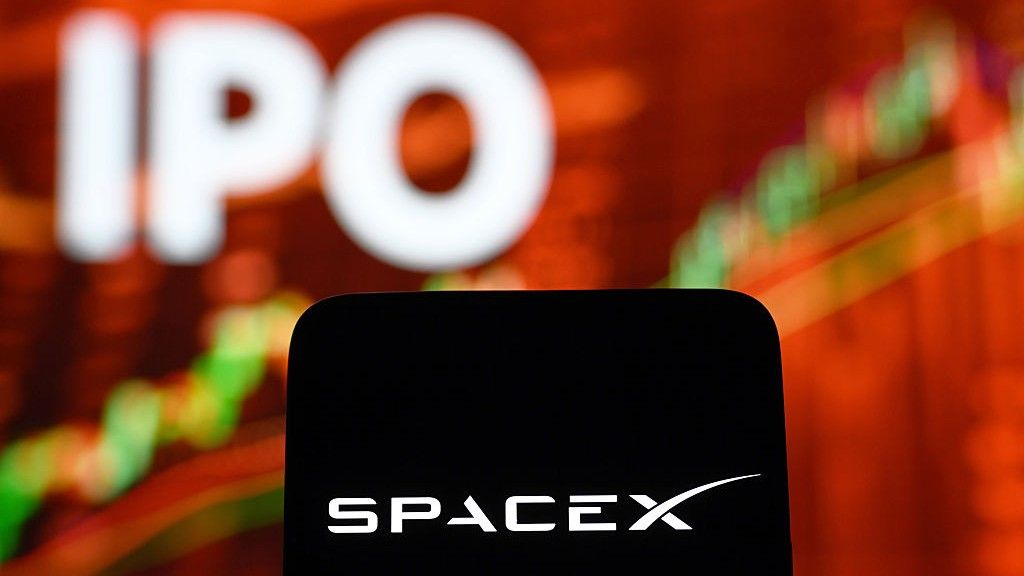
SpaceX logo on a smartphone with a blurred stock chart and the word "IPO" in the background for SpaceX IPO.

The market for initial public offerings (IPOs) has struggled to see the same enthusiasm it had in 2021, when 397 offerings raised $142.4 billion in proceeds. While 2026 has gotten off to a slow start — 71 IPOs have raised $35.7 billion — a string of highly anticipated offerings is signaling renewed excitement for IPOs.

First up was the SpaceX IPO, Elon Musk's space and exploration company going public in the largest offering ever and SPCX stock now trading on the Nasdaq.

The Kiplinger team is reported on the SpaceX IPO, bringing you the news and our expert analysis of what this means for the stock market, the economy and your money. Scroll for the updates.

Should You Buy SPCX Stock? | Hot Upcoming IPOs to Watch | The Space Sector Prepares to Blast Off

What is SpaceX?

Elon Musk founded SpaceX in 2002, intending to lower costs for space launches and eventually build a livable colony on Mars. The company had its first successful space launch in 2008 and has since had more than 650 total launches. It also wants to build data centers in space.

"A key to its success has been a relentless focus on innovation," writes Kiplinger contributor Tom Taulli in his feature on the hottest upcoming IPOs to watch for. "The company's breakthroughs include reusable orbital rockets, which have greatly reduced the costs of space flights; vertical rocket landings; and onboard autonomous systems."

In 2015, SpaceX moved to diversify its revenue stream with Starlink, a satellite internet project that today provides coverage to roughly 10 million customers across 160 countries and territories. It also has contracts with the U.S. Department of Defense to provide satellite service through its Starshield segment to government and military organizations, including with Ukraine during its war with Russia.

Geopolitical conflicts are increasing the demand for satellites, and the conflict in the Middle East shows "how space tech is crucial for missile warning and tracking, communications, surveillance, drone and vehicle connectivity, and more," writes John Miley, senior associate editor at The Kiplinger Letter.

SpaceX also bought xAI, Musk's artificial intelligence (AI) company that owns X (formerly Twitter), in February 2026 in an all-stock deal valued at roughly $250 billion. In May, Musk announced that xAI is fully absorbed by SpaceX and will rebrand as SpaceXAI.

According to its S-1 filing, which became publicly available on May 20, SpaceX had revenue of $4.7 billion in the three months ended March 31. It also incurred a loss from operations of $1.9 billion and had adjusted EBITDA (earnings before interest, taxes, depreciation and amortization) of $1.1 billion.

In 2025, the company's revenue totaled $18.67 billion, while adjusted EBITDA arrived at $6.58 billion.

SpaceX is poised to benefit from surging growth in the global space economy, which is expected to reach $1 trillion by 2034, according to Novaspace, up from $626 billion in 2025. "The U.S., led by SpaceX launching 85% of spacecraft into orbit and its Starlink Internet service, reaps most of the business," says Miley.

- Karee Venema

Space is hard

One thing I've heard over and over again from space analysts, investors and executives: "Space is hard."

The industry mantra may seem like a tired cliché or even an excuse for mishaps and bad business decisions, but it's true. The incredibly capital-intensive industry requires extraordinary feats of engineering and technology. Things can go wrong suddenly, as seen in the recent explosion during a Blue Origin engine test. Funding could dry up as timelines get extended and revenue is slow to appear.

So, when looking at the space sector, keep in mind that delays are common and outright failures happen. Or, to echo another industry cliché, it's literally rocket science.

- John Miley

How to buy the SpaceX IPO

Allocations of IPOs — especially hot ones — typically go to institutions and wealthy investors. This is a way for investment banks and brokerages to reward their best clients. This usually means that allocations for retail investors are small, say 5% to 10% of the number of shares issued.

But with the upcoming SpaceX IPO, the script will be different. The company has set the allocation up to 30%, or about $23 billion in market value.

Here are the brokerages that have been assigned to distribute the shares:

Each firm has its own requirements. Yet there is a general process for retail investors to buy SpaceX shares.

  • Investor questionnaire: You will need to fill out a form that gauges whether you meet the firm's eligibility criteria. This might include an account minimum, investor experience and risk tolerance.
  • Offer: The firm will provide access to SpaceX's prospectus , which is the disclosure document for the IPO. You will then submit an indication of interest or conditional offer — that is, the number of shares you want to buy. This is for a price range. When the IPO is priced, which typically happens the night before the public offering, you will confirm the indication of interest.
  • Allocation: On the day of the IPO, the firm will notify you if you received shares.

Keep in mind that you are not guaranteed to receive shares. If there is substantial demand for the offering, there may not be enough for the retail investors who submitted their indications of interest. Furthermore, each firm will have its own procedures for allocations. For example, if an investor "flipped" a prior IPO, which is when they sold shares soon after the offering, they may not get an allocation.

Then again, some firms have fairly straightforward approaches. In the case of Robinhood, it's solely based on a random allocation.

- Tom Taulli

What is the SpaceX IPO share price?

On June 3, SpaceX updated its S-1 filing to show that it priced its offering at $135 per share. Based on the roughly 555.6 million Class A shares it is selling, SpaceX will raise $75 billion, easily making it the biggest U.S. IPO ever. Chinese tech conglomerate Alibaba Group Holding (BABA) currently holds that title, having raised $4.6 billion in its March 2021 offering.

Most companies offer a price range for their offering in the week or so leading up to their IPO and then set a final price the night before their stock begins trading on public markets. And SpaceX could change its price later today, but it's widely expected that the $ 135-per-share price set by CEO Elon Musk last week will be the final offer.

There are likely several reasons for this, including Musk's likely desire to take SpaceX public on his terms.

Additionally, there's massive demand for SpaceX shares. According to some estimates, the IPO is 3.3 times oversubscribed, meaning demand for SPCX stock has more than tripled the number of shares available for purchase. This suggests that shares could see a big first-day pop given the supply-demand imbalance.

- Karee Venema

The SpaceX IPO is increasing excitement around the space industry and consolidation could be coming

Similar to the AI industry, there's immense excitement about space, supercharged by SpaceX's IPO. That's led to venture capitalists betting big on a growing number of start-ups.

Generally speaking, there are too many companies, even as the overall global market is poised to grow. Look for a wave of consolidation as things shake out over the next three to five years.

SpaceX's dominance could be a driving force in this trend as it aggressively seeks to control both traditional and new markets. When SpaceX decides to get involved in a particular segment of space, its competitors get nervous.

- John Miley

SpaceX will not be fast-tracked into the S&P 500

Several exchange operators have recently changed their rules to fast-track inclusion for mega-cap IPOs, including SpaceX.

Nasdaq (NDAQ), for instance, unveiled new "fast entry" rules in early May that allows it the ability to accelerate the time frame in which large companies are added to its Nasdaq-100 Index. Previous rules required that a company wait up to a year before being included in the index, but its new requirements lower the eligibility for inclusion to just 15 days.

"That's important for a number of reasons," explains Kiplinger contributor Dan Burrows in his feature on the Nasdaq's new fast entry rules. "For one thing, the delay stops hedge funds from front-running ETF investors. Under the new rules, hedge funds could buy the stock on the day of the IPO, then flip it to passive investors just 15 days later. That's basically a wealth transfer from long-term index investors to fast-money pros."

Additionally, it forces institutional investors to buy SpaceX shares once the company is included in the indices their index funds track.

But one index that SpaceX will not be allowed fast entry to is the S&P 500. "Based on S&P DJI's Index Committee review of the markets and after consideration of responses received from a wide range of market participants, no changes will be made to the eligibility criteria including financial viability screens, seasoning period, or minimum IWF, for the S&P 500, S&P MidCap 400, or S&P SmallCap 600 as a result of the S&P Dow Jones Indices consultation on the treatment of MegaCap companies," wrote S&P Dow Jones Indices in a June 4 release. "Accordingly, there will be no changes to existing methodology for this index family."

Specifically, S&P Dow Jones Indices chose to keep several rules in place, including one that requires a company to trade on a major exchange for 12 months before being considered for inclusion in an index.

So, while SpaceX shares will likely make their way into several index funds within the next several weeks, they will not be in S&P 500 ETFs for at least the next year.

- Karee Venema

Related content: Invested in Index Funds? Here's What You Need to Know About Mega-Cap IPOs

Just how dominant is SpaceX as a company?

To underscore SpaceX's dominance, consider that it had 165 launches in 2025, vastly more than any other rocket launcher, and launched 85% of global spacecraft into orbit. Its small satellite constellation, Starlink, is by far the leader in
internet speed and customers.

Unlike many space companies of years past, SpaceX is vertically integrated. It makes its own satellites, antennas, rockets, engines and all sorts of other equipment. It will build its own AI satellites, and plans to even start making its own computer chips through a partnership with Intel (INTC). Controlling all aspects of the business gives it an ongoing edge.

Perhaps an underappreciated competitive threat to SpaceX's Starlink is Amazon's (AMZN) upcoming Leo broadband service. I've tracked Amazon's planned mega-constellation over the years, and my impression is that they are very serious about winning consumers, businesses and governments.

Amazon has deep pockets and is touting how its Leo broadband service will integrate with its AWS cloud computing business. It could even offer discounted broadband for Amazon Prime subscribers.

Of course, Amazon must rely on outside rocket companies, including SpaceX, to get thousands of its satellites into orbit.

Blue Origin, which is owned by Amazon founder Jeff Bezos, could help if it starts launching a lot more in the coming years.

But Blue Origin only had two launches last year, failed to put AST SpaceMobile's satellite into orbit in April and had a massive launchpad disaster last month.

– John Miley

What Renaissance Capital's Avery Marquez is expecting from the SpaceX IPO

Few IPOs arrive with the level of anticipation surrounding SpaceX. The company's scale, brand power, retail investor interest and unusual deal structure have already made it one of the most talked-about offerings in recent memory. But the IPO also comes with significant complexity, from expected volatility and staged lockup releases to the possibility of fast-tracked index inclusion.

For perspective on what this could mean for investors and the broader IPO market, I spoke with Avery Marquez, director of Investment Strategies at Renaissance Capital, a provider of pre-IPO research and IPO-focused ETFs.

Your thoughts on the prospects for the IPO?

It's hard to contest the general consensus that this will be a hot deal. Forgoing the typical range for a set price is a solid indicator that the deal is already covered, or at least that the company and underwriters are confident in the massive demand this is expected to generate.

Early trading will likely be very volatile, especially with such a large portion expected to go to retail. I've seen reports still indicating up to 30%. I believe the extensive lockup release schedule and "forced buying" by indexes fast-tracking inclusion will also lend to some interesting trading dynamics in the first few weeks and months.

How does this compare to other large IPOs?

I'm partial to say that there is no real comparison. You can look at something like Saudi Aramco, which is the closest example in size, but the dynamics were quite different, given the government involvement and the market's relative opacity (though worth noting that the Tadawul is more transparent now than back in 2019).

In the U.S., Facebook — now Meta Platforms (META) — may be worth comparing, given the size, governance structure and disruptive tech pitch. But the months of hype leading up to the IPO, the intricacies of SpaceX's business, the sheer number of moving parts make this a wholly unusual deal.

What about the lock-up? Implications?

SpaceX's lockup is one of the most complex I've ever seen. Given the float dynamics, it could be framed as a bid to control that potential flow, or maybe it's just a way to give early investors liquidity before the standard 180 days. I do wonder how much overlap there will be between the release schedule and the schedule of indices that will now be fast-tracking inclusion.

How important is this IPO? What might it mean for the expected IPOs of OpenAI and Anthropic?

It's difficult to point to this as a bellwether for broader IPO activity, given how unusual the deal is. It will be a test of demand at scale, however, which will be particularly important for OpenAI and Anthropic, given how much capital they are expected to raise at IPO. Overall, it's going to be a historic test for the IPO market and will show us how much hype or FOMO is being baked into these high-profile names right now.

- Tom Taulli

Blue Origin explosion highlights the challenges facing a heavy launch

As SpaceX moves from the reusable Falcon 9 to the much bigger Starship, it's worth noting the unique challenges of heavy launchers. Starship is nearly 400 feet tall, while Falcon 9 is 230 feet tall. Starship can lift far heavier payloads, but that requires more powerful engines.

The challenge of a heavy launch was on display during the recent Blue Origin explosion. Its New Glenn rocket is also a heavy launcher. After the incident, NASA Administrator Jared Isaacman said on X, "Spaceflight is unforgiving and developing new heavy-lift launch capability is extraordinarily difficult."

In May, Elon Musk said on X that he was confident about Starship's road to commercialization: "The Starship production pipeline is full and will complete roughly 10 more ships and about half that number of boosters this year, so, if something goes wrong, it will not be a major setback, unless the launch stand is destroyed."

Back in 2020, Musk already had a clear view of Starship's importance, saying it "needs to be reusable and rapidly so, designed to be relaunched an hour after landing with zero nominal work."

- John Miley

Elon Musk reveals space's first space-based AI data center

In a video posted on X, Elon Musk talked about his vision for space-based AI data centers. The first one is called the AI1 satellite, which is expected to be 230 feet long and provide 120 kilowatts of compute power.

The AI1 satellite is based on the core foundation of the Starlink V3 system. According to Musk: "The AI satellite is much simpler than a Starlink satellite. The AI satellite is essentially a lot of solar cells, you still need some laser links, but you don't have all of the super complex antennas that you have on a Starlink satellite. The easier one to design for is the AI satellite."

The AI1 satellite is also expected to include Nvidia (NVDA) GPUs to power the AI processing.

In terms of timing, SpaceX expects to launch demonstration versions of the system in late 2027. So it could easily be a few years until the company generates any revenue from this program.

And Musk has a tendency to overpromise.

Still, space-based data centers are likely to gin up lots of excitement for investors. Land-based systems consume enormous amounts of power and are increasingly running into backlash from communities concerned about electricity demand, water usage, noise and local infrastructure strain. But in space, a data center could tap solar power directly and avoid many of these earthly constraints.

- Tom Taulli

SpaceX's big bets won't come in a hurry

The entire space ecosystem hinges on the success of Starship driving down launch costs. Some space business ideas only pencil out if launch costs are lowered to a certain point.

SpaceX has dreams of launching Starships daily or even hourly to send 1 million AI data centers into space. But how much it costs SpaceX to launch Starship and the price it charges outside customers are different. It may use most or all of Starship's capacity on its own orbital data centers.

While SpaceX has drastically lowered launch costs with its reusable Falcon 9, it's not passing all those savings over to customers, since it controls the market. Still, it does continue to have good relationships with all its customers.

Other launchers include Rocket Lab, Arianespace, United Launch Alliance and Firefly Aerospace. Rocket Lab ranked second globally in commercial launches last year with 18.

SpaceX takes the long view and dreams big. I often remind readers that SpaceX is 24 years old. Starlink was announced in 2015, and the first satellites were launched in 2019. It took a long time for SpaceX to get to this point.

When you look over SpaceX's prospectus and investor presentation, you see plans that could take years or decades to happen, including a mission to Mars. SpaceX will keep betting big on missions that will take a long time to pan out, using money from today's successes to fund tomorrow's dreams. Such a strategy carries inherent risk.

Consider that Musk has said, "The whole purpose of SpaceX is to help make life multiplanetary."

- John Miley

Hyperliquid SpaceX perpetual futures signal a big premium to IPO price

Perpetual futures on Hyperliquid, a decentralized blockchain-based trading platform, showed SpaceX shares trading around $168 at last check — a nearly 25% premium to the $135 IPO price. Still, that's down more than 6% from where the SpaceX "perp" was trading a month ago.

Hyperliquid has become a place for traders to speculate on assets such as cryptocurrency and commodities without actually owning them.

"Perpetuals never expire and users can hold positions indefinitely," explains BofA Securities analyst Julie Hoover. "Because there is no maturity, venues employ a funding-rate mechanism to keep perp prices anchored to the spot price. Volume on perps has tripled from ~$30T in 2023 to ~$93T in 2025."

According to BofA, Hyperliquid, in particular, has become popular for its pre-IPO pricing markets. "Like prediction markets gained popularity for calling the U.S. Presidential election, people argue that Hyperliquid is having their moment for accurately predicting IPOs."

If Hyperliquid's pre-IPO pricing of SpaceX perps is accurate, shares could be poised for a big jump when they first start trading.

- Karee Venema

SpaceX's unconventional IPO pricing

Elon Musk has always had a penchant for being unconventional. It has certainly been key to his many successes and his enormous wealth. So it should be no surprise that the SpaceX IPO has taken a different path from the traditional Wall Street playbook.

In a typical IPO, the company and its underwriters set an initial price range, conduct a roadshow, collect orders from investors and then determine the final price based on demand. This process is called "book building." It's a way to gauge investor demand. If the demand is strong, the company will set the deal at a higher price and vice versa.

The SpaceX IPO, on the other hand, has used a fixed price approach. According to Reuters, SpaceX set the IPO price at $135 per share, with plans to sell 555.6 million shares and raise about $75 billion. This would value the company at roughly $1.77 trillion.

The valuation was likely based on SpaceX's own internal assessment of the business and its long-term opportunities. But this was not just about traditional metrics such as revenue, earnings or comparable companies. A big part of the valuation was probably the "Musk factor." He has a long track record of making money for investors, and he has built a large base of loyal retail followers.

Still, the approach carries risks. The IPO is massive, the valuation is aggressive and the markets have been volatile lately. Even for a company like SpaceX, that makes the debut far from risk-free.

- Tom Taulli

The economics of AI data centers

Orbital data centers are unproven, though some companies have already launched prototypes. The economics of AI data centers in space is a big question mark. Can they really compete with terrestrial data centers? SpaceX certainly thinks so.

Consider the vast scale Elon Musk is talking about. Nearly 2,200 tons were launched into orbit in 2024. During a presentation this year, Musk talked about launching 10 million tons into orbit per year to put a terawatt of compute into space yearly.

Sound impossible? Musk's response: "We're confident this is feasible. No new physics or impossible things are required to get there."

Musk also envisions humanoid robots manufacturing satellites on the moon and then using electromagnetic mass driving to send them into orbit. Pursuing these ventures will be enormously expensive.

- John Miley

SpaceX confirms IPO pricing

Shortly before the close on Thursday, SpaceX set its final pricing for its initial public offering, confirming (PDF) that it will sell 5.6 million shares at $135 apiece.

The company also said that it will grant its underwriters a 30-day option to buy up to 83.3 million additional shares of its Class A common stock.

At $135 per share, SpaceX is poised to raise $75 billion in its offering, which will make it the largest IPO ever, easily exceeding the current record holder — Alibaba Group Holding (BABA) and its $21.8 billion offering in 2014. It will also give the company a $1.75 trillion valuation, making it the seventh-largest U.S. company by market cap and just ahead of Musk's other public company, Tesla (TSLA).

- Karee Venema

Stocks close higher ahead of SpaceX's market debut

Stocks closed higher Thursday after President Donald Trump walked back a threat to strike Iran "VERY HARD" on Thursday night and take "total control" of its oil and gas assets.

"Based on the fact that discussions with the Islamic Republic of Iran have been brought to the highest level of Iranian leadership and approved," Trump posted on Truth Social, "I have, as President of the United States of America, cancelled the scheduled strikes and bombings against Iran this evening."

A rebound in chip stocks also helped the broader markets bounce back from early week losses, though AI stock Oracle (ORCL) tumbled sharply after its earnings report on cost concerns.

By the closing bell, the blue-chip Dow Jones Industrial Average was up 1.9% at 50,848, the broad-based S&P 500 was higher by 1.8% at 7,394, and the tech-heavy Nasdaq Composite had added 2.5% at 25,809.

That's it from us today. Join us tomorrow for more updates and insight into the SpaceX IPO.

Stock futures point mostly higher on SpaceX day

The main equity indexes are trading mostly higher ahead of SpaceX's (SPCX) market debut.

At last check, futures on the blue-chip Dow Jones Industrial Average are up 0.3% and the broader S&P 500 are 0.1% higher. Futures on the Nasdaq-100 are down 0.3% lower, though, as Adobe (ADBE) slumps after earnings.

SpaceX gets mixed reviews from Wall Street

One reason there have been few analyst reports on the SpaceX IPO is that the company hired 23 banks for the offering. Keep in mind that they are under strict conflict-of-interest rules and must endure a 25-day quiet period.

But this week, several interesting reports from analysts surfaced that were not part of the IPO syndicate. On the bullish side, New Street Research set a $165 price target on SpaceX shares, representing a 22% premium to the IPO price. This is based on a $195 billion revenue projection for 2030.

Additionally, Oppenheimer initiated coverage on SPCX stock with a Buy rating. The price target: $190.

But Morningstar published a report that was quite bearish. Analyst Nicolas Owens puts the valuation on SpaceX at only $63 per share, or a 53% discount to the IPO price.

"Our valuation is the result of mathematics more than skepticism," says Owens. "With such a wide range of possible outcomes for the company's financial future, we created forecasts and valuations for three scenarios and probability-weighted them."

- Tom Taulli

What time will SpaceX stock start trading?

SpaceX stock will likely start trading on the Nasdaq this afternoon. New stocks typically make their market debut after lunchtime, so look for shares to open for trading around 1 pm to 2 pm Eastern Standard Time.

SpaceX IPO will boost funding and attention to space stocks, but investors must be aware of risks

Related to Elon's vision of a Mars mission and taking the long view, here's a quote I have in my notes from a keynote I attended at the 2020 satellite conference in Washington, D.C.: "I hope I'm not dead by the time people come to Mars. If we don't improve our pace of progress, I'm definitely going to be dead before we go to Mars. If it's taken us 18 years to get people to orbit, we have to improve our pace of innovation a lot."

With a huge amount of funding from the IPO, there's no doubt the intense focus on pushing the "pace of progress" will only accelerate.

As I wrote in April, SpaceX's stock listing will bring a new wave of capital to the entire sector, including from a flood of retail investors. Investors in the space sector are bullish about SpaceX's unprecedented stock listing.

The IPO is an "inflection point" for the space industry, said Michael Mealling, general partner at Starbridge Venture Capital, at SatShow. Mark Boggett, CEO of Seraphim Space, said it will pull up valuations across the entire sector.

The heightened attention means that more Wall Street analysts will start covering the sector as space companies are included in more stock funds and more space companies go public.

Investors should know that space stocks can be risky, requiring due diligence, and that the frenzy among investors could outpace the reality of individual businesses.

"I am a little concerned about public market investors looking at the space sector and not understanding the level of risk," said Mealling. "Not every company that goes public is a good company." Mealling also said that having lived through the dot-com bubble of the late 1990s, "I hope we don't replicate that."

- John Miley

Neuberger Berman's Daniel Hanson on why SpaceX fits a quality equity strategy

Daniel Hanson, manager of the $2.1 billion Neuberger Berman Quality Equity Fund (NBSLX), has delivered strong results, with the fund generating an average annual return of 24.2% over the past three years. One of the more distinctive parts of the portfolio has been its pre-IPO investment in SpaceX.

I had a chance to interview Daniel and here's what he had to say:

When did you start buying SpaceX? What were the factors for making the investment? What is the current allocation?

We established the NBSLX position in SpaceX in the second half of 2023 at a company valuation of $150 billion, based on SpaceX's alignment with the Quality Equity investment philosophy. I look for 3 criteria for any Quality Equity investment, all of which SpaceX is aligned with: strong profitable growth, an entrepreneurial management team and an ownership culture. It also has a clear business purpose. The NBSLX fund's pre-IPO private allocation was approximately 7%.

What's your bullish case for the next few years? Drivers?

SpaceX comprises three distinct leadership mega-cap businesses, each of which has a promising growth outlook.

First is the launch business, where SpaceX has an unmatched global lead with the Falcon 9, and exceptional upside with the Starship program.

Second is the Starlink business, currently with 11 million subscribers and rapid growth prospects to add tens of millions of incremental subscribers.

Third is the xAI business, which has both leading proprietary initiatives, including 500 million+ monthly active users on Grok and X.com, with highly profitable third-party data center compute contracts with the likes of Anthropic and Alphabet (GOOGL). There is also its market-leading ambitions to commercialize orbital data centers in the coming years.

Besides SpaceX, does your firm have any other private investments?

Yes, Neuberger has a large private equity business.

The Neuberger Berman Quality Equity Fund was the only direct private pre-IPO owner of SpaceX at Neuberger due to the strong track record of the SpaceX team and the alignment of the business with the Quality Equity investment approach.

- Tom Taulli

How worried should investors be about the "Musk Effect"?

Perpetual futures are indicating a big jump for SpaceX stock when it begins trading this afternoon, last seen trading near $180 — 33% above the IPO price.

Part of this is likely due what many refer to the "Musk Effect. As I told CNET, Elon Musk has the tendency to stoke enthusiasm given the number of extraordinary things he's done, and we're seeing that in the excitement surrounding the SpaceX IPO.

"I don’t think the 'Musk Effect' is some made-up premium ... it's backed by execution over and over again," says David Fetherstonhaugh, senior vice president and investment strategist at VistaShares. "There is something real there."

For SpaceX, specifically, Fetherstonhaugh points to the company's aggressive launch cadence over the past several years. "SpaceX did 25 launches in 2020. Then 31. Then 61. Then 96. Then 134. Then 165 last year. At some point, that is not a cool stat anymore. He is actively pushing the boundaries of multiple industries."

And impressive growth in Starlink revenue, which jumped 50% year over year in 2025, will help fund SpaceX's other initiatives.

Fetherstonhaugh admits that the SpaceX IPO is not cheap, but says that "no other public company that gives you this combination of launch, satellites, connectivity, and full-stack control of space infrastructure." So, if you buy SPCX stock, you're "paying up for execution, speed, and the possibility that the market is much bigger than investors originally thought."

However, buyers should know that the "Musk Effect" goes both ways. Folks were quick to sell Tesla shares and stop buying Tesla cars in early 2025 in part because of a backlash related to Musk's actions and commentary when he was head of the Department of Government Efficiency (DOGE).

As Fetherstonhaugh cautions, "anything tied to Musk is going to come with volatility."

- Karee Venema

Elon Musk's net worth could top $1 trillion today

Elon Musk has long held the title as the richest person in the world, but he cemented that status following SpaceX's blockbuster IPO, which will likely make him the first-ever trillionaire once SPCX stock begins trading, on paper at least.

At last check, Forbes had Elon Musk's net worth at $981.1 billion. We'll check this again at the end of the day.

The energy impact on orbital data centers

I'm still skeptical of orbital data centers technically working in a lot of ways. But the economics is an even bigger question. How the heck do you get the cost equivalent or better than Earth-based data centers?

I wrote a story about why AI dominance is measured by energy, and it's true AI models get better with more data, parameters and compute. That takes massive amounts of energy. There's no real sign that it's slowing, but in a decade, could there be some energy-efficient breakthrough? Or more efficient models? Or demand dies down? Seems possible and that would mess with orbital data center business models. They also require very low launch costs.

I read an interesting article that if Starship launched hourly, it would be a huge pollution issue. Because Starship is so enormous, it requires far bigger engines that create massive amounts of pollution. That's not an issue now with 10-20 heavy launches per year. But if you do 100s of heavy launches? I guess it could be an issue.

- John Miley

SpaceX stock opens above IPO price

SpaceX (SPCX) stock has officially begun trading on the Nasdaq, with shares opening at $150 per share, more than 11% above the IPO price.

At last check, shares were seen near $157 after hitting an intraday high of $162.98 (as of 11:55).

Track all markets on TradingView

SpaceX IPO governance: why Elon Musk's control could become a bigger investor issue

The buzz surrounding the SpaceX IPO has focused mostly on the company's massive valuation, retail investor demand and the potential for one of the largest public offerings in market history. But there has been much less attention on a critical issue for investors: corporate governance.

Alon Kapen, a partner and corporate transactional lawyer at Farrell Fritz P.C., has reviewed SpaceX's S-1 and sees several provisions that stand out. Here's what he had to say:

What are some of the key governance issues?

I'd say the concentration of control is the major governance issue here. SpaceX's governance structure seems designed to ensure that Elon Musk retains authority over the company's strategic direction, even as public shareholders come in.

The mechanism for effectuating this level of control begins with SpaceX's dual-class share structure, in which Musk's Class B shares carry 10 votes each, versus one vote per Class A share sold to the public. The structure results in Musk controlling 85% of SpaceX's voting power despite holding only approximately 42% of its equity.

Also, Musk can only be removed from his roles as CEO, CTO and chairman by a vote of Class B shareholders, which he controls.

Another key governance issue is dispute resolution. SpaceX has adopted a mandatory binding arbitration clause for all shareholder disputes, and I believe it's the first major U.S. company to do so in a public offering. Shareholders must "irrevocably and unconditionally" waive the right to a jury trial and are prohibited from bringing class actions against the company or its directors, officers or controlling shareholders.

Finally, SpaceX reincorporated in 2024 from Delaware to Texas. Texas imposes greater procedural hurdles for initiating tender offers, proxy contests and shareholder proposals, making it more difficult for activists to wage activism campaigns such as removing directors or officers.

How does SpaceX's governance compare to other tech companies?

SpaceX's dual-class capital structure certainly fits within a broader pattern of founder-led companies where insiders retain supermajority control post-IPO. Think Facebook, Snap, Google and Tesla where dual-class shares preserve founder authority beyond an IPO. But unlike SpaceX, at least most of those companies had built in sunset provisions.

Might SpaceX's governance approach influence other companies? Or is this more of a special situation?

I think it's both. SpaceX is obviously a special situation. It has a national security dimension that arguably gives regulators reason to defer to management continuity. That makes it hard to generalize. But it could still reinforce an ongoing trend of founders pushing for dual-class structures and extending control post-IPO.

If SpaceX goes public with aggressive founder control preservation mechanisms and the stock performs well, it will be harder for investors to push back on the next company that tries it.

Ultimately, SpaceX can justify its structure because of its track record and unique positioning with governments. Without those factors, though, companies trying to duplicate their governance model would likely face significant investor pushback.

- Tom Taulli

Why history points to a rough road for SpaceX stock

The SpaceX IPO may be one of the most anticipated public offerings in years. But a recent Truist study offers a cautionary reminder: big-name IPOs often come with severe volatility. The study looked at 30 major IPOs and found that the average maximum drawdown in the first year was 55%. Even more striking, the best case still involved a 20% decline, while the worst fell 90%. While the average 12-month return was positive, the median return was negative.

This could be an ominous sign for early SpaceX investors. The company has enormous promise, but the hype is already intense. That alone can create a valuation that is difficult to sustain once the stock begins trading and investors start scrutinizing the numbers.

SpaceX is also a complicated business. It is not just a rocket company. It includes launch services, Starlink broadband, Starship development, an AI-related segment and even X (the social media platform formerly known as Twitter). Each has different risks, economics, capital needs and timelines. That complexity could make it harder for public investors to value the company, especially if one segment disappoints.

Then there is the lock-up issue. Many early employees, executives and investors are sitting on enormous gains. Once they are allowed to sell, the temptation to unload shares could be strong.

This does not mean SpaceX will fail as a public company. But it does suggest that the first year could be far more volatile than the launch-day excitement implies.

- Tom Taulli

Tesla trades lower as SpaceX stock soars

While SpaceX stock is higher in afternoon trading on Friday, Tesla (TSLA) shares were last seen in negative territory, down 0.2%.

Elon Musk's other publicly traded company has struggled on the price charts in recent months and is down more than 11% for the year to date.

Track all markets on TradingView

But in the longer term, Tesla has been a strong performer. Over the past 15 years, for instance, the consumer discretionary stock has averaged an annual gain of 43%, outperforming the broader S&P 500 by more than 28 percentage points.

And Wall Street is generally upbeat on Tesla's outlook. Of the 47 analysts covering the stock who are tracked by S&P Global Market Intelligence, 23 say it's a Buy or Strong Buy, 18 have it at Hold and six rate it a Sell or Strong Sell. This works out to a consensus Buy recommendation.

Meanwhile, the average 12-month price target of $420.55 represents implied upside of nearly 6% to current levels.

- Karee Venema

SpaceX IPO mints one new trillionaire, thousands of new millionaires

Elon Musk is officially a trillionaire, on paper at least. With SpaceX stock trading near $165 per share at last check, Musk's net worth has swelled to $1.1 trillion, up $88.7 billion from yesterday.

However, Musk isn't the only person who has seen their net worth swell today. According to The New York Times, roughly 4,400 current and former SpaceX employees who held onto their early shares are poised to become millionaires in the aftermath of the blockbuster IPO.

And 400 of those people are expected to see their wealth jump past the $100 million marker.

- Karee Venema

What Wall Street is saying about the SpaceX IPO

There was no shortage of analyst notes released today about the SpaceX IPO. Here's a small sampling of what Wall Street has to say, edited at times for brevity:

"Everyone thinks of SpaceX as a rocket company. Increasingly, that’s the wrong lens. In a matter of months, SpaceX has become the world's largest and most profitable AI neocloud, and over the next year, that business will contribute more profits than launches or satellite internet." - Nicholas Anderson, portfolio manager at Thornburg Investment Management

"It's important to take some of the projections with a grain of salt. Elon has talked about a total addressable market of $28.5 trillion. Interestingly, the majority of that opportunity is tied to what is currently the company's cash incinerator — the AI segment of the business. We're also expecting a merger with Tesla in 2027 or 2028, so it's possible to envision a scenario in which not only the company's market capitalization, but also its revenue growth, becomes exponential. Right now, it's difficult to even quantify the potential scale." - Nancy Tengler, CEO and CIO at Laffer Tengler Investments

"This is not just an IPO — it's a major liquidity event for venture capital, with significant upside potential but elevated valuation, governance, and volatility risks." - Kaush Amin, Managing Director and Head of Private Market Investing at U.S. Bank Asset Management

"We have a negative outlook given dependence on unproven outcomes including Starship commercialization, orbital AI compute, and xAI monetization. While Starlink remains the strongest business, it faces risks from capacity expansion needs, regulatory approvals, and competition from terrestrial broadband and other LEO systems. We believe the market assigns too much value to future optionality and insufficient discount to execution risk." - Keith Snyder, Senior Equity Analyst at CFRA Research

"What's worth watching more closely is what comes after SpaceX. The upcoming IPO pipeline may look like a celebration of the AI boom, but looking at trader sentiment, it could have the makings of a late-cycle rush. As the company dominates commercial launch and Starlink continues to scale, analysts at New Street Research are already projecting 22% upside within 12 months of listing. The risks here aren't necessarily that SpaceX is a bad investment, but that a $1.77T entry point leaves very little margin for error, and that the retail enthusiasm surrounding it could produce the kind of volatility that shakes out investors before things play out in the long-term." - Stephen Callahan, Trading Behavior Analyst at Firstrade

- Karee Venema

SpaceX becomes the sixth largest U.S. company by market cap

At last check, SpaceX stock is trading near $170 per share, giving Elon Musk's space and exploration company a market valuation of $2.22 trillion. This makes SpaceX the sixth-biggest U.S. company by market cap, behind Nvidia (NVDA), Alphabet (GOOGL), Apple (AAPL), Microsoft (MSFT) and Amazon (AMZN).

Tesla (TSLA), Elon Musk's other publicly traded company, is the eighth-largest U.S. company by market cap, with a valuation of $1.51 trillion.

"SpaceX is not your typical mega-cap company," says Matt Britzman, senior equity analyst at Hargreaves Lansdown. "Investors are being asked to underwrite an investment case and product roadmap that stretches well beyond the time horizon for your typical trillion-dollar-club business."

Britzman adds that traditional valuation tools can help frame the debate on a stock, "but they only go so far when so much of the story depends on future breakthroughs, new markets and successful execution across several ambitious areas at once."

As such, he cautions that this creates both opportunity and risk, and "investors would do well to be mindful of both sides of that coin."

- Karee Venema

SpaceX enjoys a peaceful launch

The main equity indexes were mixed this morning, ahead of the debut of Elon Musk's SpaceX as a publicly traded company.

SpaceX (SPCX) started trading at about 11:45 am Eastern Standard Time and immediately popped 11.1% from its $135 offering price to $150. SPCX closed up 19.2% at $160.95, making Elon Musk the world's first trillionaire.

Meanwhile, all three main indexes rallied on firmer word of a potential agreement between the U.S. and Iran that would open the Strait of Hormuz.

By the closing bell, the blue-chip Dow Jones Industrial Average was up 0.7% at 51,202, the broad-based S&P 500 was higher by 0.5% at 7,431, and the tech-heavy Nasdaq Composite had added 0.3% at 25,888.

– David Dittman

Sign up to read this article
Read news from 100's of titles, curated specifically for you.
Already a member? Sign in here
Related Stories
Top stories on inkl right now
One subscription that gives you access to news from hundreds of sites
Already a member? Sign in here
Our Picks
Fourteen days free
Download the app
One app. One membership.
100+ trusted global sources.