Get all your news in one place.
100's of premium titles.
One app.
Start reading
Bangkok Post
Bangkok Post
Comment

South peace talks must stay in local hands

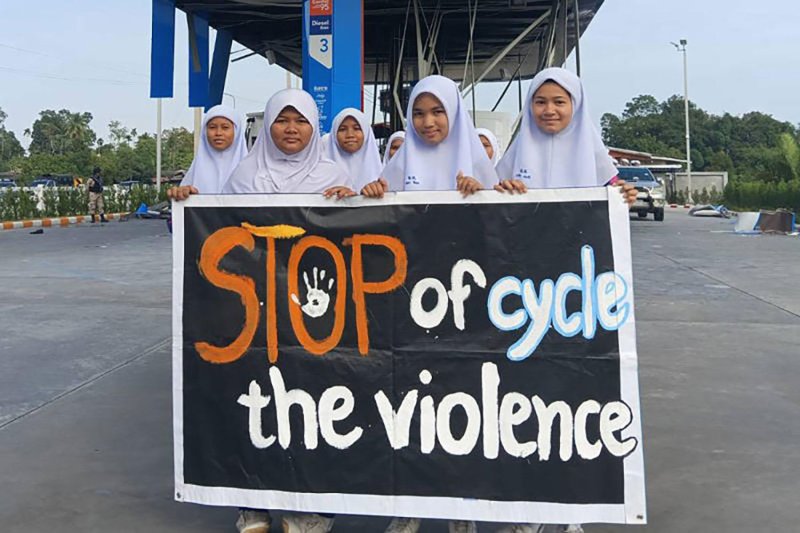
Students take part in a protest on Jan 15 against the outbreak of violence in the deep South, at one of the eleven PTT petrol stations that were targeted by bombers, in Cho Airong district of Narathiwat. (Photo: Waedao Harai)

The Barisan Revolusi Nasional Melayu Patani's (BRN) recent statement, which calls on the international community to be present at peace negotiations to resolve the violence in Thailand's deep South, is simply an unrealistic demand.

It also begs the question of what exactly BRN needs from the "peace" negotiations scheduled for September.

The first question is: Which countries or organisations does BRN want to have representatives participate in this negotiation process? What standards or criteria does BRN use in determining which countries should be allowed to play a role in the talks?

The next question is: Would they be able to offer opinions and recommendations on how to resolve the conflict in the region, or would they serve merely as observers?

The last question is: Would these representatives from the international community truly understand the context and complexities of the conflict better than BRN itself or even the Thai government? Do they actually understand the hopes and concerns of Buddhists and Muslims living in these communities, or even the views of Malaysia, which has long served as the facilitator of the peace negotiations?

In the statement, BRN expressed appreciation to the Malaysian government for its continued role as facilitator of the peace dialogue, as well as for the involvement of the international community, which it said had demonstrated professionalism and active commitment to resolving the prolonged conflict.

In my view, resolving the long-running violence in the far South can only be achieved by the parties directly involved in the conflict themselves. In this case, those parties are the Thai state and BRN, which claims to be the principal party in conflict with the government.

How can we be sure that outside actors do not have their own interests or agendas in becoming involved in efforts to resolve the conflict in the region?

Therefore, BRN should stop portraying the situation as out of control and elevating it into a global issue.

The group expressed hope that broad support from "the Patani community" would help advance the peace process. I strongly agree with this point.

First of all, both BRN and the Thai government need to listen carefully to the voices of local Muslim people living in the area. Both sides should work together not only to end violence but also to improve residents' quality of life and create conditions for lasting peace and prosperity. Sincere peace talks are the path towards joint development and reconciliation.

Peace talks between the Thai government and BRN officially began for the first time in February 2013 under the government of prime minister Yingluck Shinawatra, with Malaysia serving as the facilitator of the dialogue process. During the Yingluck government, Thailand signed an agreement initiating an open peace dialogue with BRN leaders for the first time. Hassan Taib served as the head of the BRN delegation. However, the talks stalled following the coup in Thailand in 2014.

The process was revived through the Thai side's Southern Border Provinces Peace Dialogue Panel, which continued discussions with various stakeholders. In January 2020, Thai negotiators officially met with BRN representatives, leading to significant progress in the peace process.

Both sides later advanced a General Framework Agreement during 2022–2023. They worked together on a draft framework known as the General Principles of the Peace Dialogue Process (GPP), intended to serve as a roadmap for resolving the conflict. However, disagreements remained over certain details of the proposed framework.

As for current developments in 2026, the Anutin Charnvirakul government appointed National Intelligence Agency director Thanut Suvarnananda as its new chief negotiator.

Preparations for the talks began in June, and several official-level meetings have already been held. A high-level meeting is scheduled for September. All issues -- including recent incidents of violence and BRN's recent statement -- will be discussed.

Prime Minister Anutin's visit to Malaysia yesterday and today provides an opportunity for him to discuss border security and the importance of the September peace talks with his Malaysian counterpart, Anwar Ibrahim.

The upcoming talks are therefore seen as another important opportunity to promote a culture of peace, build confidence between the parties and seek practical measures to achieve peace and stability in Thailand's southern border provinces without the involvement of the international community.

Sign up to read this article
Read news from 100's of titles, curated specifically for you.
Already a member? Sign in here
Related Stories
Top stories on inkl right now
One subscription that gives you access to news from hundreds of sites
Already a member? Sign in here
Our Picks
Fourteen days free
Download the app
One app. One membership.
100+ trusted global sources.