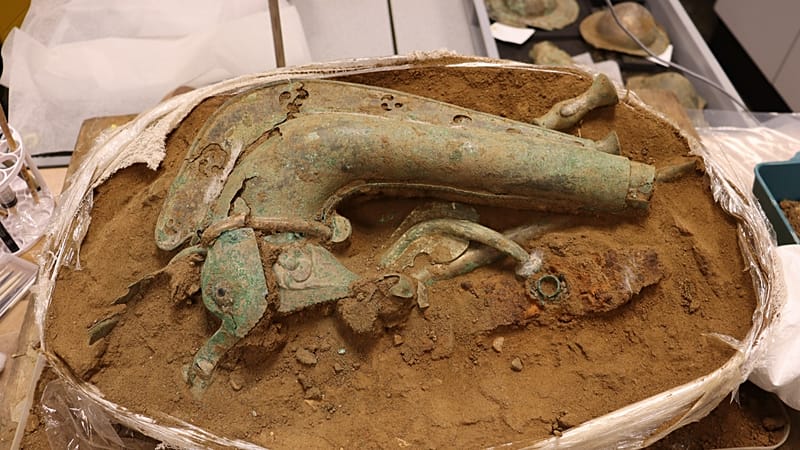
A remarkable collection of Iron Age artifacts has been unearthed in West Norfolk, shedding new light on ancient British culture.
The hoard, discovered during a routine archaeological excavation by Pre-Construct Archaeology, includes a near-complete Iron Age battle trumpet, known as a carnyx, and parts of another.

These animal-headed bronze instruments were used by Celtic tribes across Europe to inspire warriors in battle and fascinated the Romans, who frequently depicted them as war trophies. The hoard also includes a sheet-bronze boar's head, originally from a military standard, five shield bosses, and an iron object of unknown origin.

Conservation efforts
According to Dr. Fraser Hunter, Iron Age and Roman curator at National Museums Scotland, this rare find will add enormously to our understanding of the period: "The full research and conservation of these incredibly fragile remains will reshape our view of sound and music in the Iron Age."
"The carnyces and the boar-headed standard are styles well known on the continent and remind us that communities in Britain were well-connected to a wider European world at this time," he added.

Following the discovery, the objects were carefully lifted within a block of soil from the site, and initial scanning took place to reveal their position. Conservation experts at Norfolk Museums Service then removed each object for preliminary examination. The items are in a fragile condition and require extensive stabilization work before detailed research can begin.
"This find is a powerful reminder of Norfolk's Iron Age past, which still retains its capacity to fascinate the British public," said Dr. Tim Pestell, Senior Curator of Archaeology for Norfolk Museums Service. "The Norfolk Carnyx Hoard will provide archaeologists with an unparalleled opportunity to investigate a number of rare objects and ultimately, to tell the story of how these came to be buried in the county two thousand years ago."
As the find consists of two or more base metal prehistoric items from the same find, it has been reported to the coroner as potential treasure under the terms of the Treasure Act 1996. The case currently rests with the coroner, who will determine its legal status in early 2026. This decision will inform the next steps for the hoard’s future.
Historic England is working with Pre-Construct Archaeology, Norfolk Museums Service and the National Museum of Scotland to coordinate research and conservation. Where the objects will be housed long-term is yet to be determined.