
Where innovation seems to abound when it comes to decorating inside our homes, when it comes to our gardens, we often get trapped in the same, familiar materials. And, for affordability and durability, pressure-treated timber always seems to come out on top, especially for fences or the like of your garden trellis.
However, basic finishes can lead to a... well, basic finish, and often, pressure-treated timber isn't necessarily the finish that's going to make your garden look expensive. And yet, there are ways to create something like a trellis or privacy screen for your garden without picking off-the-shelf, but without being forced down the route of a custom design in a more pricey material.

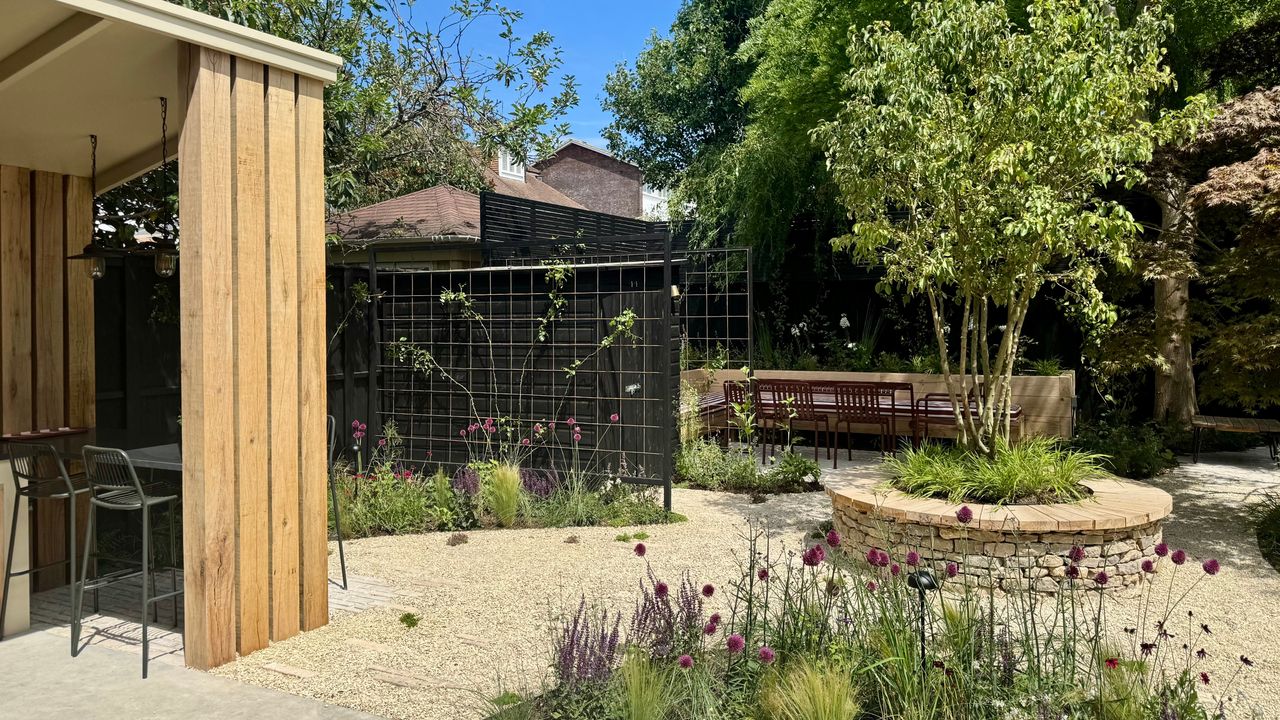
In this Wandsworth garden by landscape designer Tom Howard, it was one of the first things that stood out to me — an exposed metal grid demarcating the outdoor dining area and giving some structure to the space, while working as a garden screening idea. "We screened it with recycled reinforcing mesh from a builders' merchant, put a wooden frame around it, and the idea is that climbing roses will cover it to half-obscure the dining area," Tom explains. "The garden was only finished last year, so it's still got a lot of growing to do."
It's an inexpensive material (costing £55 per large sheet from Amazon, for example), but it gives this garden, which in other places uses more premium and classical landscaping materials, a little modern edge.
But, while it's a highlight, it's not the only inspiration this garden has to offer.
The decision to add the privacy screening came down to the client's wish for the garden to have reveals, giving their outdoor space depth. Tom tells me: "They wanted a rustic element to it, but they also wanted to zone the space so everything wasn't on display at once."
For that rustic side, Tom turned to materials that would come alive over the garden's life, including the oak used for the outdoor seating. "It's a lovely material that ages really well and has a lot of character," the designer says. "We wanted to use a lot of natural materials, so our palette included gravel, Cotswold pebble, limestone cladding for the round raised seat planter in the center, and limestone pitchers."
The transition from the Cotswold pebble, used for the patio flooring, to the gravel isn't a hard boundary. They fade into each other, with a few pavers dotted through the gravel garden, almost gradient-like. "We had them mainly in the dining area, but dispersed them slightly into the gravel area to create a visual link," Tom explains.
The material picks back up as you head to the covered outdoor kitchen. "It was built on an existing concrete terrace, which is a modern material, so we tonally matched it with the limestone to make it all work together. It's rustic, yet with a modern twist," he says.

It's a softness that translates into the naturalistic garden's planting scheme, too. "We didn't want anything too manicured," Tom says. "They were really keen on bringing wildlife into the garden, so we used a lot of pollinators to attract bees. We wanted a lot of texture, too, hence the grasses."
Little Greene Tuscan Red Interior Exterior Eggshell
"It's quite a loose, wild planting theme. We avoided straight lines, so we have these lozenge-shaped planting pockets and curves that work with the central circular raised bed. On the terrace, it's quite linear around the kitchen area, and then it slowly moves towards the more curved spaces. The planting knits those shapes together," the designer explains.
While elements of this garden feel modern, there's a timelessness to it, too, thanks to its materiality. "I love using oak," Tom says. "It's a lovely material and it's just going to last a long time. Over the years, garden trends change. 10 or 15 years ago, everyone was using porcelain and much more modern materials."
For more inspiration on garden trends, and more projects for inspiration, why not sign up to the Livingetc newsletter?