
Get all your news in one place.
100's of premium titles.
One app.
Start reading
Livingetc
Livingetc
Natasha Brinsmead

Sorry, Timber Countertops, You Will Be the First Thing to Go When I Remodel — But Can They Still Be a Good Idea? I Asked Kitchen Designers to Break Them Down

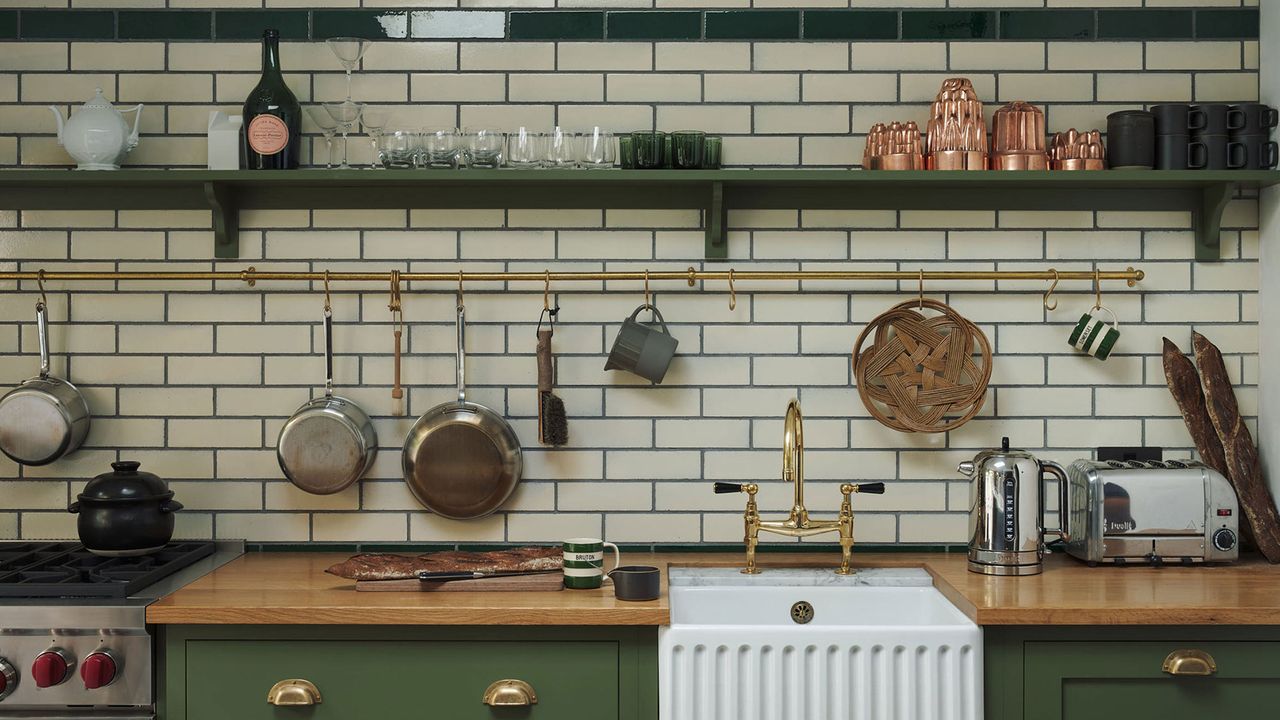
Rustic green kitchen with wooden worktops and metro tiles on the wall with pot hanging racks and ceramic sink.

Take a quick glance around my kitchen, and you may well miss the areas where time has taken its toll in the almost 10 years since it was fitted. In general, it has withstood the passage of time admirably, despite everything that has been thrown at it (quite literally at times). It has endured the over-zealous cooking efforts of two toddlers who now, as teenagers, arguably demand even more from it, hosted plenty of large gatherings, and been the place to which everyone tends to gravitate.

All that said, take a closer look and the wear and tear is all too evident — particularly when it comes to the timber countertops. Where they once lent warmth and character to the extension, adding to the relaxed, country-style vibe we were aiming for, now they just look downright scruffy. The plethora of black rings, faded patches, scratches, and ugly watermarks doesn't add charm — they just look worn-out and tired.

With a second extension and a complete remodel now on the not-too-distant horizon, I will not be choosing wood as my kitchen countertop material, and it will be the first thing to land in the dumpster. But what should I replace them with? I love the look of timber, but is it always destined to end this way? Before the project gets underway, I decided to ask the experts for their thoughts. Here's what they had to say.

Where Timber Countertops Aren't a Good Idea

Wondering, 'Are wood countertops hard to maintain?' They do require more care and maintenance than some other materials — to ensure a long lifespan, experts recommend timber worktops be resealed monthly. (Image credit: deVOL)

We have three sections of timber countertop, all made from oak. One is a long run that houses the sink, and the other two sit either side of the range cooker. Whether it is water damage, hot pans or stains from various sauces, none of these sections have escaped unscathed.

The only area of our kitchen countertops that still does the space justice is the marble composite we used for the breakfast bar — scalding hot pans, food spills, water exposure, you name it, it has seen it, yet it remains looking as good as the day it was fitted. This led me to wonder, are timber counters ever a good choice?

According to Niko Rasides, design director at Nicholas Anthony, the key lies in being clever about where you use them. "A truly insightful design respects the limitations of the material to ensure longevity. We generally advise against using timber in high-moisture zones, particularly surrounding an undermount sink. Even with the most meticulous sealing, the end-grain is susceptible to water ingress over time, which can lead to discoloration or swelling.

"Similarly, placing wood directly adjacent to a high-output hob can subject the fibers to extreme thermal stress, potentially causing the wood to move or hairline cracks to appear," continues Niko. "In these high-intensity areas, the bad idea isn't the wood itself, but rather a lack of material harmony; timber thrives in the right environment, away from the constant assault of standing water and direct flame."

Where Timber Countertops Work Best

Wooden countertops are best reserved for light-use areas, away from sinks and hobs. (Image credit: deVOL)

It seems that timber countertops do still have a place in a kitchen, but a considered approach is definitely needed — something that Paul Dore, MD, and kitchen expert from County Stone, agrees with. "Where timber really comes into its own is in lower-impact areas — breakfast bars, islands used more for prep than heavy-duty cooking, or even feature sections paired with more hard-wearing materials. We often recommend mixing materials to get the best of both worlds. For example, using stone around the sink and hob, and timber elsewhere to soften the overall look."

Ali Nash, kitchen designer at Tom Howley, has some more advice on the best uses for timber in the kitchen. "Wooden countertops work beautifully as accent surfaces — for example, as a butcher’s block at the end of an island — where they create a softer, more tactile look. They pair well with painted cabinetry, stone, and quartz countertops, offering a contrast that feels layered and timeless."

"If you are set on introducing wood, using it as a feature rather than the main surface is often the most successful approach, such as an inset end-grain butcher's block," adds Charlotte Butler, kitchen design manager at BK Eleven. "End grain is especially durable, naturally antibacterial, and has a self-healing quality that makes it well-suited to prep, though it still needs to be kept away from water and regularly oiled."

How to Keep Wooden Countertops Looking Good

Keeping timber away from water and heat, and regularly oiling it, is the route to a surface that lasts. (Image credit: Tom Howley)

It seems, then, that I don't have to forgo timber countertops altogether in my new modern kitchen — but given their rather needy nature, I'm keen to know how to keep them looking good if we do incorporate them into our design. Even the regular application of Danish oil that we have been careful to carry out hasn't spared our countertops.

"The biggest issue is water. Timber and moisture simply don’t get along long-term," explains Paul Dore. "Around sinks in particular, you’re constantly battling splashes, standing water, and general wear. Even with regular oiling and sealing, which is essential, you’ll often see darkening, staining, or even movement in the wood over time — something that many homeowners underestimate."

That said, Charlotte Butler is keen to point out that, unlike some other materials, wood can be repaired. "One of the advantages of timber is that it can be restored. Marks, scratches, or even stains can often be sanded back and refinished, which gives it a certain longevity if it is properly maintained."

Which Types of Wood Offer the Most Durable Option?

I had previously discounted granite countertops but am now seeing them being used in some really stylish ways. (Image credit: Pluck Kitchens)

The type of timber you choose for your countertop matters — you definitely don't want to be basing your decision on looks alone if you want them to hold up against the demands of everyday life.

"In terms of species, hardwoods like oak, beech, walnut, and iroko tend to perform best as they’re denser and more resilient, helping them to age more gracefully," reveals Paul Dore. "Iroko, in particular, is often chosen for its natural oils and better resistance to moisture, but even then, it’s not maintenance-free."

I have also been looking into teak as a countertop material that could suit my modern kitchen plans. Given that it is often used in boat building thanks to its high oil content and resistance to rot, mold, and warping, it seems like a good choice. However, its price tag is most definitely at the higher end, and you really need to take time to check out its certifications in terms of it having come from a sustainable source — it isn't always one of the most eco-friendly kitchen countertops.

What Are the Alternatives to Timber Countertops?

Concrete is a beautiful alternative to timber but still requires regular sealing and may develop a patina over time. (Image credit: Pluck Kitchens)

All the experts I spoke with agreed that timber countertops need careful consideration if they are going to be a worthwhile investment. Choosing the right timber, accepting that they will require regular maintenance, and that they only really work in certain areas within a kitchen space are the payoffs for a material that brings with it an undeniably cosy, rustic feel. However, I'm definitely ready for a change.

"For clients who love that warm, natural aesthetic but want something more durable, we usually guide them towards quartzite or certain granites with softer, earthy tones," says Paul Dore. "There are also engineered stones now that do a great job of inducing that warmth without the same level of upkeep. This means you get the character, but with far more resilience to water, heat and daily wear."

Charlotte Butler offers a similar take on alternative materials to consider. "For those looking to achieve a sense of warmth with less maintenance, materials like Corian offer a softer, tactile feel underhand, while honed quartz or granite can take on a gentler, less reflective character than polished finishes. It becomes less about replacing wood entirely, and more about finding the right balance between atmosphere and practicality within the space."

I'm interested in investigating terrazzo and concrete countertops, too, although my initial research has indicated that these, too, require a level of maintenance that something like a quartz composite might not.

Countertop Savers to Keep on Display

The more research I do for my new kitchen, the more I am realizing that, for many people, timber is now seen as one of those outdated kitchen countertops when used all over. It seems it is far better reserved for small areas.

For more design advice, why not sign up for the Livingetc newsletter, and it'll land straight in your inbox.

Sign up to read this article
Read news from 100's of titles, curated specifically for you.
Already a member? Sign in here
Related Stories
Top stories on inkl right now
Our Picks
Fourteen days free
Download the app
One app. One membership.
100+ trusted global sources.