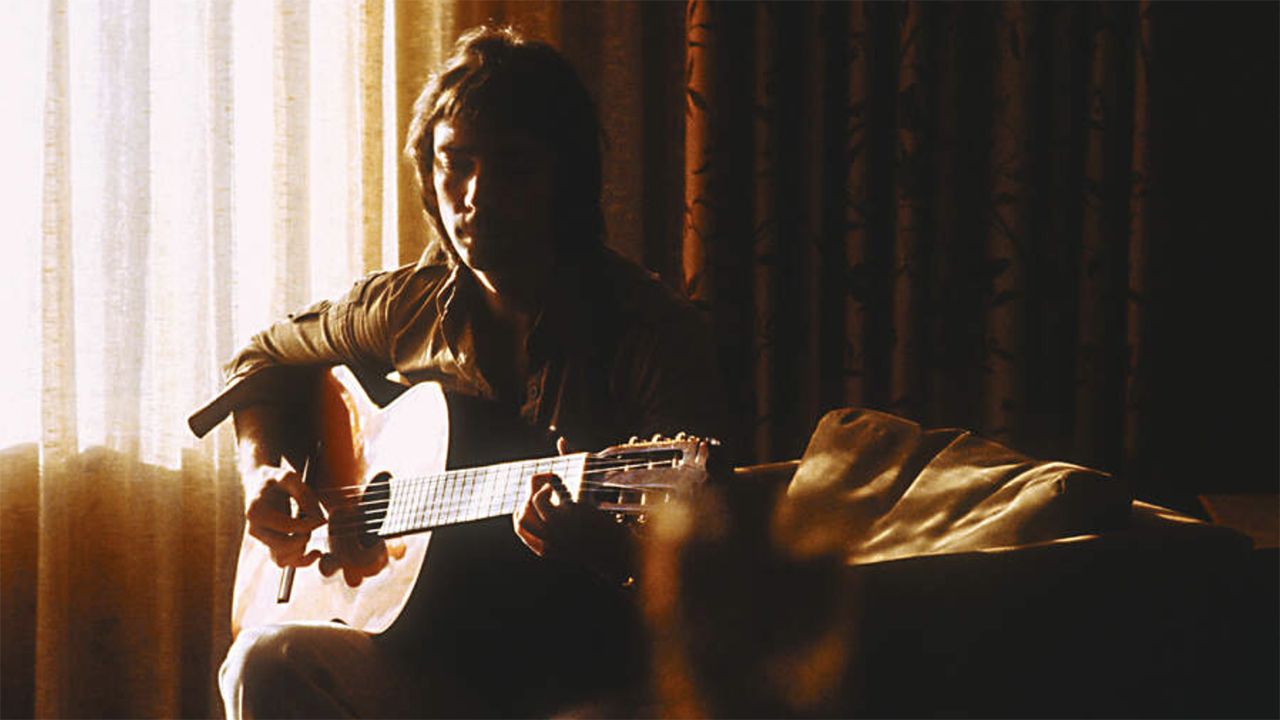
In 1971, 20-year-old Steve Hackett made his debut with Genesis. His imaginative guitar work became a key feature of their 70s sound – but when Peter Gabriel departed, his own future with the band came into question. The situation came to a head after the release of Hackett’s 1975 solo debut, Voyage Of The Acolyte.
In September 1975 Peter Gabriel announced he was leaving Genesis. The move had been rumoured but it was now official, and to fans it felt like an act of abdication.
Unbeknown to them, Gabriel had taken time out from the group the previous year, during the rehearsals for The Lamb Lies Down On Broadway, when his newborn daughter Anna-Marie was unwell. That hadn’t gone down well with factions within the band – and their reaction had not gone down well with Gabriel. He returned to record and tour the album, knowing he’d soon be going for good.
Guitarist Steve Hackett remembers feeling that Genesis were on very shaky ground. “I didn’t know if the band was going to continue without Pete,” he says. “The Lamb Lies Down On Broadway was a very good album. It’s something we all wrote. But Pete was working almost like a solo act within the band. We were like the pit orchestra to his Nijinsky or Nureyev; he was very much the star of the show. I also felt the band was losing its sense of romance and magic. The Britishness and the European-ness that we had that was part of our appeal.”
In a lengthy statement for the music press titled Out, Angels Out – an investigation, Gabriel revealed that the roots of his unhappiness lay in Genesis’ collective approach to writing, as illustrated by in the credit “All Done By All” on their records. On the surface it seemed suitably progressive and inclusive, an attempt to rectify the disparities in composing royalties that had perennially caused problems within groups. But it created its own set of issues.
Gabriel wrote, “The vehicle we had built as a co-op to serve our songwriting became our master and had cooped us up inside the success we had wanted. It affected the attitudes and the spirit of the whole band.” He needed to be able to explore musical and visual ideas in a way that this “pseudo-democratic committee system could not provide.”
Hackett had also had some ideas turned down by the committee, and he’d been writing new material during the lengthy Lamb tour. And so, “hot on the heels of Pete’s departure from Genesis,” at the tour’s conclusion in May 1975, he took the opportunity to record his first solo album, Voyage Of The Acolyte, at Kingsway Studios, London.
“It was my attempt to do something outside the auspices of the band,” he explains. “Pete was surely going to make a huge success of what he was doing – but I went into the studio thinking, ‘Am I going to come out with a whole album, or will it end up on the cutting room floor?’ I didn’t have the level of confidence that you really need to become a successful solo act.”
His interest in the tarot deck helped focus his compositional ideas. “Here’s the Ace Of Wands; it means the beginning of a new venture. ‘Aha!’ I thought. ‘This could be the first track.’ A Tower Struck Down had to be a really aggressive track. My brother John came up with a marvellous riff, which was dissonant but engaging.”
His first marriage having failed, Hackett moved back in with his parents in central London. At that time his younger brother John had quit his languages course at Cambridge University and was also at home, planning to take a music degree. “Once again, we were little boys sharing a bedroom,” says Steve. “But instead of wrestling and beating each other up as young boys do, we were being constructive, making music together.”
John had started as a guitarist, but then the siblings saw King Crimson live in 1969. Inspired by wind player and multi-instrumentalist Ian McDonald, they co-purchased a flute. John, who had a natural aptitude, had also bought a Tandberg reel-to-reel recorder with a double-tracking facility.
“That meant that we could do demos of some of the tracks we were creating,” he says. “There are a lot of harmony guitar parts and some harmony flute parts at the end of The Hermit, so it was a really useful thing to have. I used the same machine a few years later, when Steve was doing Please Don’t Touch!
“Steve is a completely self-taught musician, and it never ceases to astonish me what a natural talent he has. You can see that in a piece like Hands Of The Priestess, which has some gorgeous twists and turns of harmony and melody.”
It wasn’t a given that Steve would find a solo deal, but Genesis manager Tony Stratton-Smith was supportive, signing him to Charisma. Next, who would help produce? Enter a wildcard: John Acock, an engineer friend of Steve’s who was assisting producers such as Martin Birch. Acock recalled Steve’s excitement in auditioning for, and then joining, Genesis. He’d later be invited to Steve’s place to listen to album acetates.
“By 1975 Steve had a hankering to do an album by himself,” Acock told UDiscover in 2014. “Tony didn’t know me from Adam and I had no production credits, but Steve and I got on well. He didn’t want a heavyweight producer pushing him around, but an engineer he could bounce ideas off. There was a leap of faith on Strat’s, and Steve’s, part.”

But while Steve harboured doubts that his album would be commercially successful, John didn’t notice any lack of confidence once they were in the studio. “We worked at great speed,” he says. “It was like throwing paint at a canvas and everything seemed to stick.”
The Civil Aviation Authority, who owned the building above the basement studio in Holborn, had put a block on noise before 6pm, so sessions ran from 6pm-6am for three weeks. Mike Rutherford and Phil Collins were the core rhythm section, with session bassists Johnny Gustafson and Percy Jones and vocalist Sally Oldfield dropping in. Steve enjoyed having creative control, describing his role as “a kind of benevolent dictator in a team where other people could suggest things, particularly my brother John. But I had the last word. I thought, ‘This is great! This is a little bit like being in a band, but I’ve got Mike and Phil doing the things that I want them to do, rather than me serving the interests of the mothership Genesis.’
I thought, ‘My goodness! I’d never realised what a fantastic singer Phil is!’ And of course, the rest is history
John Hackett
“Ace Of Wands is as proggy as it comes – lots of changes and time signatures – but Phil and Mike were damn quick at picking up on things. I was hugely impressed with them, and very thankful that they performed so well. I had great fun doing Voyage Of The Acolyte. There was very little sleep, very little food, and lots of cigarettes.”
John Hackett – who played some of the keyboards along with John Acock – has vivid memories of Phil Collins singing Star Of Sirius. “There are some beautiful, layered harmonies. I thought, ‘My goodness! I’d never realised what a fantastic singer Phil is!’ And of course, the rest is history.”
The majestic, slow-building end section of Shadow Of The Hierophant, with its chord sequence that seems to go round and round and up and down like an Escher staircase, was co-written by Steve and Mike Rutherford in 1972 and had been turned down by Genesis for Foxtrot. It remains a highlight of Steve’s live set to this day.
“Genesis often rejected things then brought them back later, but some things were never revived,” he says. “So I was determined to turn Shadow into something really special. I was nailing my colours to the mast there.”
Guest instrumentalists included cellist Nigel Warren-Green – who’d gone to school with John – and classical oboist Robin Miller, who Steve had heard playing on King Crimson’s 1970 album Lizard. “It was really exciting meeting Robin,” John recalls. “At the time he was working with the BBC Symphony Orchestra. He came down to record the oboe parts, which I’d written out, after a session conducted by Pierre Boulez.
“Robin was great because there were parts done in unison and he’d point out, ‘Oh, that note’s a bit sharp,’ or whatever, so it helped with my tuning. He was very nice to work with. I don’t think he’d heard the music before he arrived at the session, but his phrasing was impeccable.”
Mike said I wasn’t giving everything to Genesis when my album came out. The truth is I worked hard on both
Steve Hackett
Released in October 1975, Voyage Of The Acolyte was a surprise hit, praised by critics and charting at No.26 in the UK. It mixed panoramic classical elements with high rock drama, prog complexity and some lovely chamber ensemble moments, particularly on Hands Of The Priestess, which featured acoustic and electric guitar, flute and oboe. The music was reflected in the mystical imagery of the cover painting by Kim Poor – Steve’s then-girlfriend and future wife.
As the album featured three-quarters of Genesis, it was, to no one’s astonishment, similar in spirit to the band. “Frankly, there were fans who preferred it to what Genesis were doing,” says Steve. “I thought, ‘This means that if I stay in the band, whatever we do as a four-piece with Phil singing will be well-received. If I can have a hit on my own, the band’s future is assured.’”
With these positive signs, work began on the first post-Gabriel Genesis album, A Trick Of The Tail, in October. It was released in February 1976, charted at No.3 in the UK and breached the US Top 40 – but things were far from straightforward.
“Mike played on Voyage Of The Acolyte, but he subsequently said I wasn’t giving everything to Genesis when my album came out,” says Steve. “The truth is I worked hard on both.”
In the aftermath of Gabriel’s departure, in a move designed to prevent further disruption, Steve was told he couldn’t have a solo career and remain in the band. “I had record companies asking for my next album, and half a band forbidding me from doing it,” he says. “It was a very difficult decision. I agonised over it for about two years.”