
Get all your news in one place.
100's of premium titles.
One app.
Start reading
The Conversation
The Conversation
Marco Ajello, Professor of Physics and Astronomy, Clemson University

Some black holes at the centers of galaxies have a buddy − but detecting these binary pairs isn’t easy

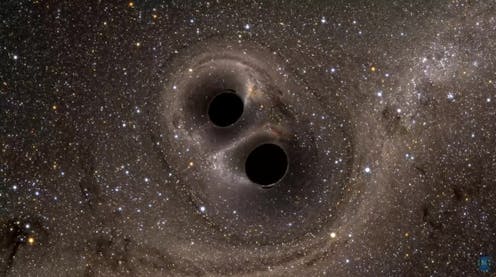
Some black holes, bound by gravity, rotate around each other, as shown in this simulated image. Simulating eXtreme Spacetimes Lensing (SXS), CC BY-SA

Every galaxy has a supermassive black hole at its center, much like every egg has a yolk. But sometimes, hens lay eggs with two yolks. In a similar way, astrophysicists like us who study supermassive black holes expect to find binary systems – two supermassive black holes orbiting each other – at the hearts of some galaxies.

Black holes are regions of space where gravity is so strong that not even light can escape from their vicinity. They form when the core of a massive star collapses on itself, and they act as cosmic vacuum cleaners. Supermassive black holes have a mass a million times that of our Sun or larger. Scientists like us study them to understand how gravity works and how galaxies form.

Sign up to read this article
Read news from 100's of titles, curated specifically for you.
Already a member? Sign in here
Related Stories
Top stories on inkl right now
One subscription that gives you access to news from hundreds of sites
Already a member? Sign in here
Our Picks
Fourteen days free
Download the app
One app. One membership.
100+ trusted global sources.







