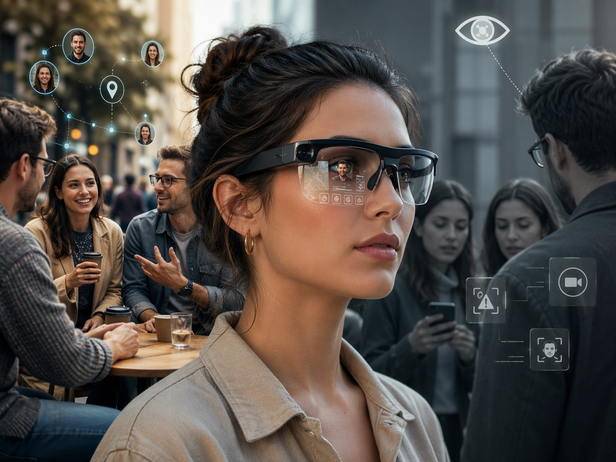
Smartphones have dominated human interaction for more than ten years. They changed how people communicate, work, consume media, and even establish connections. They still necessitate a physical activity, though: pulling out a device and concentrating on a screen. That barrier is completely eliminated by smart glasses. They incorporate technology into daily life in a way that seems nearly invisible by putting digital information right in front of the eyes. Although this shift may appear to be a natural development, it will have a deeper and complex effect on social behavior than smartphones did.
Constant Digital Presence Will Redefine Attention
Smartphones split attention between the real and virtual worlds. By opening apps or unlocking their phones, people actively switch between the two. This barrier is removed by smart glasses. Without requiring any visible action, live notifications, directions, messages, and even social media feeds can surface.
The way attention functions in social contexts will be drastically changed. Because users can read different information at the same time without anyone realizing, conversations may no longer be fully present. Because it will be difficult to tell if someone is actually interacting with digital overlays or not, eye contact a crucial component of communication , may lose its authenticity. But unlike smartphones, this conduct will be more difficult to identify, increasing the confusion of social interactions.
Privacy Will Become a Daily Social Negotiation
Concerns about privacy were raised by smartphones, particularly with regard to cameras and social media sharing. This gets better by smart glasses, which allow for continuous, covert data collection and recording. People might not always be aware that they are being captured on camera, examined, or even identified by face recognition software.
New social issues will result from this. People may become more cautious in public places because they are aware that any interaction could be recorded without permission. Norms will change synchronously. Society may someday come to embrace continuous recording as a normal aspect of daily life, just as it did with smartphone cameras. People's perceptions of one another may change as a result, moving from natural interactions to responses affected by data. Authenticity, spontaneity, and trust could all be impacted.
Communication Will Shift from Verbal to Hybrid Interaction
People's communication patterns will also be changed by smart eyewear. Interactions will become hybrid, incorporating voice, gestures, and visual clues rather than just spoken words or typed communications.
During a conversation, for instance, users may get actual time cues like recommended responses, reminders, or background information about the other person. A type of mediated contact may result from people depending more on digital support than on their own ideas.
Additionally, nonverbal communication may change. Digital interfaces could be controlled by subtle eye movements, gestures, or even patterns of blinking. This creates a gap between technology those who use it and those by introducing a new level of interaction that others might not completely comprehend.
Behavior norms and social hierarchies will change.
Social Hierarchies and Behavior Norms Will Shift
Smart glasses are likely to establish new social hierarchies, as technology frequently does. Better information, quicker reactions, and improved awareness of their surroundings may be available to early adopters or those with more advanced technology. In social and professional contexts, this could lead to an imbalance.
Someone wearing smart glasses may have access to information about the person they are conversing with during networking or job interviews, providing them an advantage. Fairness and transparency are ethical issues brought up by this.
There will be new social norms surrounding the use of smart glasses, just as it became accepted to check cellphones during meetings or social events. Expectations may exist over how to indicate attention, when to disable features, and if particular functions are suitable in particular contexts.
Relationships Will Become More Data Driven and Less Spontaneous
Through social networking, messaging, and continuous belonging, smartphones already have an impact on relationships. By immediately incorporating data into encounters in the actual world, smart glasses will increase this impact.
Birthday reminders, chat histories, and even suggested by AI emotional indicators may be relied upon by people. This could lessen social conflict and enhance memory, but it also runs the danger of making connections feel less organic. People may rely on digital aid to direct their conduct rather than responding instinctively.
Friendships and dating may also shift. People's views on one another may be influenced by actual time information about compatibility, common interests, or even behavioral analysis. Relationships become data-informed instead of based on experience as a result.
Smart glasses are more than just a novel class of gadgets. They indicate a change toward the digital and real worlds being seamlessly integrated. Smart glasses function continually in the background, subtly but effectively impacting perception, attention, and behavior, in contrast to smartphones, which necessitate intentional engagement.
Social standards, privacy, communication, and interpersonal interactions will all change as a result of this shift. Although technology greatly improves efficiency and convenience, it also presents issues that society has not yet fully resolved.
Although the technology is neutral in and of itself, it will have a significant impact on human behavior. The question is not if social behavior will change, but rather how much it will change and whether it will improve or worsen interpersonal relationships.
Unlock insightful tips and inspiration on personal growth, productivity, and well-being. Stay motivated and updated with the latest at My Life XP.