Get all your news in one place.
100's of premium titles.
One app.
Start reading
The Conversation
The Conversation
Eva-Maria Geigl, Directrice de recherche CNRS, Université Paris Cité

Skulls in Ukraine reveal early modern humans came from the East

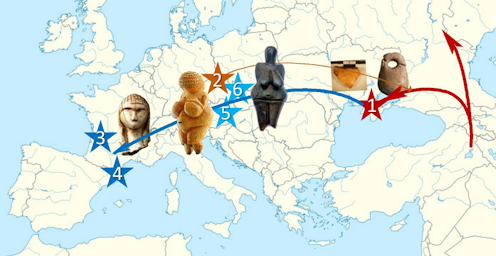
Location of the Buran Kaya III (1), Zlatý Kůň (2), Fournol (3), Serinyà (4), Krems-Wachtberg (5) and Věstonice (6) archeological sites, whose remains were were analysed in the study. Also shown are one of the analysed skull fragments and pierced beads discovered with the bone fragments from the Buran Kaya III site, as well as the Venus statuettes from Věstonice, Willendorf and the Dame de Brassempouy (from right to left). E-M. Geigl, Fourni par l'auteur

How did our species, Homo sapiens, arrive in Western Europe? Published in Nature Ecology & Evolution, our new study analyses two skull fragments dating back between 37,000 and 36,000 years to conclude that our ancestors came from Eastern Europe and migrated westwards. These two individuals interbred with Neanderthals and with the very first European Homo sapiens, who arrived around 45,000 years ago and were thought to have become extinct following a major climatic catastrophe.

Together with lithic tools and pierced mammoth ivory beads, small skull fragments of the two skulls found in 2009 at an archaeological site in the Crimea, Buran Kaya III, bear witness to the presence of anatomically modern humans in Eastern Europe. Working with French and Ukrainian archaeologists, we were able to put in place a sampling protocol that took special precautions to prevent the fragments from being contaminated by modern human DNA and identify their ancient DNA.

Sign up to read this article
Read news from 100's of titles, curated specifically for you.
Already a member? Sign in here
Related Stories
Top stories on inkl right now
One subscription that gives you access to news from hundreds of sites
Already a member? Sign in here
Our Picks
Fourteen days free
Download the app
One app. One membership.
100+ trusted global sources.