Get all your news in one place.
100's of premium titles.
One app.
Start reading
Sports Illustrated
Sports Illustrated
Sport
Nicholas Selbe

Six Decisions That Sunk Perry Minasian—and What’s Next for the Angels

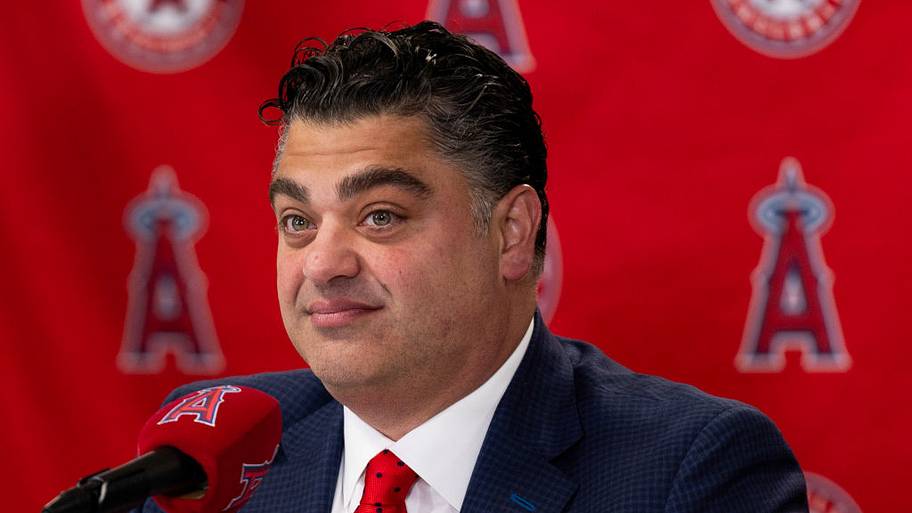
On Friday, the Angels fired general manager Perry Minasian midway through the executive’s sixth season leading the team’s front office. The baseball world met the announcement with a relatively muted response, in part due to its timing (a classic Friday news dump) and its inevitability.

Minasian was in the final year of his contract, and with the Angels comfortably in last place and pacing for their 11th straight losing season, such a change was only a matter of time. So the organization pulled the ripcord now, two weeks ahead of the MLB draft and five weeks before the trade deadline.

It was a tenure marked, at least in the early goings, by annual hope that Minasian could build around two franchise cornerstones in Shohei Ohtani and Mike Trout to end a playoff drought that dated back to 2014. Such hopes were routinely short-lived, as the Angels ended up with a 392–500 record (.439 winning percentage) under Minasian, never topping the 77-win mark in a single season.

Much of the narrative surrounding Minasian—and the Angels’ decade-long malaise in general—is that the team’s issues are most strongly tied to owner Arte Moreno, who’s long had a reputation for interfering with personnel decisions. How much blame Minasian deserves for the team’s dysfunction is up for debate, but, as is the case with any failed tenure, his demise can be marked by the key decisions that didn’t pan out. Here’s a look back at Minasian’s most consequential mistakes.

Not trading Ohtani at the 2023 deadline

No single decision will stick with Minasian more than this one. When he took over in November 2020, Ohtani had not erupted into the two-way supernova he is today. That changed the following season, when Ohtani won his first of two MVP awards he would win as an Angel.

After missing the playoffs in his first two years at the helm in 2021 and ‘22, Minasian had a big decision to make at the ’23 deadline: trade Ohtani, in his final year of team control, and inject much-needed young talent into the organization; or hang on to him for one last playoff push before Ohtani hit free agency.

Of course, he opted for the latter, and the results were catastrophic. The Angels were just three games out of the final wild-card spot at the deadline, and they pushed their chips all-in. Not only did they keep Ohtani, but they traded top prospects in a slew of win-now deals to acquire Lucas Giolito, Reynaldo López, C.J. Cron, Randal Grichuk and Dominic Leone.

Those moves backfired immediately, and spectacularly: Los Angeles lost 16 of 20 games to begin August, and by the end of the month placed Giolito, López, Grichuk and several other veterans on waivers just to lower the club’s payroll.

The Angels ended up finishing the season 73–89, the playoff drought extending to nine years. Ohtani signed with the Dodgers in December, leaving Minasian with only a 2024 draft pick in return instead of a franchise-altering prospect haul.

The infamous 2021 all-pitcher draft

During Trout’s peak years, pitching was routinely the Angels’ bugaboo. From 2016–20—the start of the Angels’ streak of losing seasons to the year before Minasian’s arrival—the team’s 4.49 ERA ranked 20th in baseball, with the starting pitchers’ ERA (4.76) ranking 24th. So, in his first draft with the team, Minasian opted for the extreme, now infamous approach to use all 20 picks at his disposal on pitchers.

Of those 20 picks, 19 of them were college selections, the start of what would become a Minasian staple of rushing draft picks onto the big-league roster. The results have been disastrous, as just three of the 20 reached the big leagues with the Angels: first-round pick Sam Bachman, fifth-rounder Brett Kerry and 11th-rounder Chase Silseth.

Bachman and Silseth have developed into key bullpen pieces for the Angels, though have combined for just 0.4 fWAR for their careers, while Kerry just made his major league debut this month. It’s a staggeringly underwhelming return for such an unbalanced strategy.

Ill-fated multi-year contracts

Evaluating Minasian’s free agent signings deserves some context. Before his tenure, the Angels spent wildly on massive multi-year deals that almost universally aged poorly. In 2021, his first season with the team, the Angels paid Trout, Albert Pujols, Anthony Rendon and Justin Upton a combined $115.7 million, all part of contracts that were agreed upon before Minasian arrived. Pujols, Rendon and Upton combined for 0.0 fWAR that season, while Trout played just 36 games.

Having that much money tied up to a small handful of very unproductive players clearly signaled a shift in free agent strategy, and whether it came from Moreno or Minasian or a combination of the two, the organization severely reined in its spending. But even with smaller deals aimed at shrewd, more modest improvements, Minasian still managed to continue the trend of doomed signings.

Starting pitcher Tyler Anderson
Starting pitcher Tyler Anderson—who signed with the Angels on a three-year, $39 million contract—posted a 18–29 record and 4.53 ERA with the team. | Kelvin Kuo-Imagn Images

Including the pre-arbitration contract extension for David Fletcher in 2021, Minasian handed out 10 multi-year contracts during his tenure, totaling over $266 million. That group amassed just 12.6 fWAR in Angels uniforms, with over a third of that production (from closers Raisel Iglesias and Carlos Estevez) coming from players who ended up being traded away midseason as the team fell out of contention.

The most productive of the group has been Yusei Kikuchi, who signed a three-year, $63 million deal before the 2025 campaign and has put up 3.1 fWAR since (he’s currently on the 60-day injured list). There are numerous failed signings, though the worst is probably Robert Stephenson, who signed for three years and $33 million yet wound up pitching just 10 innings with the team.

Trading Brandon Marsh

Marsh, currently fourth in the NL in batting average (.322) and in contention for his first All-Star bid this season, was an Angels second-round pick by Minasian’s predecessor, Billy Eppler, in 2016. He debuted in ‘21 and was getting everyday playing time in ‘22 when Minasian traded him to the Phillies at the deadline in exchange for catcher Logan O’Hoppe.

At the time, the move made some sense: both players were highly regarded as prospects and in their early 20s, and while Marsh was showing signs of being a productive player, the Angels were desperate for help behind the dish. The team ranked dead last in fWAR from their catchers (-1.4) in 2022, and O’Hoppe looked like he could be a franchise building block.

While O’Hoppe’s first two years in Anaheim showed promise—he posted 2.5 fWAR with a 105 wRC+ from 2023–24—his development has hit a wall since. He owns a .219/.270/.364 slash line over the past two seasons, and has amassed just 1.4 fWAR for his career.

Marsh, meanwhile, has been a key contributor for Philadelphia, putting up 10.9 fWAR in a Phillies uniform.

Bullpen building

We’ll group all of Minasian’s attempts at patchworking a bullpen together in one section. Under his stewardship, the Angels routinely attempted to catch lightning in a bottle on one-year deals for veteran players who had success earlier in their careers. No position group embodied that approach more than the bullpen, an area of the roster that saw Minasian hand out nearly $200 million in free agent contracts that yielded only 6.9 total fWAR.

As mentioned above, the bulk of that production came from Iglesias and Estevez, both of whom were traded midseason. Excluding the pair, Minasian signed 21 relief pitchers to big-league contracts worth just over $120 million. The group combined for just 2.5 fWAR for the Angels.

The lowlights of that collection of players included $17 million for Aaron Loup (4.86 ERA in 120 games), $14 million for Ryan Tepera (-0.1 fWAR in 69 games) and $16.55 million for Matt Moore (-0.3 fWAR in 92 games). This offseason alone, Minasian signed five relief pitchers to one-year deals: Kirby Yates, Drew Pomeranz, Jordan Romano, Brent Suter and Joey Lucchesi. To date, they’ve combined for -0.1 fWAR, with a combined salary of just over $12 million, while three of the five have been released.

Outfielder Mickey Moniak
Mickey Moniak enjoyed a breakout season with the Angels in 2023, but was released less than two years later. | Kiyoshi Mio-Imagn Images

Cutting Mickey Moniak

Minasian made a savvy move when he traded Noah Syndergaard for Moniak, the No. 1 pick in the 2016 draft, at the ‘22 deadline. The outfielder put up a 118 wRC+ and 1.8 fWAR with the Angels in ‘23 and looked like he was in the midst of a career revival.

But Moniak regressed in 2024, and just before Opening Day last year, the Angels released him to make room on the roster for Kyren Paris, a second-round pick in ‘19 who had impressed in spring training. Moniak was quickly scooped up by the Rockies, and he’s amassed 36 homers with a .269/.310/.532 slash line over the past two seasons in Denver. Paris, meanwhile, has spent most of the past two years in the minors, and owns a career .157 batting average in 80 games in the majors.


In announcing Minasina’s dismissal, the Angels also announced the hiring of John Mozeliak, the former general manager for the Cardinals, as interim GM and baseball operations consultant. He and team president Molly Jolly will be tasked with finding Minasian’s replacement, and Jolly has asserted that Moreno has granted her the necessary autonomy to lead the organization’s baseball operations into a new era.

Still, Moreno’s reputation will surely be a significant factor to overcome in finding the team’s next GM. The past decade-plus has provided ample evidence that the source of the Angels’ dysfunction is deep-rooted. Anyone signing up to take this job must operate underneath an overbearing owner with a dubious record of baseball decision-making and, lately, an unwillingness to spend like a big-market team. What’s worse is that, despite the team’s lengthy losing streak, Moreno has long refused to allow the team to commit to a full rebuild and is reportedly resistant to the idea once again this year.

That stance could charitably be viewed as understandable when the team had Ohtani and prime Trout. But with the former starring for the Dodgers and the latter about to turn 35 and often injured, it instead reads as stubborn denial. It is through this lens that Minasian’s tenure can be graded on the most generous of curves.

But in the results-driven business of professional baseball, Minasian’s time in Anaheim can be viewed as nothing more than an abject failure. He didn’t create the Angels’ mess, but he did little to clean it up, instead leaving even more disarray for someone else to sort through.

Sign up to read this article
Read news from 100's of titles, curated specifically for you.
Already a member? Sign in here
Related Stories
Top stories on inkl right now
One subscription that gives you access to news from hundreds of sites
Already a member? Sign in here
Our Picks
Fourteen days free
Download the app
One app. One membership.
100+ trusted global sources.