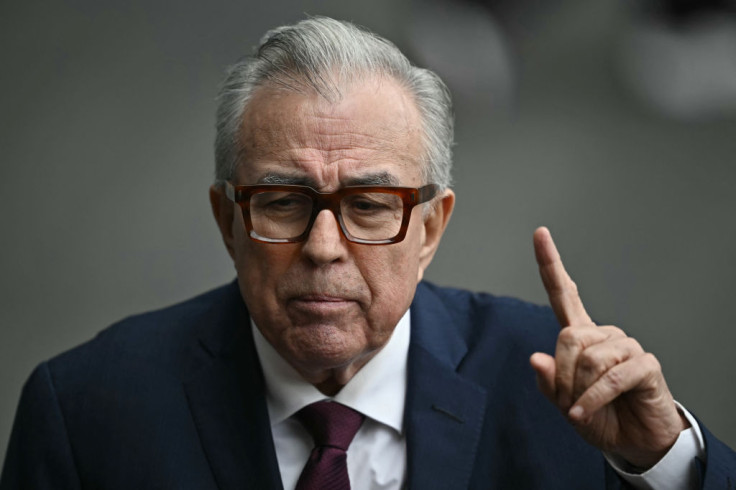
Rubén Rocha Moya spent nearly four months away from the Sinaloa governor's office while Mexican authorities investigated U.S. allegations that he protected one of the world's most powerful drug cartels. When he finally returned Friday, his comeback lasted only 34 hours.
By Sunday, Sinaloa's Congress had unanimously approved another indefinite leave of absence for the embattled governor, ending a chaotic weekend that exposed a rare public rupture inside Mexico's ruling Morena party.
Rocha, 77, announced his return on Aug. 21 after 112 days away, declaring that he was resuming his duties with a "clear conscience" and his "head held high."
"Here I am," Rocha said in a video recorded inside the government palace in Culiacán. "We are going to continue governing with firmness and dedication for our land, for Sinaloa."
Minutes after returning, he convened his Cabinet and reinstated Yeraldine Bonilla Valverde, who had served as interim governor, as Sinaloa's secretary general of government. His daughter, Eneyda Rocha, also returned to lead the state's family welfare agency.
But the triumphant language immediately collided with a very different message from Mexico City.
President Claudia Sheinbaum's government said Rocha had decided to return without consulting federal officials. Morena's national leadership issued an unusually blunt statement saying it had no advance knowledge of the move and was distancing itself from his "personal decision."
The federal Interior Ministry also stressed that the Mexican attorney general's investigation remained open, contradicting Rocha's suggestion that authorities had effectively cleared him.
By Saturday morning, Sheinbaum delivered what was widely interpreted as a direct warning to the governor, although she did not mention him by name.
"Power without principles becomes arrogance," the president wrote on social media. "No personal interest can ever be above the interests of the people or the nation."
The message triggered a coordinated political response. Morena governors said personal political projects could not take precedence over the country, while the party's Senate bloc called for respect for the continuing investigation. Ricardo Monreal, Morena's leader in the lower house and a longtime Rocha ally, publicly urged him to reconsider his return.
Rocha surrendered before the day was over.
"Sinaloa, the nation and the transformation movement are above all else," he wrote while publishing a letter requesting an indefinite leave lasting more than 30 days.
The Sinaloa Congress approved the request unanimously during an extraordinary session Sunday. Rocha had been back in office for approximately 34 hours.
The spectacularly brief return unfolded against the backdrop of an escalating criminal case in the United States. Federal prosecutors indicted Rocha and nine other current or former Mexican officials in April, accusing them of conspiring with Los Chapitos, the Sinaloa Cartel faction led by the sons of Joaquín "El Chapo" Guzmán.
Prosecutors allege the officials accepted bribes and political support in exchange for protecting an operation that transported fentanyl, cocaine, heroin and methamphetamine into the United States. Rocha, the first sitting Mexican governor charged by U.S. authorities over alleged cartel ties, denies the accusations and calls them politically motivated.
Sheinbaum has rejected Washington's request to arrest and extradite the defendants without evidence that Mexico considers sufficient. Her government opened its own investigation, however, and has not publicly announced that Rocha was exonerated.
The timing of his attempted comeback deepened the intrigue. Mexican authorities had just arrested Fausto Corrales Rodríguez, a witness connected to the July 2024 events that ended with Sinaloa Cartel co-founder Ismael "El Mayo" Zambada being taken to the United States and politician Héctor Melesio Cuén Ojeda being killed.
Zambada previously claimed he was lured to a meeting intended to settle a dispute between Cuén and Rocha. Rocha has consistently denied attending the meeting or having advance knowledge of it.
At the same time, Gerardo Mérida Sánchez, Rocha's former public security secretary and another defendant in the U.S. case, disappeared from the federal inmate database after months in custody, generating speculation that he may be cooperating with prosecutors. No cooperation agreement has been publicly confirmed.