Get all your news in one place.
100's of premium titles.
One app.
Start reading
Digital Camera World
Tom May

She wrote the history of photography. Then they cruelly erased her from it

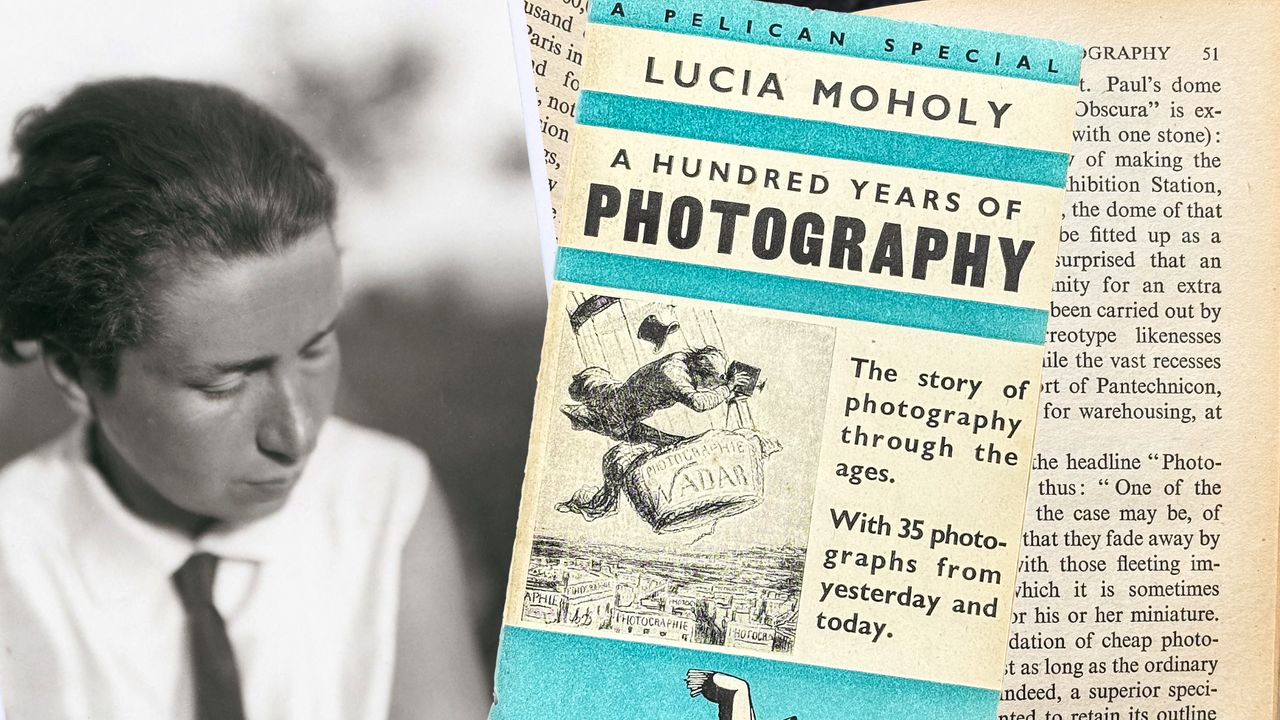
Lucia Moholy with the cover and pages of her book on the history of photography.

There's a particular species of injustice in photography's past, where the person behind the camera (often a woman) did the work while someone else took the credit. But even by those depressing standards, what happened to Lucia Moholy ranks as extraordinary.

Here was a photographer so skilled and so important that her images defined how the world came to see the Bauhaus, one of the most influential art schools in history. Yet for decades, those images circulated without her name attached to them.

Moholy was born in Prague in 1894 and came to the Bauhaus in Weimar, Germany in 1923, having already worked as a theater critic, a publisher's editor and a writer. She wasn't a student; she arrived as the wife of László Moholy-Nagy, who'd just been appointed a master by Walter Gropius.

Group image of eminent members of the dadaist and constructivist movement in 2022. Lucia and her then husband Laszlo are the two at the very top of the image. (Image credit: Getty Images)

She was entering a confident, bohemian artist community who were culturally reinventing everything around them. Exciting times. Unfortunately, it appears that some members of that community were more focused on their own importance than that of others.

Portrait of Lucia Moholy in 1927 by unknown photographer (Image credit: Alamy)

The camera that changed everything

What the Bauhaus needed urgently, it turned out, was a systematic photographer. Moholy provided one. Using an 18×24 plate camera, she methodically documented the school's buildings, workshops, furniture, typography and people. In the process, she created a visual archive that would later shape every book, exhibition and retrospective of Bauhaus history.

She also used a Leica for portraits (tightly cropped, clear-eyed, egalitarian) and alongside her husband, pioneered photogram experiments in the darkroom. Their joint work appeared in László's celebrated 1925 book Malerei, Fotografie, Film, but published under his name alone.

Walter Gropius, the founder of Bauhaus in Weimar, by Lucia Moholy, 1926 (Image credit: Alamy)
Laszlo Moholy-Nagy at the Bauhaus, by Lucia Moholy. 1926 (Image credit: Alamy)
Double Portrait Photogram by Lucia Moholy (Image credit: Alamy)

When the pair eventually separated in 1929, Moholy left behind her glass-plate negatives in Berlin: 560 of them, her entire Bauhaus archive. In 1933, due to her Jewish heritage, she fled the country after the Nazis came to power. The negatives ended up with Gropius.

Rebuilding in London

Lucia Moholy's book A Hundred Years of Photography 1839–1939 (Image credit: Future)

By 1934, Moholy had settled in London, establishing a portrait studio at 39 Mecklenburgh Square in Bloomsbury. She photographed scientists, writers, and members of the wider intellectual milieu that gathered around that part of the city. She lectured at the Central School of Arts and Crafts. She rebuilt.

Then, in 1939, she did something remarkable. Commissioned to mark photography's centenary, she wrote A Hundred Years of Photography 1839–1939, published by Penguin in their Pelican Specials series at sixpence a copy. It sold 40,000 copies in two years.

For many readers, it was the first serious account of the medium they had ever encountered. Tracing a path from Daguerre and Talbot through pictorialism, the new objectivity, photomontage and photojournalism, it was intelligent, accessible and genuinely original.

But when Beaumont Newhall, the influential curator at MoMA, reviewed it in 1941, he called it superficial. Whether the review was fair criticism or professional territoriality (Newhall was, at the time, busy establishing his own authority over photographic history), the damage was done.

Slow erasure

(Image credit: Future)

The erasure that followed was surgical. Helmut Gernsheim, who'd become the dominant historian of early photography, mentioned Moholy's book warmly in his first publication of 1942. Yet by his major 1955 survey it had been reduced to a footnote in the bibliography. By the second edition in 1969, it was gone entirely. A book that had introduced photography's history to tens of thousands of readers had been, in the space of two decades, written out of the story.

Bauhaus Metal Workshop, Teapot and Ashtray by Marianne Brandt, photographed by Lucia Moholy (Image credit: Alamy)

Meanwhile, 49 of her uncredited Bauhaus photographs appeared in the catalogue for MoMA's Bauhaus, 1919–1928 exhibition in 1938: an exhibition partly organised by Gropius, who still held her negatives. It would take until 1957 for her to recover 230 of them. The remaining 330 are still missing.

Lucia Moholy died in Zürich in 1989, aged 95. During her last few decades she wrote, lectured and pushed back against the record. The negatives she eventually recovered are now in the Bauhaus Archive in Berlin. Her portraits hang in the National Portrait Gallery in London.

Her Penguin paperback is still findable secondhand if you look (but will now cost you much more than a sixpence). For anyone today who wonders how the history of photography was shaped, and by whom, it remains a great place to start.

Sign up to read this article
Read news from 100's of titles, curated specifically for you.
Already a member? Sign in here
Related Stories
Top stories on inkl right now
Our Picks
Fourteen days free
Download the app
One app. One membership.
100+ trusted global sources.