VISAKHAPATNAM: About 290 km of the 970-km coastline in Andhra Pradesh is faced with the threat of sea erosion. A cumulative shoreline change analysis done by the National Centre for Coastal Research (NCCR) for nearly three decades reveals that about 27% of the Andhra Pradesh coast is eroding, 42% is subject to accretion, and only 31% is remained stable.
Experts warn that a significant erosion may over time prove to be catastrophic to the coastal communities and environment. This may result in damage to the structures along the coast, including causing land and vegetation loss. Vizag city of late experienced several spells of erosion, leading to damage to parks on the Beach Road.
The saltwater intrusion into the land may also pose a threat to the agrarian communities in the coastal Andhra Pradesh, affecting their livelihood , experts warn calling for regular monitoring of shoreline changes to identify critical areas for coastal management to safeguard property and population.
Shoreline in north coastal AP more stable
The sea level rise is only worsening the problem further.
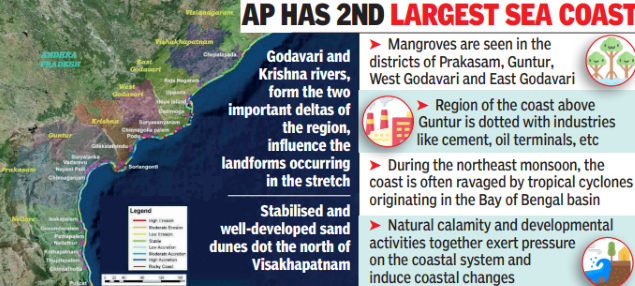
AP has the second largest sea coast after Gujarat. The NCCR study has revealed that different regions in coastal AP exhibited different shoreline changes since 1990.
According to the report, the shoreline in the north coastal Andhra Pradesh has displayed somewhat stable conditions, while (undivided) Prakasam, Guntur and West Godavari districts have very high accretion zones. It is altogether different in the delta regions of Krishna and East Godavari which has seen alternating bands of erosion and accretion.
The NCCR has identified several regions above the Upputeru river and Binginipalle (Prakasam), Rayaduruvu (Nellore), Pedda Boyapalem (Prakasam), Ullapalem (Prakasam) and Uppada (East Godavari) as erosion-prone areas.
For instance, Uppada in East Godavari has been subject to severe erosion for the last two decades. According to a study done by Andhra Pradesh Space Applications Centre, the coastline near Uppada is eroding at an average rate of 1.23 metres per year between 1989 and 2018.
Adikavi Nannaya University vice-chancellor Prof M Jagannadha Rao said that both anthropogenic and natural causes are leading to coastal erosion. "Whenever the coastal dynamic processes, which control the erosion and deposition cycle, are affected by any anthropogenic activity, the balance is disturbed and may lead to erosion. In a given erosional and depositional cycle, erosion will occur in some seasons and the deposition will be based on the longshore current. If this is obstructed, the areas concerned will be deprived of sand nourishment, leading to erosion. Similarly, natural reasons like cyclones, sea level rise, etc. may also aid further erosion," said Prof Rao, who as a geologist has done several studies on coastal erosion.
"The remedial measures should include identification of such points as well as drafting an immediate action plan. For example, coastal protection measures such as groins can help trap the sand. Sand nourishment can also be undertaken in an artificial way by dredging and other means," said Prof Rao.