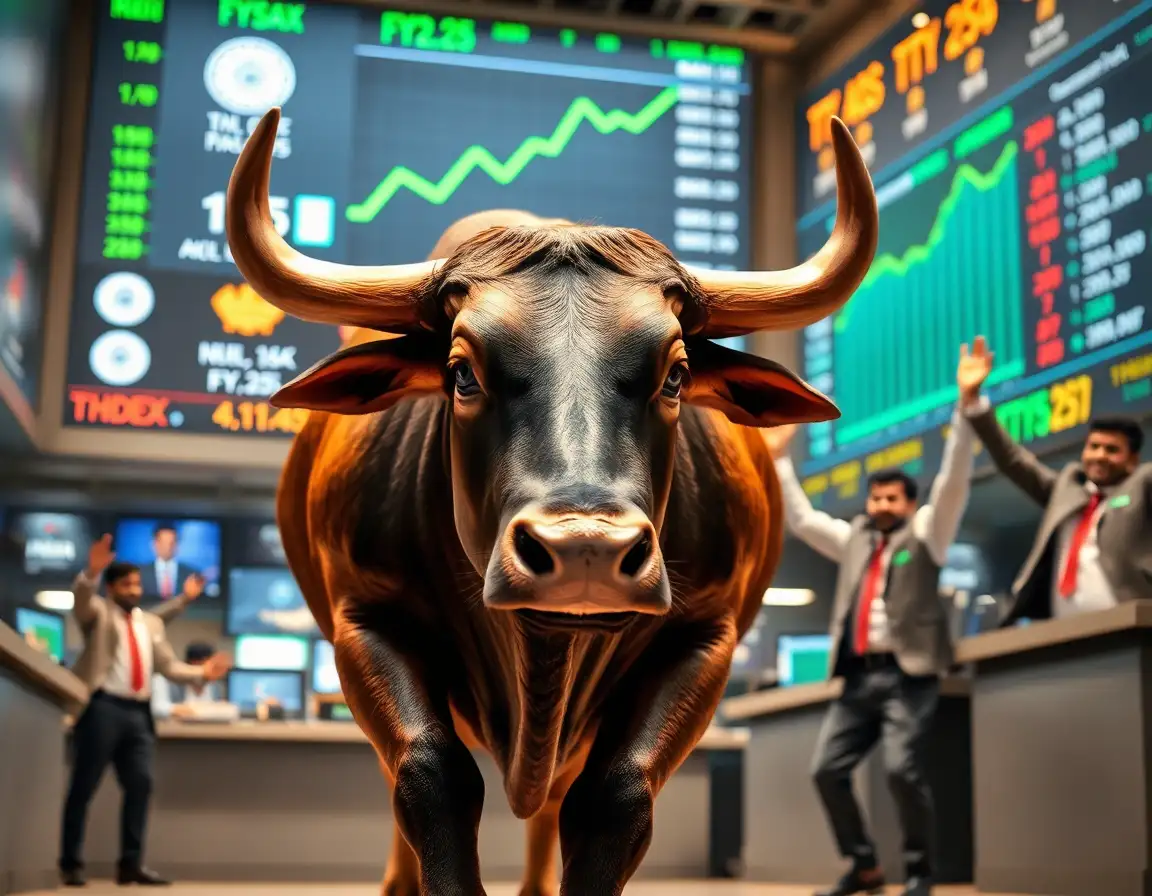
Indian equities traded in deep green on Thursday, with the Sensex and Nifty each rising over 0.8%, recovering some of the ground lost in Wednesday's crash that had wiped out more than Rs 8 lakh crore in investor wealth.
The Sensex gained over 635 points to 77,139, while the Nifty rose 195 points to 24,077, as of 10:10 am. The rally added around Rs 5.45 lakh crore to the total market capitalisation of BSE-listed companies, pushing it up to Rs 477 lakh crore.
Bharti Airtel, Eternal and Sun Pharma shares jumped around 3% each to lead gains on the Sensex, while Asian Paints, ICICI Bank and Reliance Industries gained over 1% each to follow. Bucking the trend, IT stocks including Infosys and TCS, along with Bajaj Finance shares, declined 1-2% to lead losses on the benchmark index.
The renewed optimism was broad-based, with the Nifty Smallcap 100 and Nifty Midcap 100 indices gaining up to 2%. This came as India VIX, which measures market volatility, crashed more than 9% to 13.34 after skyrocketing 26% in the previous session.
Sectorally, Nifty FMCG, Nifty Pharma, Nifty PSU Bank, Nifty Realty, Nifty Consumer Durables and several other sectoral indices gained 1-2%. Nifty IT, however, slipped into the red, falling nearly 1% ahead of heavyweight TCS's Q1 earnings. The overall market breadth was positive, with NSE seeing 2,506 advances and 433 declines, while 93 stocks remained unchanged.
Here are five key factors boosting market sentiment today:
1) Trump says Iran war unlikely to resume
US President Donald Trump on Thursday said that he did not expect the conflict with Iran to restart, but warned that Washington would hit harder if Tehran launched fresh attacks. "I don't think it's going to start again... If they hit, we hit ten times harder. Anything that happens will get over very quickly, and we'll make things safer, even for oil. Oil is going to be very free, very easy,” he said.
This comes a day after he said an interim agreement with Iran to end the war was “over,” stoking fears of a fresh escalation in the Middle East and sparking a massive stock market crash.
2) Positive market cues
Japan’s Nikkei surged around 2% as chip stocks rebounded. However, South Korea’s Kospi slipped into the red with marginal losses after a massive 6% plunge yesterday pushed Asia’s best-performing stock market of 2026 into bear territory.
Meanwhile, in the US market, the S&P 500 ended lower, but the Nasdaq closed in the green yesterday. Dow Jones futures are currently trading with marginal gains, signalling a positive start for the American stock market later today.
3) FII remain net buyers
Foreign investors continued to remain bullish on Dalal Street, buying Indian equities for the sixth consecutive session on Wednesday despite the market crash. They net purchased shares worth Rs 1,962.80 crore yesterday, according to the provisional NSE data.
4) Rupee stays steady amid Iran tensions
Rupee meanwhile opened at 95.55 against the US dollar, nearly unchanged from the previous closing level of 95.5550. “Market participants will continue tracking developments in the US-Iran conflict, crude oil prices, and global risk sentiment for further direction. Technically, the rupee is expected to trade in the 95.20–95.80 range in the near term, with volatility likely to remain elevated,” said Jateen Trivedi, VP Research Analyst of Commodity and Currency at LKP Securities.
5) Earnings expectations
The sharp rebound comes amid decent earnings expectations. Nifty 50 companies are expected to report year-on-year double digit revenue growth for the June 2026 quarter for the second consecutive quarter after a series of single digit growth in the prior six quarters.
However, net profit growth is likely to remain in single digit for the third quarter in a row amid compressed profit margin on account of input cost inflation. According to the ETIG estimates, revenue and net profit is expected to grow by 10.6% and 5.8% respectively. In the year-ago quarter, revenue and profit growth was 4.9% and 8.5% respectively.
"We expect the June quarter to mark the beginning of an earnings recovery, although the aggregate numbers will be distorted by the sharp weakness in the performance of oil marketing companies (OMC) due to elevated crude prices during the quarter," said Siddhartha Khemka, research head, wealth management, Motilal Oswal Financial Services.
What lies ahead?
Geopolitics has again played spoilsport with the Indian market, which has been slowly strengthening, said VK Vijayakumar, Chief Investment Strategist at Geojit Investments. He noted that Trump’s statement that the ceasefire with Iran is over triggered sharp selling in the market, shaving off 516 points from the Nifty yesterday, which is almost 50% of the recent gains.
“Long unwinding and fresh shorts might have played an important role in this sell-off. The spike in Brent crude to around $80 raised market concerns. However, there are market indications that things may not deteriorate as feared. First, Brent at $80 is not a problem. It won’t create a BoP crisis. The crisis will reemerge only if the tensions lead to the closure of the Strait of Hormuz again and consequently crude spiking above $ 100. The present futures do not reflect such a pessimistic scenario,” the analyst added.
Another important trend is that the trend of FIIs turning buyers continues, according to Vijayakumar. He added that this trend may continue if crude remains stable. Large caps generally, and in financials and automobiles in particular, are likely to remain resilient, as per the analyst.
Technical view on Nifty
Going forward, it will be crucial to watch whether the Nifty manages to hold the 23,800 support level, according to Rupak De, Senior Technical Analyst at LKP Securities. He added that a decisive break below 23,800 could extend the ongoing corrective phase, while sustained trading above this level may pave the way for a meaningful recovery in the near term.
Notably, Nifty 50 has comfortably risen above the key level suggested by the analyst.
(With inputs from agencies)
(Disclaimer: Recommendations, suggestions, views and opinions given by the experts are their own. These do not represent the views of The Economic Times)