
Get all your news in one place.
100’s of premium titles.
One app.
Start reading
Space
Space
Science
Anthony Wood

See the moon meet up with the Seven Sisters of the Pleiades early on Nov. 6

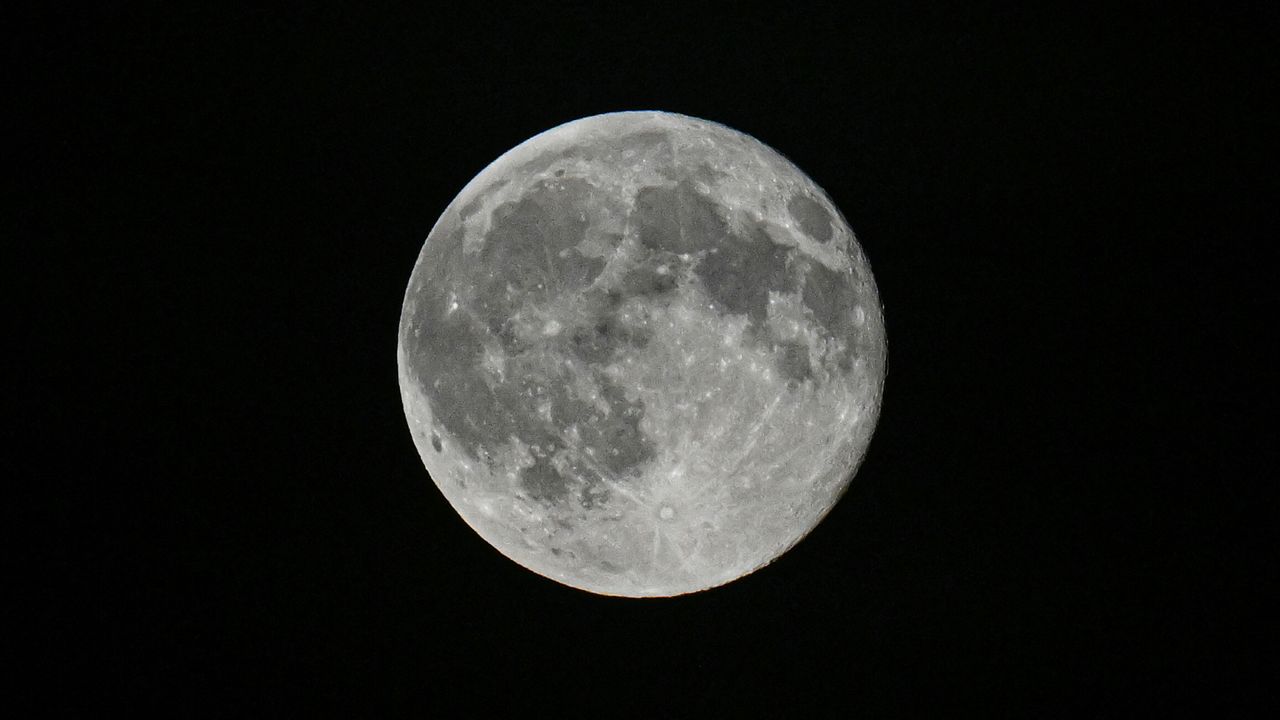
A detailed shot of a grey full moon is pictured against a black sky, sporting bright craters and dark features known as lunar maria. .

Look to the western sky in the hours preceding dawn on Nov. 6 to see the moon shine close to the constellation Taurus and the stars of the Pleiades open cluster.

The 94%-lit moon will appear roughly halfway up the western sky in the hours before sunrise on Nov. 6, with the stars of the Pleiades appearing as a hazy patch of light 5 degrees to its upper left — though they'll be a challenge to spot in the glow of the bright near-full moon. Remember, the width of your three middle fingers held at arm's length spans roughly 5 degrees in the night sky.

A pair of 10x50 binoculars will help reveal the seven brightest stars of the Pleiades open cluster — Merope, Electra, Maia, Taygete, Asterope, Alcyone and Celaeno, the "Seven Sisters" — along with a phalanx of dimmer stars belonging to the 1,000strong stellar hive.

Look 5 degrees to the lower left of the Pleiades to find the patch of sky containing Uranus. The distant ice giant has a magnitude — or brightness — of just +5.6, rendering it incredibly difficult to spot with the naked eye even under perfect dark sky conditions.

The moon approaches the Seven sisters on the evening of November 5th (Image credit: Chris Vaughan/Starry Night)
Celestron NexStar 8SE
(Image credit: Amazon)

Want to see the stars of the Pleiades or the cratered surface or the moon up close? The Celestron NexStar 8SE is an excellent option for beginners or experienced stargazers alike and with crisp views across the field of view and a useful magnification of up to 180x, it provides plenty of bang for your buck. You can check out our Celestron NexStar 8SE review too.

However, a telescope with an aperture of 8-inches or more will reveal Uranus as a tiny blue dot in the eyepiece under good atmospheric conditions. That may sound unimpressive until you remember what you're looking at — a titanic world four times the size of Earth, which is separated from us by a gulf of 1.72 billion miles (2.78 billion kilometers)!

Stargazers hoping to get a closer look at the planets of the solar system should read our roundup of the best telescope deals available in 2025, along with our nightly skywatching guide that lists all of the top stargazing sights on display in November.

Editor's Note: If you would like to share your photo of the moon and Pleiades with Space.com's readers, then please send your photo(s), comments, and your name and location to spacephotos@space.com.

Sign up to read this article
Read news from 100’s of titles, curated specifically for you.
Already a member? Sign in here
Related Stories
Top stories on inkl right now
One subscription that gives you access to news from hundreds of sites
Already a member? Sign in here
Our Picks
Fourteen days free
Download the app
One app. One membership.
100+ trusted global sources.