Get all your news in one place.
100's of premium titles.
One app.
Start reading
Bangkok Post
Bangkok Post
Comment

Second chances can turn deadly

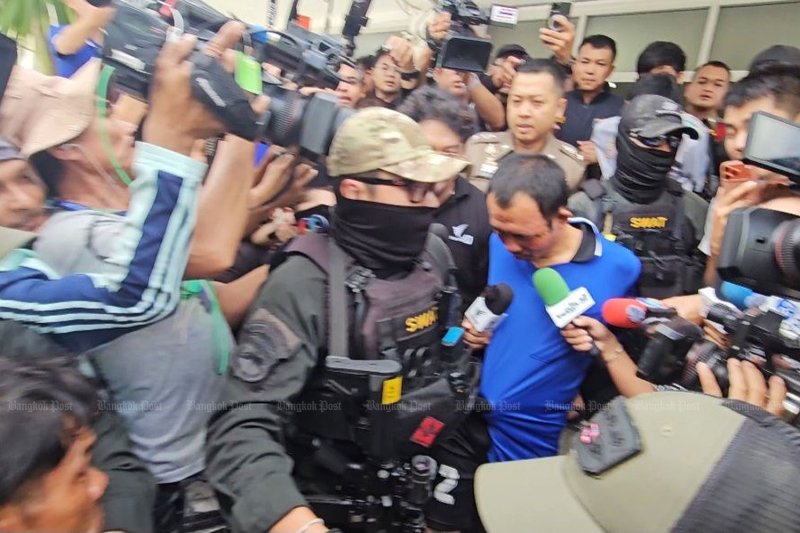
Officers escort murder suspect Thana Kerdthong, 43, from police detention to Pattaya Provincial Court on Aug 1. (Photo: Bangkok Post)

Every horrific crime reignites the same debate: Should society believe every offender deserves another chance, or is there a point when protecting potential victims must come first?

The allegations against Thana "Pong" Kerdthong, 43, have brought that question into focus. Police identify him as the primary suspect in the brutal killings of five people -- a Thai family of three and two Russian siblings -- whose bodies were found buried in separate locations in Chon Buri. Police allege the killings were carried out to steal the victims' motorcycles, adding another layer of public outrage to a case already marked by extreme violence. The investigation is continuing, and the courts will determine his guilt. Meanwhile, public opinion is starting to take shape.

One upsetting fact has already shaken public confidence. Before his latest arrest, Thana had served more than seven years in prison for attempted murder after a 2018 attack in which he fired a revolver into a residential area before shooting a man he had argued with at close range, leaving him seriously injured. He was also convicted of firearms and drug offences and released only in June this year. Within weeks, police allege, he struck again.

Records of the prime suspect's repeated offences have ignited an immediate backlash. Victims' families have called for the death penalty. Nine civil society organisations have petitioned for executions in brutal murder cases and urged tighter controls over sentence reductions and parole. Lawmakers are now considering legislative measures aimed at repeat violent offenders.

Such outrage is understandable. Families who lose loved ones to horrific crimes are not debating criminal justice theory. They are asking whether stronger safeguards could have prevented further suffering.

The case has revived debate over capital punishment. Thailand has never abolished the death penalty, and courts continue to issue death sentences. The Department of Corrections reported that 480 prisoners were on death row as of May 2026. Most of them remain within the appeals process, with 28 having exhausted all appeals and awaiting petitions for royal pardon. Yet Thailand has not carried out an execution for nine years.

Supporters of capital punishment believe executions permanently remove dangerous offenders and may deter future violence. Opponents contend that no justice system is perfect and that an irreversible punishment carries unacceptable risks.

Ex-Corrections Department deputy director-general Krit Krasaethip said the deeper question raised by the Thana case is whether the criminal justice system can effectively protect society from offenders who remain a serious threat, and why high-risk repeat offenders are allowed to return to the community.

Appeals, sentence reductions and parole determine when prisoners are released. The effectiveness of these safeguards depends on whether risk assessments are accurate and whether release decisions properly consider public safety.

Rehabilitation remains an essential principle because many former prisoners have successfully rebuilt their lives. However, completing a sentence does not automatically mean an offender no longer poses a risk.

The allegations surrounding Thana have highlighted that concern. Since his arrest, more people have come forward with claims involving kidnapping, sexual violence, intimidation and abuse. Those allegations remain part of the legal process, but they have intensified questions about whether earlier warning signs were missed.

The challenge for the criminal justice system is not simply whether to impose harsher punishment, but whether it can distinguish between offenders capable of rehabilitation and those who continue to pose a serious danger.

That requires difficult questions. Should repeat violent offenders face tougher punishment? Should life imprisonment without parole be considered more often for the most dangerous criminals? Are sentence reductions being applied appropriately in cases involving extreme violence?

These questions matter because justice is not only about punishment after a crime has occurred. It is also about preventing future crimes and protecting potential victims. Not every criminal deserves a second chance. Equally, not every prisoner should be denied one. The challenge is knowing the difference.

The Thana case has exposed the consequences when risk assessment fails. Until stricter release criteria and more rigorous risk assessment are applied in cases involving serious violence, each new crime committed by a repeat offender will further erode public confidence in the justice system.

Sign up to read this article
Read news from 100's of titles, curated specifically for you.
Already a member? Sign in here
Related Stories
Top stories on inkl right now
One subscription that gives you access to news from hundreds of sites
Already a member? Sign in here
Our Picks
Fourteen days free
Download the app
One app. One membership.
100+ trusted global sources.