
Get all your news in one place.
100’s of premium titles.
One app.
Start reading
Cycling News
Cycling News
Sport
Sean Kelly

Sean Kelly's Classics column: All eyes are on Pogačar and Van der Poel, but Isaac del Toro is the danger man at Milan-San Remo

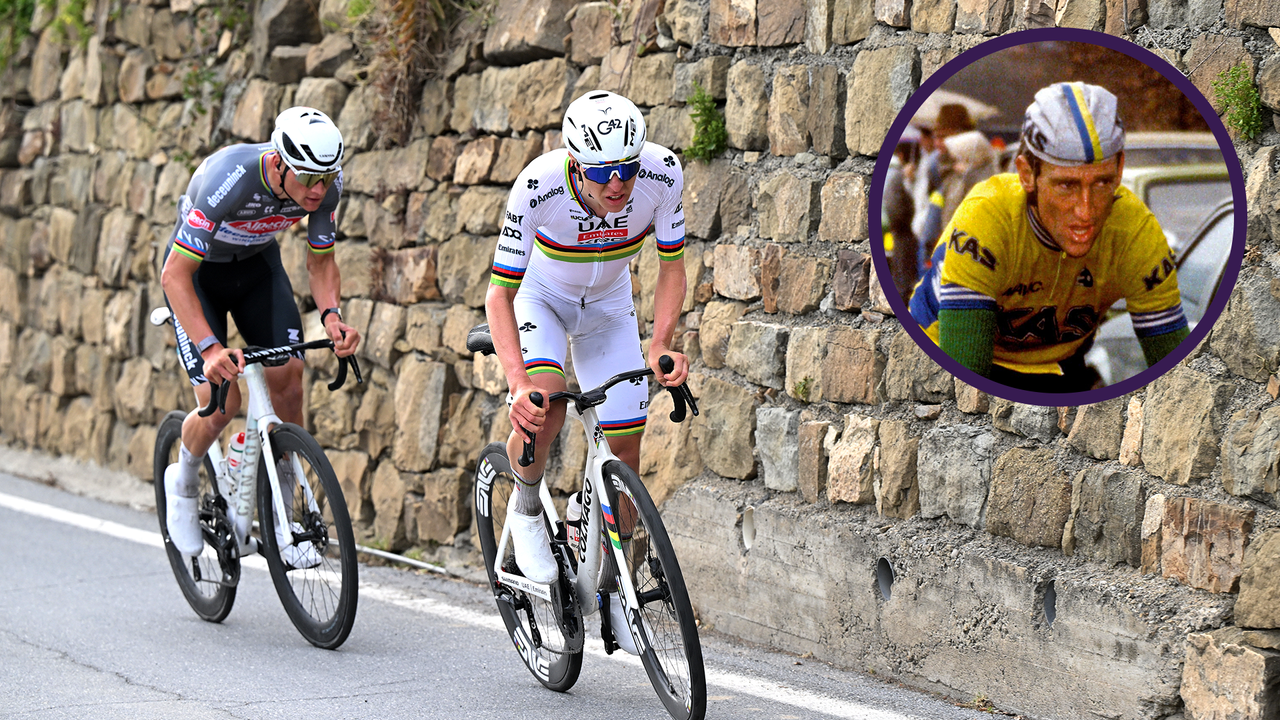
Tadej Pogačar, Mathieu van der Poel, and Sean Kelly (circled).

As Monuments go, Milan-San Remo is unique. It's a long, drawn-out route, and yet it's all about the final. Take the Tour of Flanders, for example, there’s possibly 10 sections of the course where you can blow the race apart and tee up victory – whereas here, you’ve got one, possibly two, in the closing stages. Some riders would like to try something earlier to get the win, or even just a podium spot, but unfortunately, you have to wait until the very end to see what you can do.

Having won La Classicissima twice during my career, and finished inside the top 10 in seven other editions, I know better than most that it all comes down to who you are and how good you are at that moment.

Of course, for the men's race this year, Tadej Pogačar and Mathieu van der Poel are the two big favourites. I expect the Slovenian to throw everything he's got at Saturday's race, because it's both the race he wants to win the most right now, but also the hardest race for him to win, too, given his current competition.

Van der Poel, having seen him in action at Opening Weekend and Tirreno-Adriatico, you can tell he's in excellent shape. So, he's going to be right there on Pogačar's wheel and hard to shake off. If the pair come to the finish together, I find it highly unlikely that Pogačar can beat the two-time winner.

His only option is on the Poggio. Say a few riders get a gap, and you're able to play some games in the final kilometres, things will start to get complicated. But for UAE Team Emirates-XRG, while they can win it on the Poggio, the work of his team – which are fractionally weaker than last year’s, given the absence of Tim Wellens and Jhonatan Narváez – has to start on the Cipressa with an infernal pace that puts everybody in difficulty, not least Van der Poel and Filippo Ganna. If that works out for them, then on the Poggio, you try to finish off the riders who are still left clinging to their talisman's wheel.

Of course, as I mentioned earlier, much of winning Milan-San Remo is how you feel in your mind and legs in the moment, and there could be a touch of hesitation and nerves with Pogačar. Van der Poel isn’t as desperate to win this race, nor is he necessarily in a position where he needs to attack on the final climb, because he knows the odds favour him in a reduced sprint situation. It's the same reason why I wouldn't be worried to see the Dutchman heavily outnumbered by UAE riders after the Cipressa has been tackled, because the pair's tactics are completely different.

Pogačar was guided by both Narváez and Wellens during the closing stages of the 2025 edition (Image credit: Luca Bettini/Getty Images)

If you look back to last year, Pogačar thought he had Van der Poel on the limit, only for him to put in an attack just before the crest of the Poggio. It was probably a pretty heavy blow to Pogačar, who must've said to himself, 'Oh, my God, this fella is going to attack me.'

Similarly, on the descent, I don't think Pogačar would be bold enough to try too much because he knows he can't distance Van der Poel there; he's made that mistake before. Besides, I doubt he'll take crazy risks to get a gap, because it puts himself in danger.

For all my focus on the likely Pogačar-Van der Poel duel – and I do believe the latter to be the favourite – there's always a couple of riders that you say 'My God, he's on a good day,' and I think we can't completely discount the likes of Ganna, Tom Pidcock, Wout van Aert and even Jasper Stuyven. But, if I were going to the bookmakers, I would put some money on Isaac del Toro.

Why? Well, I think he could be the danger man who could benefit from the two favourites marking each other's every move up and over the Poggio. If Del Toro goes, and Van der Poel reacts to close down the move, it offers Pogačar an opportunity to counter. Similarly, should the Mexican attack and get a 15-second gap, there could be a stand-off that ultimately leaves Del Toro clear on the Via Roma.

Amidst the chaos, a plan and self-confidence are equally valuable

While the women's race is shorter and only in its second year back on the race calendar, I suspect the tactics will be similar to those in the men's edition, finishing a few hours later. The Cipressa will thin down the field, before a final selection on the Poggio. However, I could see somebody riding away alone, or maybe a group of four or five riders.

A reduced bunch sprint saw Lorena Wiebes claim victory last year, but if the race splinters further, I feel it could be a tough ask for her to repeat her 2025 heroics. She will have to really dig deep to stay in there, especially with the climbing prowess elsewhere on the startlist. Kasia Niewiadoma-Phinney showed strong form at Strade Bianche, as did Puck Pieterse, and there's also Lotte Kopecky and Elisa Longo Borghini to add into the mix.

Longo Borghini's climbing ability is stronger than that of the pure sprinters, which provides her with an advantage, in my opinion. As for SD Worx-Protime, going into a race with multiple options – in Wiebes and Kopecky – can work better at Milan-San Remo than in other Classics. In cobbled Classics, like the Tour of Flanders or Paris-Roubaix, the plan can go out of the window very early, after 60 or 70 kilometres, because of the parcours, how other teams tackle the race, and the higher chance of suffering a mechanical.

Whereas at Milan-San Remo, the element of surprise, which could swiftly rip your team's well-laid plan to pieces, is far lower. So it is a race in which a plan can actually work out quite well.

SD Worx-Protime had two cards to play in the final last year, with Lorena Wiebes coming out on top (Image credit: Dirk Waem/ BELGA MAG / Belga via AFP/Getty Images)

However, for what the first Monument of the season might lack in potential tactical surprises, the 300km route creates a psychological element unlike any other one-day race. It's a slow, slow build-up before the Capi, where it starts to wind up. That's where keeping position becomes a priority, and it can be difficult because there are another 100 riders all trying to do the same ahead of the Cipressa. If you get caught up in a crash, then it could well be game over.

I can recall from my own racing days, everybody shouting as they fight for position, and plenty of bad language being thrown about. If you even touched an Italian rider, they'd go crazy!

So that constant tension is difficult. I don't think physically it's too challenging for the pelotons nowadays, considering the distances that they can do in training or at other Monuments. But, mentally, it's a different story.

Should you overcome this early tension and avoid any potential crashes, finding yourself in the top 15-20 riders on the Cipressa, then that's the place to be. It's then all about how good you feel and your choice of tactic, depending on whether you want a sprint or to attack over the Poggio. Either way, it's all about having the confidence within yourself to execute the plan.

Sign up to read this article
Read news from 100’s of titles, curated specifically for you.
Already a member? Sign in here
Related Stories
Top stories on inkl right now
One subscription that gives you access to news from hundreds of sites
Already a member? Sign in here
Our Picks
Fourteen days free
Download the app
One app. One membership.
100+ trusted global sources.







