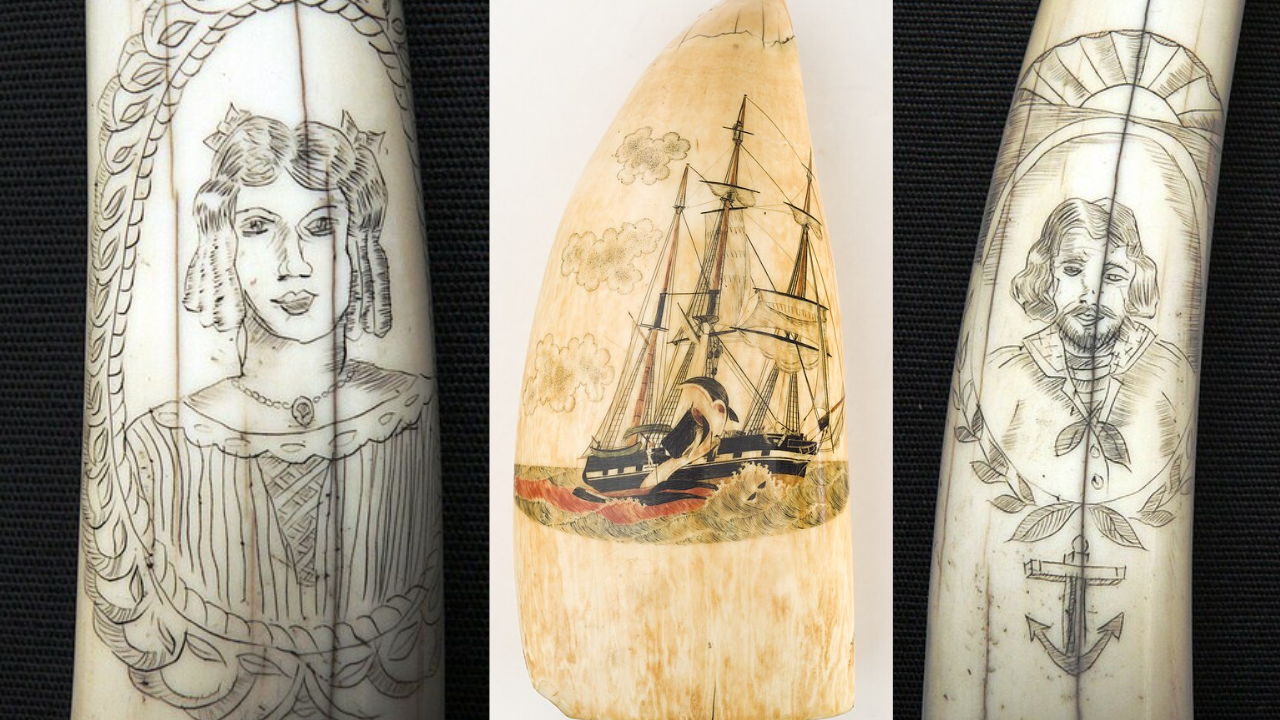
The link between scrimshaw, maritime art, whaling, and sailors' craft is profound in the artistic style of scrimshaw. Born from sailors' need to kill time on long sea journeys, scrimshaw allowed sailors to keep the memory of their families and themselves alive. Scrimshaw is a type of maritime art that was usually carved onto the bones of whales by sailors, combining elements of personal expression and historical background. Currently, scrimshaw art is viewed as a vital element of maritime history, providing us with insights into sailors' feelings, lives, and creativity. Today, it also serves as a cultural artefact that helps historians trace the emotional and social dimensions of life at sea during the age of whaling.

The origins of scrimshaw in maritime history
The art of scrimshaw flourished especially from the late eighteenth century through the nineteenth century due to its flourishing popularity during the period of whaling. Many of the sailors had months or even years of boredom during which they did not have much to do besides work.
As per the explanation provided by the University of Cambridge’s ‘Unlocking the cultural and biological archive of sea mammal art,’
"Scrimshaw refers to the engravings that were done by sailors in their leisure time at sea on whale teeth and bones and other objects."
This suggests that the term scrimshaw may have developed amongst the sailors themselves.
Scrimshaw as a form of sailor expression
Scrimshaw was not only decorative but a visual journal. Sailors carved detailed depictions of ships, people’s portraits, seaside views, and even idealised pictures of those they left behind.
As recorded by the New Bedford Whaling Museum:
“Scrimshaw often shows homesickness, chronicling the inner life of sailors as well as the outer world around them.”
Every piece told a tale. There were victorious whale hunts, but there were also lonely and hopeful moments. In an age where communication was not instantaneous, scrimshaw became a tangible representation of whalers dealing with distance, away at sea, yet closer to the warmth.
Materials and techniques in traditional scrimshaw
The traditional practice of scrimshaw was usually done by using whale teeth, bones, or baleen. Basic tools like needles or knives were employed to inscribe figures onto the surface of the material before rubbing ink, soot, or tobacco juice on the surface to highlight the design.
The lines carved would be filled with colour, providing contrast to make the design visible. Though the tools used were very simple, the amount of detail created from the process was commendable.
Scrimshaw’s place in modern maritime heritage: A vital element of maritime history
Modern-day scrimshaw art has become known as one of the prominent kinds of maritime folklore art. Historical pieces of scrimshaw are kept in museums or private collections where they are highly appreciated due to their artistic value and the cultural significance they bear.
Nevertheless, modern scrimshaw artists do not use any whale products in their work, taking into account the legislation concerning the conservation of marine animals. They prefer using alternative materials such as fossilised ivory or synthetic alternatives.
It should be mentioned that, according to maritime historians, scrimshaw art helps to reveal important information about life onboard ships that is often not reflected in historical documents. Not only can the observer see the events depicted in the art piece, but they may also feel the emotions associated with them.
It is thanks to scrimshaw that history remembers episodes that may have remained unnoticed otherwise. Scrimshaw reflects the resilience and creativity of people who had nothing left but the desire to preserve something tangible despite all difficulties.
The story of scrimshaw starts when sailors tried to spend their leisure hours productively. What was intended to entertain people became the means of storytelling.