Get all your news in one place.
100's of premium titles.
One app.
Start reading
The Times of India
The Times of India
World
TOI World Desk

Scientists found an ancient reef beneath Australia's vast Nullarbor Plain, and it changed what we know about a 'flat' continent

For generations, the Nullarbor Plain has been shorthand for emptiness.

Get breaking news anytime, anywhere. Download the TOI app now!

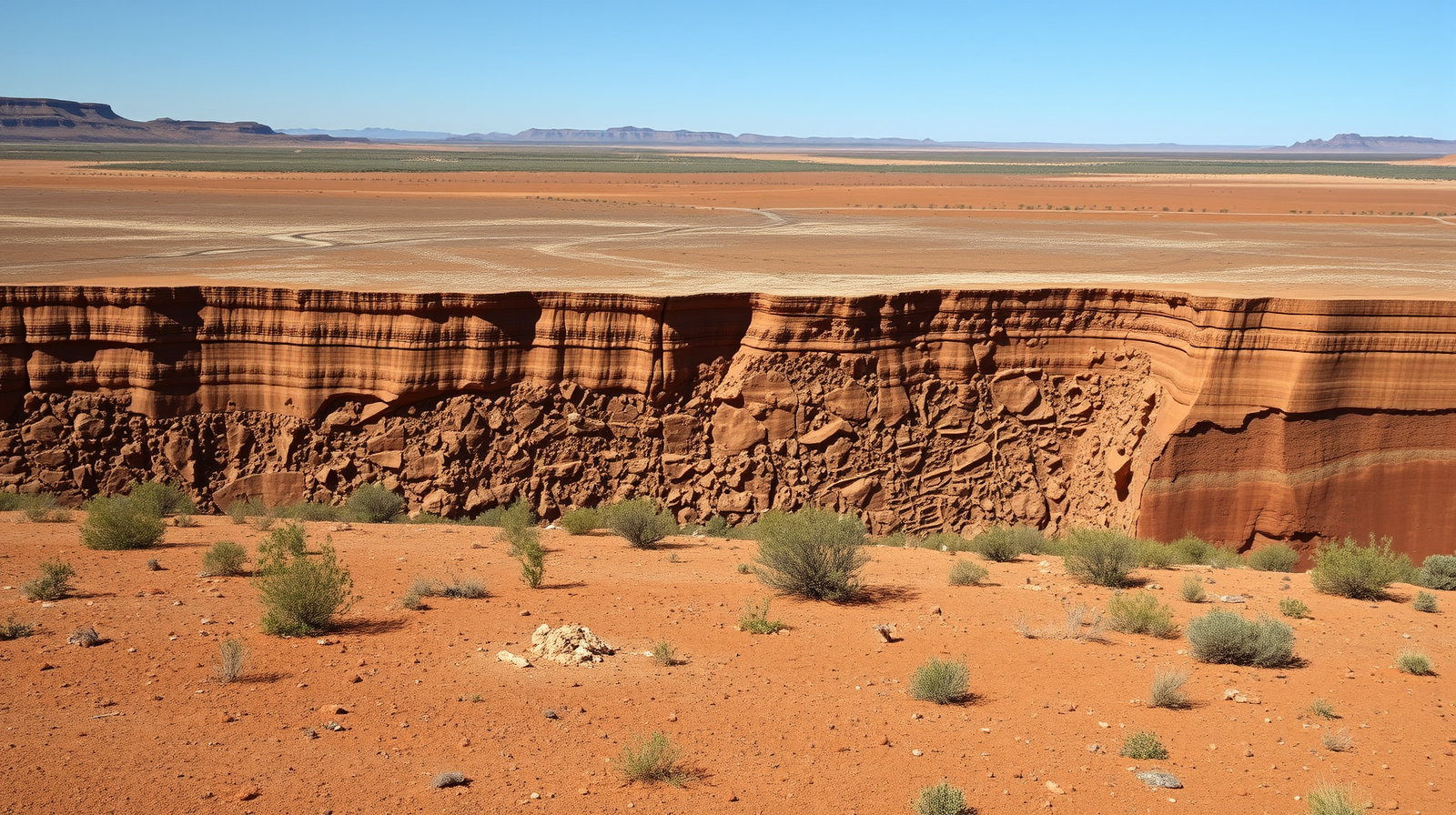
Covering southern Australia, this vast limestone landscape is often described as flat, barren, and infinite; travelling across it by road or rail, many travellers come away with the impression that there is little to see.

But an ancient, reef-like structure revealed by researchers through the use of high-resolution satellite data suggests the plain has a more complex geological history than it appears. Scientists have identified an ancient reef-like landform preserved within the Nullarbor Plain, revealing that one of Australia’s most recognizable "featureless" landscapes is actually much more complex in its geological history than once believed.

This finding was published by the peer-reviewed scientific journal Earth Surface Processes and Landforms, available through Wiley . The study was conducted by Dr. Matej Lipar, joined by his colleagues, including Dr. Milo Barham, a geologist at Curtin University.

A reef-like structure hiding in plain sight

The existence of the reef-like feature emerged through a combined effort of remote satellite terrain analysis and field investigation.

According to the study reported in Earth Surface Processes and Landforms, scientists noticed that a unique, ring-shaped landform, domed at its center, emerged clearly on the Nullarbor from high-resolution satellite data when viewed top-down, but it was not readily visible when observed from ground level.

The landform in question is described as an inner, dome-like formation approximately 500 meters in diameter, surrounded by an outer ring of around 1.3 kilometers in diameter, according to reports from the Australian Broadcasting Corporation (ABC) in their interview with research team members.

From ground level, however, the structure appears extremely subtle.

"It is only maybe three to ten meters higher than the surrounding plains," said Dr. Barham to ABC, explaining why the feature had gone unnoticed in a very open landscape.

Scientists describe it as a reef-like marine structure

Although referred to as "reef-like", the researchers are careful not to declare the formation a preserved coral reef in the common vernacular sense.

Instead, the structure has been described as a reef-like marine structure that existed during the Miocene, when the region lay beneath a shallow sea. Reportedly, the ring-shaped landform preserves both microbial textures and sedimentary characteristics comparable to those found in present-day reefs. Scientists concluded that the feature is the surviving remnant of an ancient seabed structure that has been preserved ever since the region emerged from the ocean millions of years ago.

The Nullarbor was indeed once part of a shallow sea; evidence exists suggesting it emerged from the sea roughly 14 million years ago, leaving behind one of the largest exposed limestone regions in the world.

A long-held assumption is challenged by the discovery

The finding matters because it shows how much a flat landscape can hide.

The Nullarbor Plain is frequently described as a geographically "simple" region simply because it appears visually uniform; this newly identified feature, however, reveals that even a visually featureless region does not necessarily imply the absence of history. Reportedly, in an announcement by Curtin University, Dr. Barham noted that significant areas of the Nullarbor have remained remarkably unaltered throughout millions of years of erosion due to their stability. As a result, these surface structures are exceptionally well-preserved.

Because of this unusual stability, the plain may effectively be considered a type of geological time capsule, containing traces of former landscapes that have long since disappeared.

Technology reveals what the eye cannot see

This discovery is another example of how modern mapping technology is changing geological research.

Rather than happening upon a dramatic fossil site directly, the feature was first identified from high-resolution satellite imagery and digital elevation models that illustrate subtle topographic variations that go unnoticed from the ground.

The study reported that the reef-like formation became noticeable only at a certain scale within the landscape, and not from any single observation. This is increasingly becoming a trend in Earth science as advanced remote-sensing capabilities allow geologists to map ancient river systems, buried landforms, and previously overlooked landscapes and environmental features in regions previously thought to be completely documented.

The Nullarbor, for instance, appears visually unremarkable to the eye, but new mapping tools have revealed hidden complexity.

More than just a geological curiosity

Fossilised reef formations hold many clues about past environments, including their water levels, deposition patterns, and the marine ecosystems that thrived in them. Information about reef formations is essential for understanding how landscapes change over long periods.

The Nullarbor finding further helps shed light on the past environmental conditions of Australia and adds a different perspective to a region generally thought of only in terms of its immense size and relative emptiness. What appears today as an expansive, dry plain was once a part of a dynamic marine ecosystem, and the discovery of this ancient structure serves as a reminder of the long-lasting impact vanished landscapes can have.

Perhaps the broader lesson is that the Nullarbor was never as simple as it appeared. The Nullarbor was never truly empty; it just took the right kind of technology to reveal what was always there.

Sign up to read this article
Read news from 100's of titles, curated specifically for you.
Already a member? Sign in here
Related Stories
Top stories on inkl right now
One subscription that gives you access to news from hundreds of sites
Already a member? Sign in here
Our Picks
Fourteen days free
Download the app
One app. One membership.
100+ trusted global sources.