
Get all your news in one place.
100’s of premium titles.
One app.
Start reading
LiveScience
LiveScience
Sascha Pare

Scientists find 2 marsupial species, thought to have gone extinct 6,000 years ago, living in the forests of New Guinea

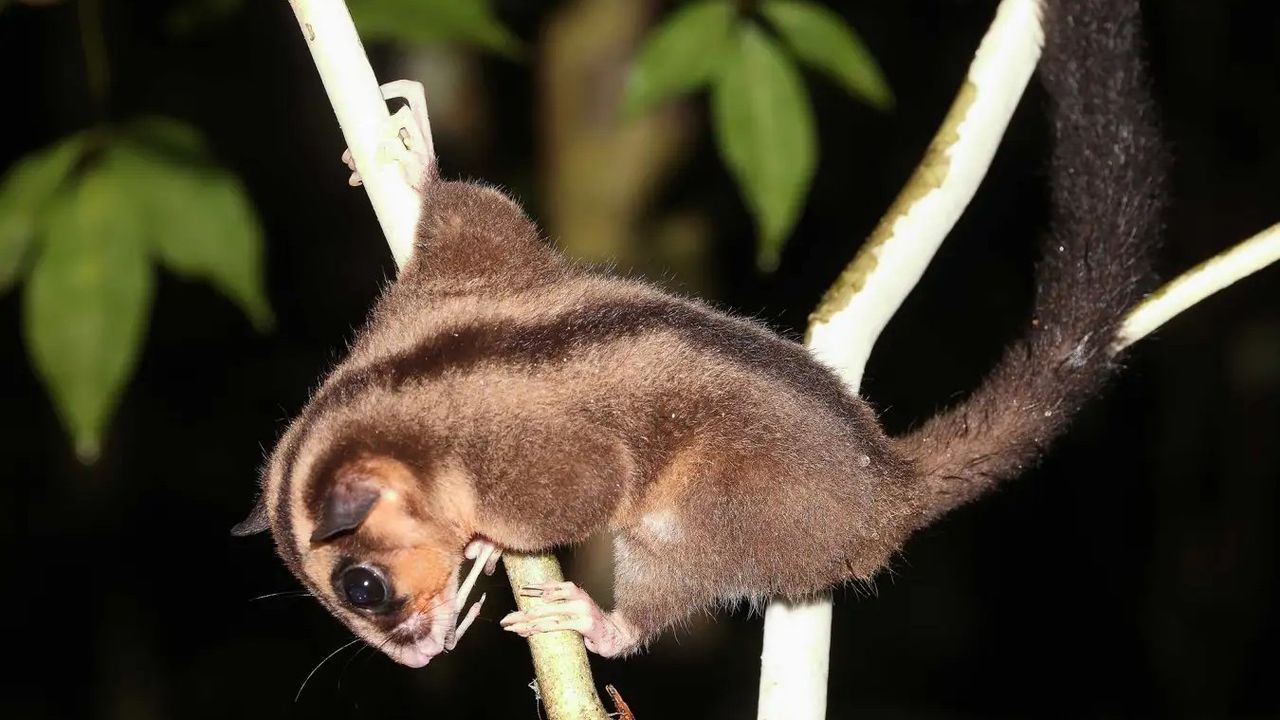
A pygmy long-fingered possum climbing a branch in New Guinea.

Two marsupial species that were thought to have gone extinct at least 6,000 years ago have been found on the island of New Guinea.

The discovery was far from swift, with the first clues of the marsupials emerging in 1999 and requiring ample photographic evidence to confirm. But 27 years later, scientists are now sure that the ring-tailed glider (Tous ayamaruensis) and the pygmy long-fingered possum (Dactylonax kambuayai) are alive in the remote rainforests of the Vogelkop Peninsula in Papuan Indonesia.

"The Vogelkop is an ancient piece of the Australian continent that has become incorporated into the island of New Guinea," Tim Flannery, a professor at the Melbourne Sustainable Society Institute and a distinguished visiting fellow at the Australian Museum who led the research, said in a statement. "Its forests may shelter yet more hidden relics of a past Australia."

Marsupials are mammals with a characteristic pouch to hold newborns until they are fully developed. The pygmy long-fingered possum and the ring-tailed glider were previously known to scientists only from fossils in Australia dating to the last ice age and the first phase of the early Holocene epoch, which is the current period of geological time.

The pygmy long-fingered possum is a striped marsupial with one digit on each hand that is twice as long as the next-longest finger. The ring-tailed glider is a relative of Australia's three greater glider (Petauroides) species, which are named after their ability to soar through forest canopies using furry membranes that extend from their elbows to their ankles. The ring-tailed glider is smaller than its Australian cousins and has unfurred ears, as well as a tail adapted for grasping and wrapping around objects such as branches.

The pygmy long-fingered possum and the ring-tailed glider are what researchers call "Lazarus taxa," meaning they are animals that vanish from the fossil record and seem to go extinct for an extended period before reemerging as living species. Their recent discovery was possible thanks to Indigenous communities in Papuan Indonesia that helped Flannery and his colleagues track down the animals. Specifically, the researchers collaborated with local elders from the Tambrauw and Maybrat clans.

"The discovery of one Lazarus taxon, even if thought to have become extinct recently, is an exceptional discovery," Flannery said. "But the discovery of two species, thought to have been extinct for thousands of years, is remarkable."

The ring-tailed glider (Tous ayamaruensis) is considered sacred by some Indigenous groups in New Guinea. (Image credit: Photo by Arman Muharmansyah (CC-BY-4.0))

Some local Indigenous groups consider the ring-tailed glider to be sacred and deserving of the highest protection, which might help explain why the species has remained hidden, New Scientist reported.

Ring-tailed gliders form lifelong pair bonds and raise only one young per year. Like greater gliders, they nest in tree hollows, which makes them extremely vulnerable to logging.

The pygmy long-fingered possum also faces threats from logging. Its ears may be adapted to detect low-frequency sounds, including noise from wood-boring beetle larvae, which the possums dig out from rotting wood with their fingers to eat, Flannery told New Scientist.

Much remains unknown about the specific range and ecological needs of each species. The exact locations where they were found is being kept secret to prevent wildlife traders from targeting them. What is known so far about the marsupials was published March 6 in two peer-reviewed studies in the journal Records of the Australian Museum.

"The findings underscore the critical importance of preserving these unique bioregions and the value of collaborative research in uncovering and protecting hidden biodiversity," Flannery said in the statement.

Sign up to read this article
Read news from 100’s of titles, curated specifically for you.
Already a member? Sign in here
Related Stories
Top stories on inkl right now
One subscription that gives you access to news from hundreds of sites
Already a member? Sign in here
Our Picks
Fourteen days free
Download the app
One app. One membership.
100+ trusted global sources.