
Get all your news in one place.
100's of premium titles.
One app.
Start reading
LiveScience
LiveScience
Jamie Carter

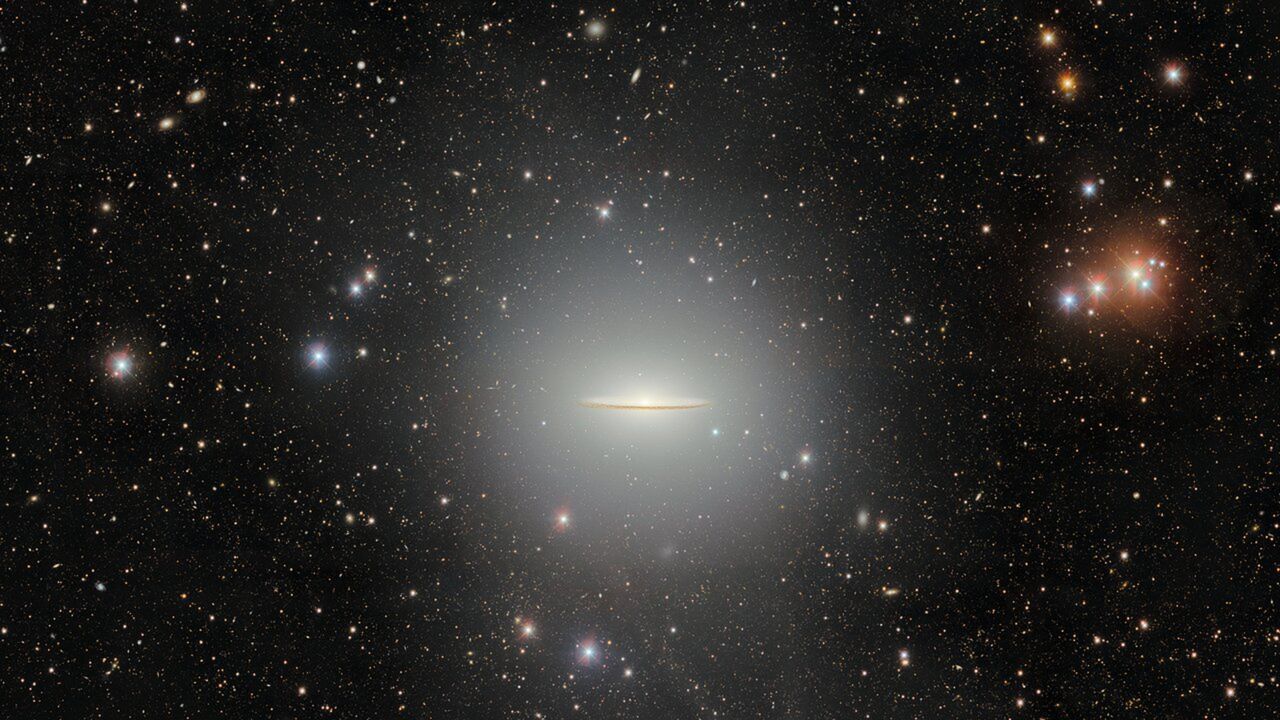
Scientists detect an enormous halo around the iconic Sombrero Galaxy — Space photo of the week

A flat disk of glowing light is seen against a starry background in space. .
Quick facts

What it is: Sombrero Galaxy (M104)

Where it is: 30 million light-years away, in the constellations Virgo and Corvus

When it was shared: April 24, 2026

The central bulge and dark dust trail, which together resemble a traditional Mexican hat, give the Sombrero Galaxy (Messier 104, or M104) its nickname — but this new image of the galaxy from the powerful Dark Energy Camera reveals two never-before-seen features.

The defining hat-like shape of M104 is evident here with exceptional clarity. Its central bright nucleus, surrounded by a swarm of about 2,000 globular clusters (balls of ancient stars), glows intensely. The dust lane itself appears sharper and more continuous than in previous observations, cutting cleanly across the galaxy and reinforcing its distinctive "brimmed" silhouette. This dark band of cold dust and hydrogen gas is where stars are being born in the Sombrero Galaxy.

What sets this image apart are features that are usually too faint to detect. Surrounding the galaxy in this wide-angle image is an enormous, diffuse halo that extends far beyond the bright disk, stretching over three times the width of the sombrero itself and significantly increasing the galaxy's apparent size.

The image also captures a faint stellar stream stretching away from one side of the galaxy. This thin, curved feature is barely perceptible at first glance, but a closer inspection reveals it as a distinct arc of light beneath the galaxy as it's shown here. It breaks the galaxy's perfect symmetry and suggests past violent interactions with a smaller satellite galaxy.

The remarkable clarity of the image is due to the capabilities of the Dark Energy Camera, a 570-megapixel instrument mounted on the Víctor M. Blanco 4-meter Telescope at the Cerro Tololo Inter-American Observatory in Chile. Operated by the National Science Foundation's NOIRLab, the system is designed to detect extremely faint light, allowing both the bright core and the dim outer structures of the galaxy to be captured in a single image.

The new image comes in the wake of the James Webb Space Telescope's first-ever mid-infrared observations of the Sombrero Galaxy in 2024, which it improved upon in June 2025.

See more Space Photos of the Week

Sign up to read this article
Read news from 100's of titles, curated specifically for you.
Already a member? Sign in here
Related Stories
Top stories on inkl right now
One subscription that gives you access to news from hundreds of sites
Already a member? Sign in here
Our Picks
Fourteen days free
Download the app
One app. One membership.
100+ trusted global sources.







