Get all your news in one place.
100’s of premium titles.
One app.
Start reading
LiveScience
LiveScience
Tia Ghose

Science history: Carbon-14 is discovered, opening a window into past civilizations — Feb. 27, 1940

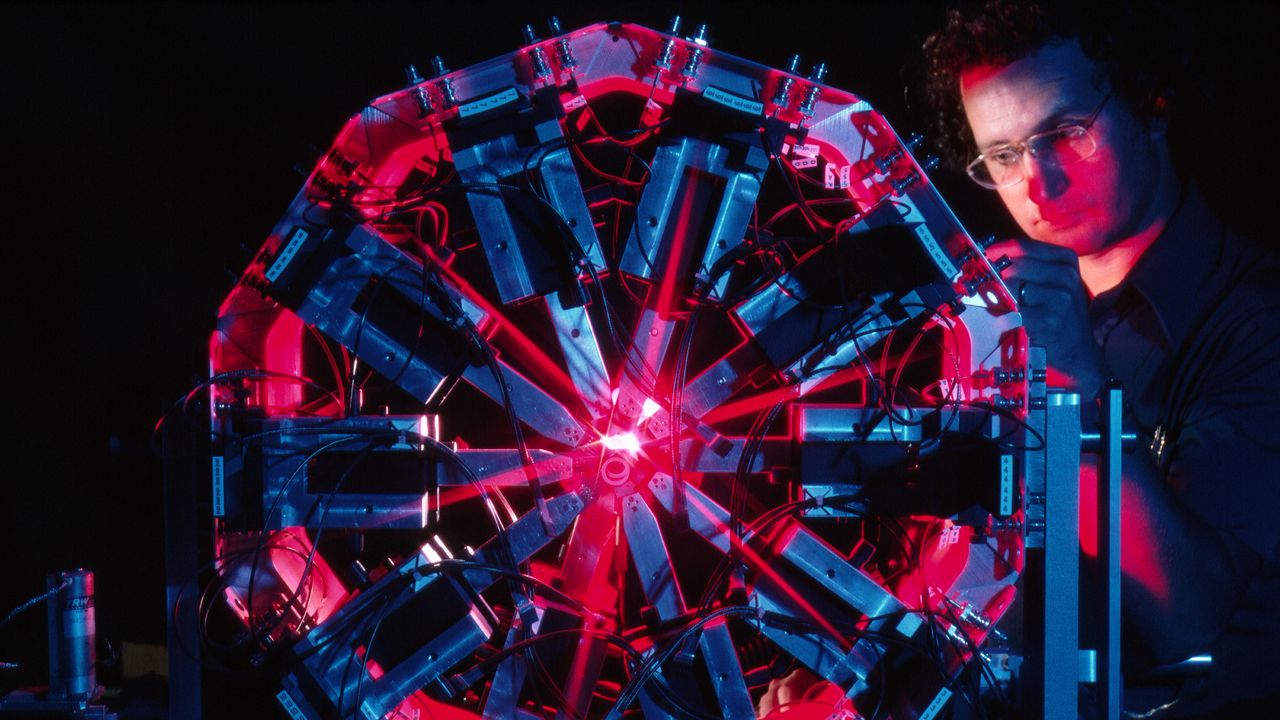
A man with glasses and a blue shirt stands behind a Ferris-wheel looking contraption with red and blue lighting in a dark room.

Milestone: Carbon-14 discovered

Date: Feb. 27, 1940

Where: Berkeley, California

Who: Martin Kamen and Samuel Ruben

On this day in 1940, two scientists discovered an elusive form of carbon — and inadvertently opened a window into lost civilizations.


Since the mid-1930s, scientists had predicted the existence of a form of carbon with two extra neutrons in its nucleus, but they thought it would be so short-lived that it would be impossible to measure.

But Ernest Lawrence, who founded the Berkeley Laboratory, was determined to find it. In 1939, he tasked chemists Martin Kamen and Samuel Rubin with discovering carbon-14. For a year, they found no hint of the elusive atom.

Then, in January 1940, they launched a "desperation" experiment, in which they placed a piece of graphite (a crystalline form of carbon) inside a cyclotron, one of the first types of particle accelerators. The cyclotron bombarded their sample with deuterons — nuclei of a heavy form of hydrogen with one proton and two neutrons. The hope was that the crystalline form of carbon would absorb the extra neutrons, emit a proton, and become a "heavy" version of carbon.

They ran the experiment for 120 hours straight. On Feb. 15, a sleep-deprived Kamen stopped bombarding the sample with deuterons and headed home. He was so disheveled that police, who were looking for an escaped murderer, briefly questioned him.

Scientists at the Berkeley Lab (now Lawrence Berkeley Lab) used a cyclotron to discover a host of radioactive elements from the 1930s onward. (Image credit: Department of Energy. Office of Public Affairs, Public domain, via Wikimedia Commons)

When Kamen was released, he returned to the lab, where his colleague Ruben noted faint signs of radioactivity in the sample. For the next two weeks, they purified the carbon, converting it into a CO2 gas that could be pumped at the right angle at the Geiger counter to measure its radioactivity.

Surprisingly, the carbon did not have a short half-life — the time it takes for half the radioactive atoms to decay into a stable atom.

"The measured cross section coupled with low yield suggests the half-life to be very long (years)," the researchers wrote in a short paper published March 15, 1940, in the journal Physical Review Letters.

Their measurements indicated it would take around 4,000 years for about half the carbon-14 to decay into nitrogen-14. (We now know the half-life of carbon-14 is about 5,730 years.)

Even at the time, they recognized the significance of their find.

"Long-lived radio-carbon will be of great importance for many chemical, biological, and industrial experiments," the researchers wrote in the paper.

Martin Kamen was one of the co-discoverers of carbon-14. Along with Samuel Ruben, he would go on to identify the key chemical reactions behind photosynthesis. (Image credit: American Institute of Physics (AIP) via Wikimedia Commons)

In the next few years, Ruben and Kamen used radioactive carbon and oxygen molecules to elucidate the key steps in photosynthesis. Sadly, Ruben died in 1943 in a lab accident while working with a poisonous gas, and Kamen was fired from Berkeley after having social interactions with musicians and other people considered "leftists" during the Red Scare. In 1948, he was hauled up to testify in front of the House Un-American Activities Committee, and although he was never found guilty of any wrongdoing, he was dogged by unfounded allegations for years.

While the implications of Kamen and Ruben's experiments were immediately apparent, it wasn't until 1949 that University of Chicago chemists James Arnold and Willard Libby demonstrated that the ratio of carbon-14 to stable carbon could be used to estimate the ages of carbon-containing relics. Libby would earn the 1960 Nobel Prize in chemistry for his work on radiocarbon dating.

Archaeologists routinely use radiocarbon dating to estimate the ages of ancient skeletons and other artifacts that are up to 50,000 years old. And newer techniques analyze radioactive isotopes of elements such as strontium and lead to determine where ancient people lived and died, what they ate, and which pollutants they had encountered during their lifetimes.

Sign up to read this article
Read news from 100’s of titles, curated specifically for you.
Already a member? Sign in here
Related Stories
Top stories on inkl right now
One subscription that gives you access to news from hundreds of sites
Already a member? Sign in here
Our Picks
Fourteen days free
Download the app
One app. One membership.
100+ trusted global sources.