Scb Julius Baer has told wealthy investors in Thailand to look beyond short-term market noise and position portfolios for opportunities in a world increasingly shaped by geopolitical rivalry, shifting supply chains, artificial intelligence and rising demand for capital.
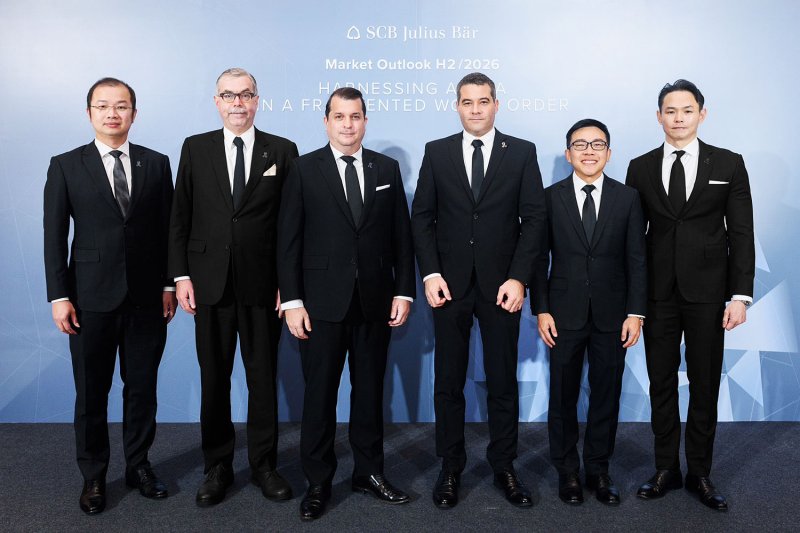
Scb-Julius Baer Securities Co Ltd recently hosted its Market Outlook H2/2026 seminar, "Harnessing Alpha in a Fragmented World Order", for ultra-high-net-worth individuals at The Ritz-Carlton, Bangkok.

The event brought together Adrian Mazenauer, chief executive of Scb-Julius Baer Securities, Mark Matthews, head of research Asia at Bank Julius Baer, Louis Chua, investment analyst research Asia at Bank Julius Baer, and Hao Jie Poh, director of global client solutions at KKR.
Mr Mazenauer said the second half of 2026 would be defined by a more fragmented economic and geopolitical landscape. Despite tensions in several regions, particularly the Middle East, financial markets have remained resilient and continued to look beyond short-term political shocks.
He said the world was moving from an era of abundant liquidity to one of stronger capital demand, meaning investors should focus on selective portfolio positioning rather than simply cutting risk.
Scb Julius Baer said several major structural forces are likely to shape markets, including higher defence spending, energy transition, the regionalisation of supply chains, rapid investment in AI infrastructure and renewed momentum in capital markets from large IPOs.
On fixed income, the firm recommends an overweight position in longer-duration bonds, especially US 10-year Treasuries, supported by easing inflation and expectations that interest-rate cuts are more likely than hikes. It also sees value in UK and Australian government bonds.
In equities, Scb Julius Baer remains cautiously positive. AI-linked sectors continue to stand out, backed by strong earnings and heavy spending by major technology companies on the infrastructure needed for the next stage of AI growth.
The firm is also upbeat on European equities, particularly banks and utilities, while maintaining a positive view on Asia. Japan is expected to benefit from AI infrastructure investment and policies aimed at attracting foreign capital, while China’s push to strengthen its technology sector could create opportunities despite recent weakness in large-cap tech stocks.
In commodities, gold remains attractive because of central bank buying, geopolitical uncertainty and the possibility of a weaker US dollar. Oil, however, may face pressure from supply-and-demand fundamentals and the longer-term move towards cleaner energy.
Mr Hao of KKR said private markets are becoming increasingly important for investors seeking alternatives. Private equity offers access to a large universe of companies outside public markets, where valuations may be more compelling, while active ownership can help improve long-term performance. He added that private infrastructure also remains attractive, offering stable income, diversified growth, inflation protection and capital preservation benefits.
Scb Julius Baer said successful investing in a more complex world will require flexibility, diversification and disciplined asset allocation.