Get all your news in one place.
100's of premium titles.
One app.
Start reading
GamesRadar
GamesRadar
Technology
Andrew Brown

Saros directors say Housemarque's greatest influence is itself: "As much as we love other games, we wanted to do it our way"

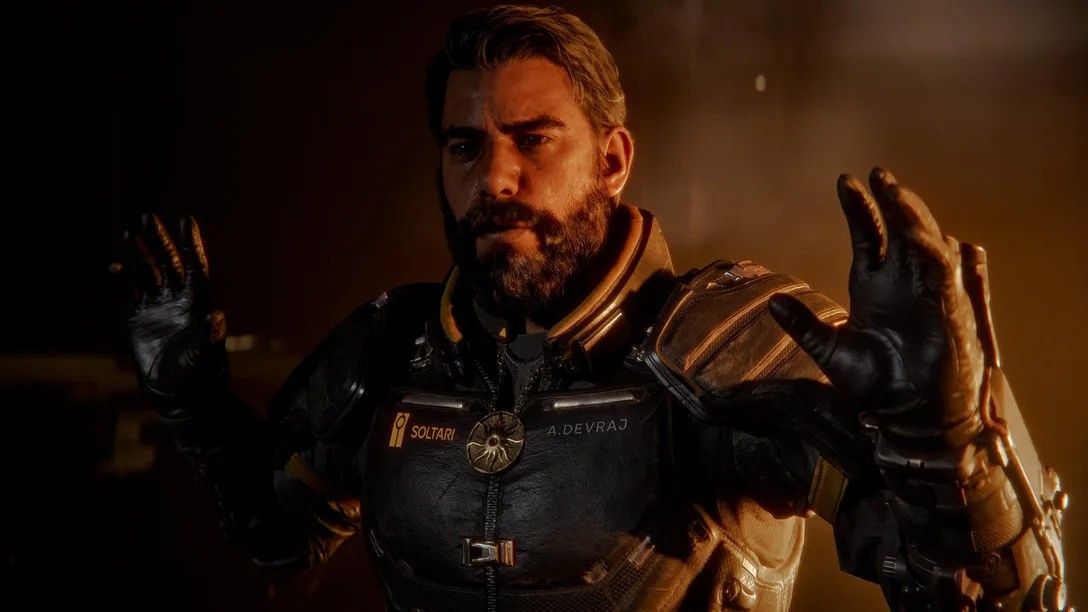
Arjun holds up his hands in a Saros cinematic.

Saros is putting so much pressure on my controller's right-trigger that it will likely turn into diamond before the credits roll. Surviving in this sci-fi shooter demands dividing your attention between dodging bullets, flinging them back, and hoping you don't back-pedal off a ledge. Yet – fitting to developer Housemarque's cosmic horror leanings – I can't resist sneaking glances at the forbidden knowledge that the planet of Carcosa teases in my peripheral.

Pillars of stone-carved hands reach for eclipsed heavens, while silver gates gleam incongruously in ancient alien ruins. Below, mineshafts carved by would-be colonizers sprawl into futuristic vaults. What does it all mean? Your guess is as good as mine – I'm only a few bosses into Saros at time of writing – but Carcosa feels skeletal yet still autophagic; devouring itself to excess.

With the back-to-back release of Returnal and now Saros, Housemarque has become one of the greatest modern storytellers in cosmic horror and weird fiction. Combined with its knack for compulsive arcade action and using looping roguelike conventions as narrative tools, few AAA studios seem as comfortable in their own skin as this PlayStation-owned developer.

Hoping to get a clearer sense of Housemarque's eclectic identity, I caught up with Saros' creative director Gregory Louden and art director Simone Silvestri. Certain shared influences go some way toward explaining the studio's arcade-arcademia formula – the works of H.P. Lovecraft and esoteric short story collection The King in Yellow were particular inspirations for Saros – but in truth, Housemarque's biggest inspiration is… Housemarque.

The Silver Key

(Image credit: Sony)
Come back stronger
(Image credit: PlayStation)

Saros review: "A lean fusion of roguelike sci-fi action and eldritch horror that successfully remixes Returnal for a broader audience"

Saros carries everything from Returnal but the name. Both games task the player with exploring a hostile alien planet, sidestepping bulbous neon bullets and steadily finding better gear before dying and starting another run anew. Both are roguelike-Metroidvanias, and while these conventions are remarkably fun as standalone elements, they're also used smartly to drip-feed gripping existential stories.

For most developers, making such a fluid continuation in Saros would warrant simpler signposting – IE 'Returnal 2' – but I get the sense that Housemarque prefers the freedom to play around with past ideas without boxing itself in. In doing so, the studio has honed its identity with each iteration – something Louden touches upon while explaining where Housemarque's signature weirdness comes from.

(Image credit: Sony)

"There is almost this self-perpetuating reverence of our past"

Jeremy Louden, creative director

"The number one reference for Housemarque games are other Housemarque games. That was true of Returnal – when I joined, our biggest reference was Nex Machina. And it's true of people I've introduced to Saros, our biggest reference is Returnal. So there is almost this self-perpetuating reverence of our past, to really want to stay true to our DNA.

"The other thing is, we like to be bold," Louden continues. "In a lot of ways, we try to do something the Housemarque way. When I was the narrative director and the cinematic director on Returnal, as much as we love other games, we wanted to do it our way. We wanted to do a game where characters are discovered, not told. We wanted to have rules like 'play, don't show'. We love big cinematics and have them in Returnal and Saros, but they're always about reward. We want you to play a lot of it. This ethos that we follow is to try to create something really bold and exciting for players to get lost in, [with] this sort of reverence for what we've done. That way we stay true to our past, but we're also innovating and bold and trying to stand out in the future as well."

(Image credit: Housemarque / Sony)

For Silvestri, who joined Housemarque after Returnal, the studio's interest in cosmic horror is the reason he joined Housemarque. "It's the last real frontier of human curiosity, right?"

In that regard, Saros doesn't disappoint. The game's story follows search efforts for a lost colony on Carcosa, a planet covered in the ruins of an ancient civilization and wracked by supernatural eclipses which corrupt life on the surface.

"When I started and Greg told me about the eclipse, I was like 'Yeah, we're going to cook with this one,'" recalls Silvestri. Heading into Returnal's follow-up, Housemarque wanted to recapture the same atmosphere, but couldn't "repeat the same tricks" – which meant no repeating color palette and taking a "much bolder" approach, for starters. Yet across all disciplines, both Silvestri and Louden say, there was a drive to not just meet that challenge but exceed it at an individual level.

(Image credit: SIE)

"One thing I always say about art in Housemarque is that we live on the fringe," says Silvestri. "We have this spectrum of minimalistic to extreme, and we always tend to go towards the extreme side. One of our pillars was called radical escalation, which means whenever you're in doubt, go for maximum impact. Then, when you put the eclipse on, go [for] even more. We always try to find the maximum expression of the concept that we have. If it doesn't work, can we make it more extreme? And if you can't, then it means it's probably not the right thing in the game. But usually there's many more levels to go.

"I think our artists are so comfortable in this space, which is very unique to us, and it's very inspired by the narrative that we have," he adds. "The kind of stories that we tell are very old and different and rare – I would say fringe as well – and to me, that's really precious. It means I can give my best. And I have partners in gameplay and narrative who want to be as weird as I want to be. That's a legit term that we use!"

At a mechanical layer, Louden carried forward lessons learned from Returnal to ensure Saros could be enjoyed by more players without making compromises. A good example is in the game's opening run, which plunges you into the deep end against a boss you're unlikely to survive. Saros gets into the action far quicker – a delight for returning fans with itchy trigger-fingers – but compensates with the option to earn permanent upgrades at your hub. These upgrades take some time to feel powerful, with more dramatic boons locked to higher tiers of an unlock tree, but create a net for struggling players to still take something from dying.

"We wanted to allow more people to experience this game," says Louden. "And for people that haven't played a Housemarque game, this is a great one to start with."

Not-so tattered mantle

(Image credit: Sony Interactive Entertainment Europe)

Indeed, 'come back stronger' is more than just Saros' tagline. It's been a "vision statement" for the team throughout development, Louden stresses, and I see it in action every time I'm stuck – each death offering a chance to grow, or less generously, callusing my head as I bang it repeatedly against the same boss fight.

It's a smart evolution of Returnal's own spin on the roguelike loop, which slowly eked out its mysterious story with each run. Saros is similarly well-paced, both as a story and roguelike. Upgrades and new areas unfurl often enough to keep the game fresh, while its story makes each run feel like coming back for another bite of a baited hook. It's the product of "iteration and a lot of playtesting," says Louden, who feels the result makes Saros hard to categorize as a roguelike. "As much as we love the genre, we almost feel like we're creating our own voice," he adds. "The only game that's quite similar is Returnal."

"The game will tell you if it works"

Gregory Louden, creative director

(Image credit: SIE)

Louden and Silvestri have a tendency to make Saros sound more like a collaborator than creation. There's an undeniably intimate relationship between the studio and its games, and there lies Housemarque's true identity: a studio confident in its own artistry and ideas.

"It's a constant dance between what you think will work, and then what works," says Louden on the development process. "The game will tell you if it works. We just listen to the game."

Saros aims for bite-sized 30-minute runs, and the cool-off makes you "ready for another", its game designer tells me

Sign up to read this article
Read news from 100's of titles, curated specifically for you.
Already a member? Sign in here
Related Stories
Top stories on inkl right now
One subscription that gives you access to news from hundreds of sites
Already a member? Sign in here
Our Picks
Fourteen days free
Download the app
One app. One membership.
100+ trusted global sources.