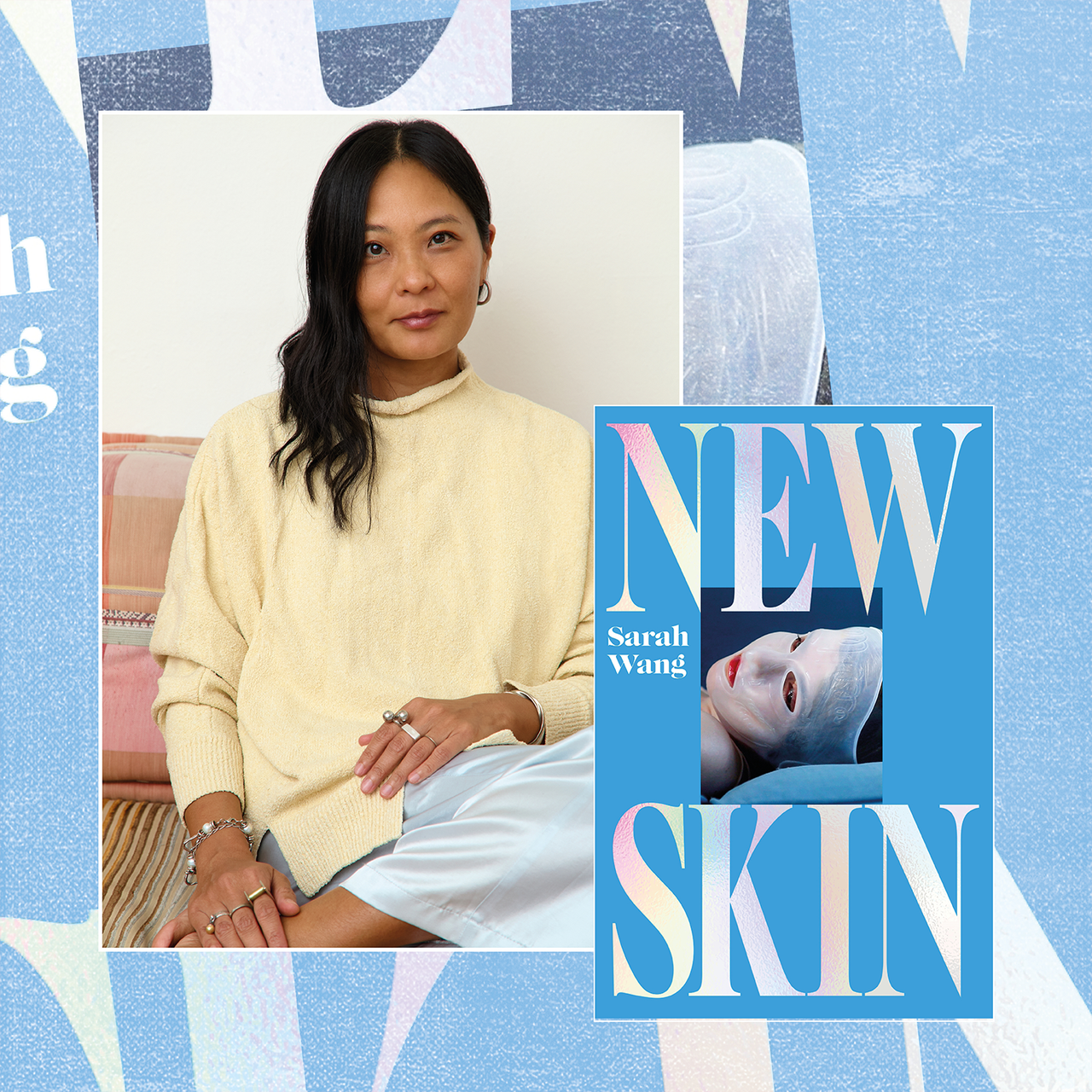
They say a book can contain multitudes and Sarah Wang’s debut novel, New Skin, arrives with much anticipation as case in point. For years the writer has published essays, cultural criticism, and short stories that are as astutely written as they are politically poignant, and her novel shares these impressive dualities. It balances an admirable attention to sentences with pressing resonances about immigration and class, all topped off with a delightful, dark romp through plastic surgery, reality TV shows, and underworld crime subplots.
New Skin begins as twenty-six-year-old Linli returns home to Los Angeles after a 3-year hiatus. On arrival, she finds her mother Fanny’s face remarkably disfigured due to an addiction to bootleg plastic surgery procedures administered at under-the-table LA parlours. A careful portrayal of a seething mother-daughter relationship ensues, one in which traditional caretaking roles are skewered as Linli tries to get her mother’s dependency under control. Things spiral, to say the least, when Fanny signs herself up to star on America’s Beauty Extreme, a reality show that offers its winner facial reconstruction surgery.

Sarah and I speak the weekend before her novel’s stateside launch, and she tells me she’s running on a high because she’s just received news that her event at New York City’s McNally Jackson, an ultra-popular bookstore, has sold out. Despite the buzz, she has a calm, considered, and intelligent demeanour. From her book-clad NYC apartment, she talks about the years it took to write New Skin, balancing difficult subject matter with wise-cracking humour, and current beauty standards. She also talks about writing as a form of protest.
New Skin is such a beautiful and important debut novel. Tell me about the seed of inspiration
I've been living inside this book my whole life. I just needed to be brave enough to begin writing it. This novel is about an intense mother-daughter relationship that is, in some ways, inspired by the experiences I had in my own life with my mother. It’s maybe the most difficult terrain; it took me a bunch of tries to get closer to the material before I finally let go and began to write.
In one particularly heartbreaking scene not long after Linli returns to LA, she tells her mother she has “lost her face”. What does this statement mean to you?
In Chinese culture, and a lot of Asian culture, losing face is a huge shame. It's the biggest shame of all to lose face, to bring shame upon yourself, your family by extension, and even to your community and workplace. It can extend outwards.
I love Fanny, Linli’s mother. She’s so fierce and empowering, despite some of the questionable decisions she makes
Fanny is my hero. She can do anything she wants. What she wants isn't always good for her, but she can do it. Fanny energy for us all, please.
What did your research look like during the writing process? I imagine you watched some reality TV?
I didn't start watching reality TV until I decided to write this reality TV subplot in the book! I watched a lot of Botched to understand all the different things that can happen with botched plastic surgery procedures. And I watched Survivor to understand gameplay, how factions form, and how people can be pitted against each other.
I was struck by how adeptly you write the body
This is a novel about marginalised people, immigrant women, women of colour, undocumented women who are performing labor. While I admire and read all kinds of fiction where people are more distanced from their experiences, including their own bodies, I really wanted this to be a novel where people are experiencing the world through their bodies. If you're marked by ethnicity - if you're marked by being a woman or being marginalised in some kind of way - you are more aware of your body than perhaps someone who doesn't have to think about how their body or appearance is affecting the world around them. And in my purview, it is a radical embodiment to be extra aware of how you're being perceived and what your body is doing and how it's contextualised.
The novel, despite its depth, is hilarious! Talk to me about humour and satire in your writing practice
I like to be funny! I'm using humour in the novel not only because it's natural to me, but because I believe humour is a kind of intelligence. If you've ever been at a dinner with someone who's so witty and sharp but also hilarious and has this command over their story or the table, it is really a marvel. I think humour is also a way for my characters to balance all the very intense things that are happening and the dire circumstances they’re in. Sometimes, you can only laugh. Also, they enjoy each other's company, and they do enjoy life. And I wanted to show that: joy.
Do you have any thoughts on the beauty standards women are up against today?
I hope that when people read my book, they understand I am absolutely not against any kind of body modification. I wouldn't say I'm pro or anti anything, whether it's plastic surgery or natural aging. I think everyone should do what they want to do. I've been writing this book for over 10 years, and the fact that it just happened to be published in 2026 feels timely. It feels like the year when everything is really exploding, from K-beauty to medical tourism in Seoul. When I started writing the novel, we didn't have this variety of cosmetic procedures that are available now. I'm just trying stay current on everything. I'm fascinated by what’s available in terms of technology. I just learned about cadaver fat injections.
There is so much humanity and difficult subject matter at the heart of this novel. How do you hope it’s perceived?
All my nonfiction and fiction writing is very political and deals with serious issues, like poverty, intergenerational debt, incarceration and always, a female subjectivity. Thanks to how capacious a novel can be, I was allowed to put all my concerns, worries, heartbreaks, into a single work, which is miraculous, if you think about it. New Skin is really about the lives of these women who occupy a certain position in society. In some ways, it's a very difficult story. Life is hard for a lot of people. But it's not only hard. Like everyone else's life, it’s full of love and triumphs and joy.
I do think of this novel as an act of protest against beauty standards. I wanted to write about people who use their bodies as a site of politics and protest and speech, and I wanted to write against these narratives that I see commonly and that are prevalent in not only stories written by women writers, but also Asian women writers. I - while I like reading some of these other books - noticed that the goal is often for an Asian female protagonist to get together with a white guy. I wanted to subvert this heteronormative dynamic and goal. I wanted to de-centre it, or not even de-centre it, but not even have it be relevant. This is ultimately a book about undocumented immigrants and the next generation of immigrants in America. Immigrants are the future.
What does the title New Skin mean to you?
It can mean a lot of things. New skin is about wanting a new life, a new beginning. It’s about a desire to regain something you've lost. It’s also about shedding skin and becoming anew, again and again. It's regenerative. While I think the title speaks to the process of immigration - you have to go to a new country and shed some of your old skin and grow new skin to fit in, to learn a new language – there are also some amazing things about new skin.
Sarah Wang's Book Recs and Writing Advice
Last but not least, some bookish and writing questions. What is…
…the last book you recommended to a friend?
Landscape for a Good Woman by Carolyn Steedman.
…the last book that made you cry?
Push by Sapphire.
…the book that made you fall in love with reading?
Flowers for Algernon by Daniel Keyes.
…the book that shaped you into the person you are today?
The Red Parts by Maggie Nelson.
…a book you wish you could read again for the first time?
I Love Dick by Chris Kraus.
…the most important piece of writing advice anyone ever gave you?
Writing is rewriting.
…a piece of popular writing advice that everyone should ignore?
Write what you know.
…one thing you would tell all new writers at the start of their journey?
Anything can be writing. Anything can be a story.
New Skin by Sarah Wang is published in the UK by Picador, and is available to pre-order now.