Get all your news in one place.
100's of premium titles.
One app.
Start reading
Tom’s Guide
Tom’s Guide
Technology
Michael Desjardin

Samsung's new Micro RGB TV is finally here — but I'd rather buy this OLED instead

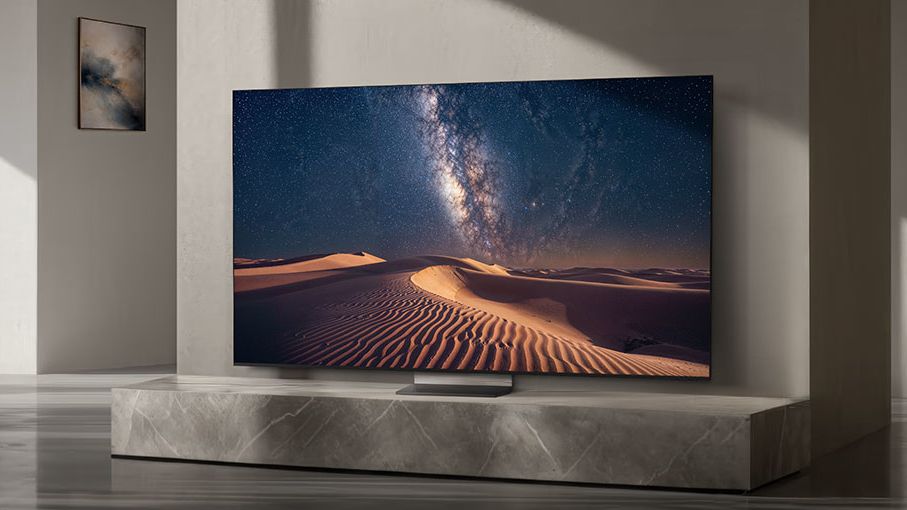
The Samsung R95H in a gray-colored living room displaying the Milky Way over sand dunes in the desert .

Samsung has officially launched a pair of TVs that are the first of their type. The R95H and the R85H leverage an all-new type of technology that the brand is calling Micro RGB, and in the coming months, these sets will go toe to toe with similar RGB LED screens from Hisense, LG, TCL and Sony.

Recently, I was lucky enough to spend an entire afternoon with the R95H, the flagship model that occupies the very top spot of the Samsung 2026 TV lineup. And, for as impressive as this TV is, I'd much rather put that money towards Samsung's top-shelf OLED TV for 2026, the Samsung S95H.

As a TV expert, getting to see a brand-new type of TV technology is always a hoot. There's a ton of hype surrounding Samsung's Micro RGB TVs — and for good reason, too. But for now, I'd still rather park myself in front of an OLED TV, and I suspect that many home theater enthusiasts would, too.

The Micro RGB advantage

(Image credit: Samsung)

While all of these TV brands have their own, similar-sounding names for RGB LED technology, they're all building off a similar formula. Standard Mini-LED TVs use white backlights and a filter to produce color, but RGB LED backlighting taps red-, green- and blue-colored LEDs.

So, in Samsung's case, while you'll almost certainly enjoy a bright, colorful HDR picture on its top-shelf Mini-LED TV for 2026 (the QN80H), a Micro RGB TV like the R95H delivers brighter, purer color in addition to the benefits that typically come with bright, carefully controlled LEDs arranged into separate zones.

As I cycled through colorful, visually appealing content on the R95H, I couldn't help but feel drawn towards the brand's flagship OLED right down the hall.

When I saw the R95H at Samsung headquarters last month, some basic tests seemed to bear this out. According to my results (which are subject to change when we formally test the R95H again in our lab), the unit I measured covered about 92% of the BT.2020 color gamut, which is the highest I've seen on a TV that isn't built around QD-OLED technology.

The R95H was also pretty bright in HDR, though my measurements of roughly 1,700 to 1,800 nits on a 10% white window in Samsung's Filmmaker mode were lower than what I expected based on my understanding of the technology.

On paper, this is a winning formula. In person, it's a feast for the eyes. But as I cycled through colorful, visually appealing content on the R95H, I couldn't help but feel drawn towards the brand's flagship OLED right down the hall.

For as good as Samsung Micro RGB TVs seem to be in 2026, I'd still rather buy a top-shelf OLED. There's still plenty of time for this new tech to sweep me off my feet, but for now, it just can't do what Samsung OLEDs can do.

The OLED advantage

(Image credit: Tom's Guide)

For as bright as the Samsung R95H gets, it's still reliant on LED backlights. OLED TVs —like the Samsung S95H — don't need a backlight. Every single pixel in the display is self-illuminating. This advantage not only allows for consistently perfect black levels, it allows for that unmistakable OLED look.

OLED TVs can drive a ton of light to a tiny cluster of pixels in the way that makes an the picture look eerily realistic. For as good as Samsung's best Micro RGB display is at creating highlights and controlling contrast, it can't replicate pixel-level dimming.

OK, but what about color? The R95H holds this distinct advantage over many of the best OLED TVs on the market, but consider the brand's top OLED TV of 2025, the Samsung S95F. According to our tests, the S95F covers about 90% of the BT.2020 color gamut. That's very, very close to the 92% figure I measured on the R95H.

In addition, we clocked the S95F's HDR highlight brightness at around 2,100 nits. When paired with the precision of pixel-level dimming, highlights practically leap off the S95F's screen.

Critically, were you to look at the S95F OLED side by side with the R95H Micro RGB TV, your eyes would almost certainly pick up on the contrast-related benefits of the S95F before they'd notice the R95H's slightly punchier color.

Samsung Micro RGB vs OLED: pricing and outlook

(Image credit: Samsung)

As eye-opening as some of these performance specs are, they're even more valuable if the pricing of these TVs is taken into consideration. Here's how Samsung's top Micro RGB TV stacks up against the brand's flagship OLED at launch:

Size

Samsung R95H

Samsung S95H

55-inch

N/A

$2,499

65-inch

$3,199

$3,399

75-/77-inch

$4,499

$4,499

85-/83-inch

$6,499

$6,499

The R95H and the S95H are the same price across the board save for the 65-inch size point, which is about $200 cheaper on the Micro RGB side. All things being (mostly) equal, I'd rather splash out on the OLED and its jaw-dropping contrast. (And, not for nothing, but the S95H is available in a 55-inch screen size for folks who want something smaller than 65 inches.)

There's hope, however, for anyone looking to indulge in the Micro RGB experience without spending over $3,000 in the coming months. Samsung is also rolling out a step-down Micro RGB TV called the R85H. Unlike the R95H, this set is available in a 55-inch model, and it starts at $1,599. The 65-inch R85H will set you back $2,099, while the 75- and 85-inch models are on sale for $2,799 and $3,999, respectively.

Over the next few years, more brands will jump on the RGB LED bandwagon. Prices will likely come down and the technology will probably get better. There may come a day where a Samsung-branded Micro RGB TV becomes more appealing to me than its award-winning, quantum dot-enhanced OLED TVs. But that day isn't today.

More from Tom's Guide

Sign up to read this article
Read news from 100's of titles, curated specifically for you.
Already a member? Sign in here
Related Stories
Top stories on inkl right now
One subscription that gives you access to news from hundreds of sites
Already a member? Sign in here
Our Picks
Fourteen days free
Download the app
One app. One membership.
100+ trusted global sources.