
Get all your news in one place.
100’s of premium titles.
One app.
Start reading
Livingetc
Livingetc
Alan Martin

Samsung Just Announced a New 'Micro RGB' Design TV, as Huge as 130' but Smaller, too — Here's What It Means, and Why You Should Care

Samsung micro RGB TV launch.

Back in August, Samsung announced its first TV using Micro RGB technology. While this is an upgrade on the popular Mini LED technology, proving to be a capable competitor to OLED, this particular announcement had limited appeal because the MR95F came in just one size: 115 inches at around $30,000 in the States. Too big for most people’s wallets or living rooms.

But just months later, with the annual Consumer Electronics Show (CES) upon us, the brand has made this Samsung TV proposition more appealing. While the headline announcement champions the arrival of the world’s largest Micro RGB TV — 130 inches with pricing yet to be announced — the company has also revealed five more models more appropriately sized for the average living space.

Soon, you’ll be able to purchase Samsung Micro RGB TVs in 55, 65, 75, 85, and 100-inch sizes. Prices are to be confirmed, but assuming they’re within budget, should you be looking to make your next TV a Micro RGB TV? Here are the pros and cons.

What Is Micro RGB TV tech?

Micro RGB is an advancement on the Mini LED technology that’s been popularized in the last few years.

Like Mini LED, the pixels aren’t light emitting and need backlighting. The difference is that the backlight can produce red, blue and green light via tiny LEDs that illuminate a liquid crystal layer. As these are individually controlled, dimming zones can be tightly controlled.

The upshot of this is that you get both better contrast and greater color accuracy than Mini LED TVs can deliver. Indeed, Samsung boasts that its Micro RGB technology can display 100% of the BT.2020 HDR color gamut, which is a huge deal. That means these TVs can kick out billions of colors, displaying more than any other TV technology so far produced.

Or, as Samsung Electronics’ Executive Vice President of the Visual Display Business, Hun Lee, puts it: “Our Micro RGB portfolio delivers vivid color and clarity that make movies, sports and TV shows feel more expressive and engaging.”

How Does Micro RGB TV Tech Compare to OLED?

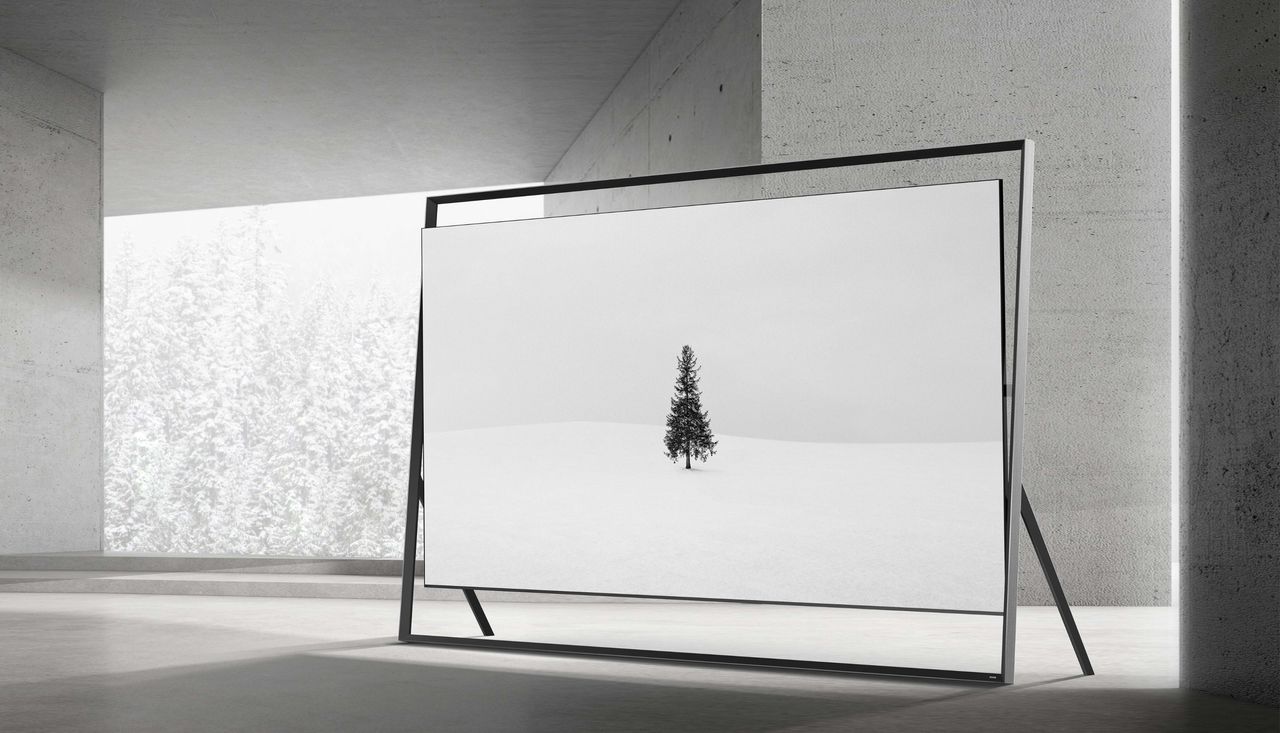
Samsung's 130-inch Micro RGB TV (Image credit: Samsung)

So Micro RGB is a step up from Mini LED, but how does it compare to OLED?

Well, there are pros and cons. Starting with the positives, as OLED TVs use self-illuminating pixels, there are limits to how bright they can get, making them a poor choice for bright rooms with unblockable natural light. Micro RGB sets should have no such difficulties, reaching a far higher brightness and suffering from no washout, even in very well-lit environments.

This gives them a second advantage. While OLED TVs have got better at avoiding the dreaded burn-in, where static images can get stuck on the screen over time, Micro RGB is completely immune to the problem in the first place. That makes it a good choice if you value picture quality, but remain paranoid about the risks of extended OLED usage.

Color accuracy should also be better if Samsung’s BT.2020 HDR claims stand up to independent testing. That 100% coverage is unheard of.

Where Micro RGB loses out to OLED is in terms of black levels and contrast. As explained above, the new technology is backlit, and while there are likely thousands of dimming zones in the new sets, this still can’t match OLED, where each pixel is self-illuminating, and thus can be turned on or off for infinite contrast and perfect black levels. In other words, Micro RGB TVs may still experience some blooming where neighboring pixels leak light onto dark areas.

The Alternatives to Samsung

Samsung isn't the only brand launching into Micro RGB. (Image credit: LG)

While Samsung is dominating the Micro RGB headlines at the moment, it’s not the only game in town, and CES is packed with companies showing off their own implementation of the technology.

HiSense released its first Micro RGB TV last year, beating Samsung’s then largest 115-inch model by a single inch. The 116-inch 116UX is available at Curry's for £24,999.

Like Samsung, the company has also announced a whole bunch of smaller TVs. These will range in size between 55 and 100 inches, branded UR9 and UR8. And, possibly with an eye on the future, the company also revealed a 163-inch model which adds a ‘Y’ to the ‘RGB’ mix. The addition of yellow, HiSense says, expands the spectrum “where human vision perceives the most nuance”.

LG is also getting in on the act, with its own Micro RGB “evo” lineup, featuring 75, 86 and 100-inch models. These also boast the 100% BT.2020 color gamut claim, and feature over 1,000 dimming zones, but once again pricing has yet to be confirmed to see who wins in the Samsung vs LG TV battle.

That’s the big unknown of Micro RGB in 2026. We only have a couple of pricing data points here: $19.999 to $32,000 from US retailers. But these prices are for TVs sized 100, 115 and 116 inches, and the real proof will be how much the companies charge for their more living room-friendly models.

Don’t get your hopes up too much, though. This is new technology and, as such, you should expect to pay a premium for some time, before prices settle to more mainstream levels as OLED has in recent years. Nonetheless, the arrival of technology to rival OLED is an extremely exciting development for home cinema buffs.

Sign up to read this article
Read news from 100’s of titles, curated specifically for you.
Already a member? Sign in here
Related Stories
Top stories on inkl right now
One subscription that gives you access to news from hundreds of sites
Already a member? Sign in here
Our Picks
Fourteen days free
Download the app
One app. One membership.
100+ trusted global sources.